日本刀 — The Hamptons
Nihonto & Tosogu Collection Catalogue
Generated
October 1, 2026
98 pieces
Collection Pieces

雲龍波濤図 — Dragon amid Clouds and Surging Waves
#001This tsuba presents a dynamic, high-contrast composition typical of the Tosa (Doshū) Myōchin lineage. The obverse focuses on the dragon executed in deep sukidashi-takabori against heavily carved clouds. Vivid gold zōgan iroe highlights the dragon's eyes, horns, and claws, as well as the surrounding vapor, creating sharp visual distinction against the dark tetsu migakiji ground. The motif flows seamlessly onto the reverse side, shifting emphasis to deep, crashing waves (hatō) below swirling clouds. The maker's signature (土州明珍紀宗英) is crisply chiseled to the left of the nakago-ana. The piece is cleanly framed by an uchikaeshi-mimi, adding structural depth and protecting the detailed high-relief carving within the web.

Kamiyama Keigyoku Tsuba
#002The Balance of Yin and Yang
Kamiyama Keigyoku- 神山 珪玉 Female Tsubako Did you ever wonder if there were female Tsuba makers? Well, yes there were and quite good ones at that! Kamiyama Keigyoku for one was the daughter of Kamiyama Hanzo who is known under his artist name Munemichi. Her name was Sada and she was the elder of his two daughters. As Munemichi’s son took over the lead of his wife’s family, the two sister carried on the Kinko workshop of Munemichi. Her father’s teacher was the 4th generation Tsuchiya Yasuchika and it is not surprising that Sada also carried on working in the style of Yasuchika with very classic designs. She and here sister ‘Mitsu’, who also became a skilful artist were active in the early 19th century. Haynes mentions several recorded items of her and the Meikan lists here as a skilful worker. This Tsuba is made from Shakudo and the Dragon and waves on the Omote (表) front, is carved from the base metal with copper and gold inlays. The Ura (裏) back, shows a Tiger in Shibuichi inside a cave with several inlays. Dragon and Tiger stand for the two forces yin and yang. The Minneapolis Institute of Art describes this motive quite nicely as following: “Male traits are yang, and female traits are yin. Yang qualities are active, while yin qualities are passive. Everything in the universe results from the interaction of yin and yang. NBTHK Tokubetsu Hozon Token.

Mino no Kami Fujiwara Masatsune- 美濃守藤原政常
#003Mino no Kami Fujiwara Masatsune- 美濃守藤原政常 政常Masatsune was the son of the famous 美濃Mino school smith 大道Daido (early Mei 兼道Kanemichi), with an original Mei of 兼常Kanetsune. He was adopted by the 1st gen 相模守政常Sagami no Kami Masatsune and inherited the 政常Masatsune Mei, as his son. The 2nd gen 相模守政常Sagami no Kami Masatsune, passed away at young age. Thus, in some context, he (Mino no Kami Masanori) were referred to as “the 2nd gen Masanori”, and in the others, he was referred to as “the 3rd gen Masanori”. He was rewarded with the title of 美濃守Mino no Kami during 2nd year of 寛文Kanbun (1662), Together with the 2nd gen, he was listed as 上作Josaku (“upper rank”) within the 新刀位列Shinto Iretsu (“Shinto smith ranking”). Acording to some writings, he was considered as a 業物Wazamono ranking smith, as the entire 相模守政則Sagami no Kami Masanori smithline were recorded as 業物Wazamono smith in Edo period’s test cutting record with no specification on generation. Additional info on 1st gen Sagami no Kami Masanori: During 19th year of 天正Tensho, he was summoned by the famous late Warring States period 大名Daimyo 福島正則Fukushima Masanori and became a 抱工Kakae-ko (formally designated/ supported smith) of him due to the great skill in Nihonto smithing. It was recorded that the 政Masa character in the Mei 政則Masanori was given by Daimyo 福島正則Fukujima Masanori to reward his great skill in Nihonto smithing. Together with 信高Nobutaka and 氏房Ujifusa, they were known as the 尾張三作Owari Sansaku (“The Three Greatest Smith of Owari”). Sayagaki Mino no Kami Fujiwara Masatsune 銘 美濃守藤原政常 長さ 二尺?寸六分 Nagasa 2 Shaku 4 Sun 6 Bu Koshirae- NBTHK Tokubetsu Kicho Token (Green) Tachi- NBTHK Hozon Token

Magnificent Dragon & Waves Tsuba by Baigetsu (Circa 1800)
#004A canvas of martial elegance
Baigetsu saku- 梅月作 Magnificent Dragon & Waves Tsuba by Baigetsu (Circa 1800) A spectacular example of late-Edo period Japanese metalwork, this masterfully carved tsuba (sword guard) captures the awe-inspiring power of a dragon writhing through tempestuous waves and swirling clouds. Crafted from brass (sentoku) in a round form with a slightly raised border (tate-maru-gata with taka-mimi), the piece utilizes dynamic high-relief carving (maru-bori) and elegant openwork (yo-sukashi). The artist’s exceptional skill is evident in how the kinetic composition faithfully continues from the obverse to the reverse. Exquisite gold and silver inlay (ten-zogan) highlights the dragon’s scales and the crashing surf, bringing an extraordinary sense of life and movement to the mythical beast. Technical Details & Historical Notes Signature: Signed “Baigetsu saku” (梅月作) — Haynes reference H 00164.0. According to Wakayama, this maker’s name is notably linked to a dragon-motif fuchigashira (hilt collar and pommel cap), which may have been the original companion fittings to this very guard. Features: Includes both kozuka and kogai hitsu-ana (accessory openings). Significance: A very rare and important example combining bold sukashi design with refined metallic detailing, elevating functional armor to a museum-quality canvas of martial elegance. Pedigree & Provenance Published: Prominently illustrated and described in the late scholar Robert E. Haynes’ seminal reference, “Gai So Shi - Study Collection of Japanese Sword Fittings” (Nihon Art Publishers, 2010, No. 160). Provenance: Formerly a prized possession within the esteemed M. Tomkinson Collection (Inv. No. 265), widely regarded as one of the most historically significant early Western collections of Japanese art.

Bunka Shinmoushun, Gōzan Masayuki- 文化辰孟春 峩山政之 花押
#005A masterclass in balance and sculptural power
This exceptional copper-alloy (yamagane) tsuba represents a pinnacle of narrative metalwork from the late Edo period, capturing a visceral moment of atmospheric tension. Grounded in uncompromising traditional craftsmanship, the piece commands attention through its profound depth and dynamic structural continuity across both faces. Technical Artistry & Composition The Unryū Motif: Executed in masterful high-relief carving (takabori), the dragon emerges from the upper quadrant with formidable presence. Sharp, deeply undercut chisel strokes define pronounced orbital ridges, flared nostrils, and undulating whiskers, capturing the fierce vitality of the subject through pure sculptural precision rather than stylized exaggeration. The Elements: The composition brilliantly contrasts the organic fluidity of the billowing clouds (kumo) and crashing waves (nami) with the rigid, geometric precision of diagonal rain lines (shigure) incised across the central plate. Raised nodules of sea spray (shibuki) at the base highlight an exquisite preservation of the original surface relief. Functional Engineering (Sekigane): A crucial detail not always seen on pieces of this artistic caliber is the presence of the yamagane fitting plates (sekigane) housed within the top and bottom of the central tang opening (nakago-ana). These soft-metal inserts were carefully utilized to adjust the guard to perfectly seat a specific sword's tang without causing structural damage to the blade. Their preservation confirms that this was not merely a pristine, unmounted art object, but a functional martial implement historically mounted for active use. Continuous Narrative: The artwork transcends the obverse face. The dragon's sinuous, scaled body coils seamlessly onto the reverse plate, weaving through the rain columns before its tail plunges back into the churning waters—a hallmark of elite, thoughtfully engineered kodōgu. Epigraphy & Provenance The reverse plate features a beautifully incised, two-column inscription (mei) executed in a confident running script (gyōsho), securely anchoring this piece to its precise historical context: Date Inscription: 文化辰孟春 (Bunka Shinmoushun) Translates to the "Early Spring of the Dragon Year in the Bunka Era." This specific cyclical date code precisely anchors the creation of this piece to the early months of 1808. Artisan Signature: 峩山政之 [花押] (Gōzan Masayuki + Kaō) Identifies the master artisan, Gōzan Masayuki, finalized with his stylized personal monogram (kaō). The fluid, unhesitating cuts of the signature reflect a smith operating at the absolute height of their technical capability. A profound example of the samurai's story told through crafted metal, this tsuba stands as a masterclass in balance, pristine patination, and raw sculptural power. -Dimensions: 7.21 cm x 6.68 cm x 0.33 cm -Weight: 89.8 grams

KAGAGUSOKU YOROI- Early Edo Period
#006The armor of the warrior's resolve
Produced in the wealthy and culturally refined Kaga Domain during the Edo period, this extraordinary Kagagusoku Yoroi represents the pinnacle of Japanese martial artistry. Artisans of the Kaga region—supported by the immense wealth of the ruling Maeda clan—were celebrated across Japan for their exceptional metalwork, seamlessly blending robust battlefield functionality with sophisticated aesthetic elegance. At the absolute center of this suite is a magnificent, three-dimensional ryū (dragon) mounted directly onto the dark russet-iron dou (cuirass). In traditional Japanese culture, the dragon is a venerated water deity, symbolizing fierce protection, immense power, and the unwavering resolve of the warrior class. The intricate chasing of the dragon's scales, its coiled whiskers, and the sweeping dynamism of its horns are a masterclass in metalcraft, perfectly encapsulating the story of the samurai told through crafted metal. Above the cuirass sits the imposing suji-bachi kabuto, a multi-plate helmet engineered with distinct raised ridges designed specifically to deflect downward sword strikes. It is crowned by sweeping kuwagata (frontal crests) that dramatically expand the warrior's silhouette, projecting an aura of commanding authority. Beneath the helmet, the menpo (facial armor) was engineered for psychological warfare; its fierce expression, deeply contoured cheeks, and bristling mustache made from natural animal hair were crafted to unnerve adversaries long before blades ever crossed. Contrasting the unyielding, jet-black and dark russet iron is the remarkable odoshi (silk lacing). Arranged in meticulous, alternating tiers of forest green, pale cream, and subtle gold, these vital cords bound the kusazuri (skirt panels) and shikoro (neck guard) together. This provided the samurai with essential flexibility and shock absorption while offering a brilliant visual contrast that would identify the wearer on a chaotic battlefield. Preserved alongside its original yoroi-bitsu (armor storage box)—which bears a faded gold mon (family crest) indicating the aristocratic lineage of its original owner—this complete suit stands not just as a weapon of war, but as a profound historical record of Kaga craftsmanship and the enduring identity of the warrior elite. Family crest: Maru Ni Mitsu Gashiwa Mon(Oak in circle) meaning: The oak leaf which died in autumn does not shed their leaves until a sprout appears in spring. From this characteristic, Oak leaf is symbol of "The history of the clan does not break off". Oak is the shinboku (sacred tree) (species of evergreen sacred to Shinto). Reference./ Busho who used this crest: Shima clan, Hagiwara cran, Tsuboi cran, Watanabe clan, Makino clan, Yamauchi, clan, Kubota clan, Osada clan,etc. Size: Kabuto/Height: 18.11 in(46cm)/ width: 13.39 in(34cm)/ Depth: 14.17 in(36cm) Menpo/Height: 10.24 in(26cm)/ width: 9.06 in(23cm)/ Depth: 5.12 in(13cm) Do /Height: 31.5 in(80cm)/ Width: 14.17 in(36cm)/ Girth: 42.52 in (108cm) Sode/ Height: 11.42 in(29cm)/ Width: 10.63 in(27cm) Kote/ Length: 26.38 in(67cm) Haidate/ Height: 23.62 in(60cm) / Width: 27.56 in(70cm) Sune/ Height: 11.81 in(30cm) Box/Height: 23.62 in(60cm)/ width: 20.08 in(51cm)/ Depth: 18.11 in(46cm) Weight: 19500 g

Daisho Koshirae — Kanbun 7 (1667)
#007A remarkable dragon daishō koshirae preserving the spirit of the early Edo samurai tradition.
A remarkable dragon daishō koshirae preserving the spirit of the early Edo samurai tradition by Okugawa Yasumitsu- 奥川 康光. Kanbun shichi nen hachi gatsu hi (a day in the eighth month of the year 1667) 寛文七年八月日 Anchored by a dated tsunagi inscription reading: 寛文七年八月日 — Kanbun 7 (1667) This extraordinary paired set carries more than visual power; it carries continuity. The deeply sculptural dragon tsuka, dynamic dragon tsuba, and aged lacquer saya reveal generations of preservation, refinement, and reverence within a hereditary warrior tradition. Though the original blades are no longer present, the koshirae themselves survive as profound historical objects — eloquent remnants of a once complete daishō carried during the formative decades of Tokugawa Japan. The dragons surge across the mountings with remarkable cohesion and movement, embodying authority, vigilance, and protection — symbols long associated with elite samurai identity. Every surface, every worn edge, every layer of patina speaks to centuries of life and stewardship. Sets of this caliber and coherence rarely survive intact. An early Edo-associated daishō of exceptional atmosphere, historical resonance, and museum-level presence. 寛文七年八月日 Kanbun 7 — 1667

Tsuba with Dragon Motif and Goto Mitsuyoshi Signature
#008A canvas for high-status artistic expression
This striking Japanese sword guard (tsuba) features an intricate, high-relief carving of dragons circling the rim, set against a highly detailed, stippled nanako (fish-roe) background. The piece takes the traditional four-lobed mokko-gata shape, showcasing highly skilled and dynamic metalwork. Signature and Authenticity Debate: As seen on the obverse in, the central web (seppa-dai) bears the engraved signature (mei) of Goto Mitsuyoshi. The authenticity of this signature is a subject of notable discussion within the sword-fitting community. While it is widely believed by many to be a gimei (a false signature added later to increase value), the renowned Japanese metalwork expert Ford Hallam has stated that he considers it to be a true, authentic mei. Despite Hallam's assessment, other specialists and collectors maintain differing opinions, leaving its definitive status a matter of ongoing debate. The reverse side, displayed, beautifully continues the fluid, wrapping dragon motif without any signature, maintaining the high quality of the carved nanako ground. Before his untimely departure, Mr. Ford Hallam did review this piece and its Mei. “Just to be clear, I think the work is of the standard of the artist named and that the Mei is correct.” Sent from my iPhone 04/22/2022.
SAGEMONO: Inro (提物:印籠) A storm captured in gold.
#009A storm captured in gold.
SAGEMONO: Inro 提物(印籠) Mumei- 無銘 Wave and Dragon Motif Inro (Nami Ryū Zu Inro) From a curatorial perspective, a notable detail immediately emerges when pairing this piece with the tomobako (storage box) you shared previously. The calligraphy on the box lid explicitly translates to 浪龍図鐔 (Nami Ryū Zu Tsuba—Wave and Dragon Motif Tsuba). Because the object pictured here is an inro (a traditional tiered carrying case) and not a sword guard, it is highly likely that this is a "married" set. A previous collector likely paired this exceptional inro with the box because their motifs match perfectly. Despite the box originally belonging to a tsuba, the piece itself is a magnificent example of Edo-period craftsmanship that bridges the worlds of lacquerware and tosogu artistry. It serves as a highly compelling subject for high-contrast documentation or inclusion in a specialized exhibition catalog like The Black Book of the Dragon Tosogu. Here is a detailed curatorial description: Form and Construction This is a sophisticated five-case (four compartments plus a lid) gold lacquer inro. The cases fit together seamlessly, held by a purple silk cord (himo) that runs through the side channels (himo-toshi), allowing the tiered compartments to slide open. Lacquer Work (Maki-e) The foundational ground of the inro is finished in luminous gold lacquer. The surface is decorated with dynamic, stylized waves (nami) and swirling storm clouds, rendered using gold and silver dust sprinkled into the lacquer—a technique known as maki-e. The continuous flow of the clouds and water across the segmented cases demonstrates precise alignment and masterful planning by the lacquer artist. Metalwork Inlay (Kanagu) The focal point of the inro is the spectacular metalwork dragon (ryū) applied in high relief (takabori). The dragon weaves in and out of the lacquer clouds, breaking the boundaries of the individual cases. Material: The dragon appears to be crafted from shakudo (a copper-gold alloy patinated to a deep, purplish-black), creating a striking visual contrast against the gold background. Detailing: The scales, claws, and facial features of the dragon are sharply chiseled with the same precision expected from high-level sword fittings. Gold accents highlight the dragon's eyes and horns, bringing a fierce vitality to the mythical creature. It is quite common for master machibori (town-carving) sword fitting artisans to have collaborated with lacquerers to produce metal inlays for high-end inro like this one. Provenance Context While the tomobako may be a later marriage to this inro, the box itself carries significant historical weight. The underside of the lid bears the character 光 (Mitsu / Kō) followed by a highly stylized 花押 (Kaō / monogram). This indicates that the box—and the dragon tsuba it originally held—was formally appraised and authenticated by a mainline grandmaster of either the Gotō family (the Shogunate's premier metalworkers) or the Hon'ami family (the foremost sword appraisers in Japan).

Emerging from the Depths: The Power of Chōshū Tomonobu
#010Emerging from the Depths
Emerging from the Depths: The Power of Chōshū Tomonobu The raw, mythological power of the dragon (龍, ryū) is captured in solid metal, breaching the surface of churning waves and turbulent storm clouds. This exceptional tsuba (鍔) bears the signature Chōshū Tomonobu saku (長州友信作), a striking example of the Chōshū school's masterful metalwork from the Edo period. Tomonobu utilized the school's hallmark sukidashibori (鋤出彫) technique—the painstaking process of carving away the solid background to leave the design in dramatic, high relief. Emerging from the jet-black void, the deep chiseling catches the shadows perfectly, breathing life and aggressive three-dimensionality into the dragon’s intense gaze and the sweeping, kinetic energy of the sea. A stunning testament to the Chōshū artisans, who forged unyielding iron and bronze into scenes of fluid, breathing motion. Made of iron with beautifully carved dragon. Size: 75 mm x 71 mm x 4 mm

Sukemitsu- 助光
#011A compact masterpiece of restraint and refinement.
A compact masterpiece of restraint and refinement. This elegant tantō embodies the quiet sophistication of late Edo craftsmanship — a blade where every detail feels intentional, balanced, and deeply personal. The sugata is exceptionally graceful, with a powerful yet refined hira-zukuri form and a beautifully controlled hamon that flows in soft undulating rhythm along the edge. The polish reveals a calm, luminous steel surface, allowing the nioi-based temperline to breathe with understated elegance rather than overwhelming activity. It is the kind of blade that rewards prolonged study. The koshirae is equally compelling. Rich dark tones dominate the mounting, contrasted by warm shakudō and delicate gilt ornamentation that create an atmosphere of restrained luxury. The tsuba’s asymmetrical silhouette gives the piece a distinctly artistic presence, while the fine gold floral accents and flowing kozuka transform the mounting into a complete aesthetic composition rather than merely functional fittings. Particularly striking is the saya — its deep, textured lacquer possessing remarkable warmth and depth under light, evoking aged wood and flowing lacquer traditions of the Edo period. The black tsukamaki over the pale samegawa creates a timeless visual tension, subtle yet commanding. The accompanying kozuka and kogatana elevate the entire ensemble further, giving the piece the feeling of a complete samurai personal article rather than a standalone blade. Every component speaks to taste, status, and cultivated appreciation. Signed blades in mounts of this quality always carry a special presence, but this tantō feels especially intimate — refined not for battlefield utility, but for the cultured world of the Edo warrior class where aesthetics, symbolism, and craftsmanship became inseparable. * An exceptionally elegant example of Japanese artistry in miniature form.

Koto End of Muromachi period (Eiroku era about 450 years ago) Mino
#012A Wealthy Merchant's Eccentric Elegance
Kanemichi Saku- 兼道作 Koto End of Muromachi period (Eiroku era about 450 years ago) Mino Sugata(configuration) : Hira-zukuri, Iori-mune. Long tanto. There is a slight sakizori curve and fukura (upper cutting edge) is prominent. The entire blade is heroically made and stout. There is chiselled half way bo-hi grooves on both sides. Kitae(forging pattern) : Kitae-hada is conspicuous itame hada mixed in with large mokume, entwined flowing masame hada. The surface is covered in with sparkling Ji-Nie activity that generates thick Nie lines of Chikei scene over the surface. Hamon(tempering pattern) : Hamon is Ko-nie based gunome-midare of which head is round and waist is narrow adding some tobiyaki temper spot marks here and there. Thick nie feet works toward the cutting edge. The interior of temper is filled in deep Nioi and Sunagashi blushing activity works frequently. Boshi (tip): The temper of the tip waves into medium circle then turns back deeply so called JIZOU shape. Nakago(tang): UBU un-altered, cross over (Higaki) filemarks and round kurijiri heel. One mekugi-ana. The signature in hakiomote is located in center, thick chiselled three character that reads Kane Michi Saku. This is a work of smith KANEMICHI who named himself as the 9th generation Shizu Saburo KANEUJI. As seen from the subject blade, its workmanship, especially forging method shows Sōshu school technique although his own home Mino school favor can be seen from it temper pattern. He enjoyed Saemon-no-jo and Mutsuno-kami title in 1596 (12 th year of Eiroku) and changed his name O-Kanemichi or Mutsunokami Daido. His eldest son Iganokami Kinmichi established a Mishina school in Kyoto and flourished throughout Edo period holding a special privilege to nominate the title of sword smiths on behalf of imperial family. Also, his second son Rai-Kinmichi, third son Tanbanokami Yoshimichi and Fourth son Echunokami Masatoshi, all of them had become top famed and admired sword smiths. This wakizashi or identified as an extra sized tanto (Sun-nobi Tanto) was possibly made in earlier year of Eiroku period and its forging technique is true Itame under Sōshu school favour and frequent Nie lines Sunagashi shows the initial stage of SUDARE-ha workmanship (like a scnene of Bamboo Blind). An exceptional sword mount, showing nothing of the austere taste of Japan’s upper class. It is instead probably made for a wealthy merchant with eccentric taste. The sword comes in a beautiful hand carved wooden presentation koshirae from the Edo period. Carved in the form of RYU (dragon)s carved in low and high relief. The hand-crafted mount carved of mystical Japanese spiraling dragons adorn the beautiful koshirae from head to the tail are extremely detailed. From the long flowing whiskers to the majestic horns with rolling clouds with twisting scales makes a beautiful art work. The undercut Japanese Seigaiha wave pattern with golden highlights match the kozuka (knife) on side of saya, it is a faux carved wooden accent with seigaiha wave pattern with golden accents. The swords tsuba (guard) being carved of buffalo horn with leaves and floral adornments along with the saya are signed by the maker Yoshi Varna- . The Japanese dragon can take different forms and shapes, but generally, it stands for wisdom, strength, valor, protection, rebirth, good luck, and prosperity. Japanese dragons typically only have three claws, a sub-dragon in China. In Japanese culture, the number four is considered unlucky since it is correlated with and pronounced similarly to the word for death - shi. The Japanese dragon is aesthetically beautiful sometimes carved into a simple wooden piece of the handle, a departure from the more common ray skin wrapping, large metal guards, and pommels. This sword shows a male dragon on the tsuka and a female dragon kojiri end of the saya. NTHK (Tanto & Koshirae each)
NTHK certified (Tanto & Koshirae, each). Attributed to the 9th generation Shizu Saburo Kaneuji lineage. Comes with a hand-carved Edo-period dragon koshirae signed by Yoshi Varna.

Katsumasa- 勝政
#013A Tale of Humility and Dragons
A Tale of Humility and Dragons: The Legend of Choryo and Kosekiko This masterful Edo-period fuchi-kashira set brings a legendary tale of patience, respect, and martial strategy to life! The Legend: The fuchi (collar) captures the dramatic moment the hero Choryo (Zhang Liang) wades into churning, perilous waters to offer a retrieved shoe to a dragon. On the kashira (pommel cap), the enigmatic old man Kosekiko (Huang Shigong) is depicted riding above. According to ancient lore, Kosekiko intentionally dropped his shoe into the river to test Choryo’s humility. Because Choryo retrieved it without anger, he was gifted a scroll of supreme military strategy that helped found the Han Dynasty. The Craftsmanship: The artisan utilized an elegant oborogin (shibuichi) alloy ground, elevating the dynamic scene with exquisite high-relief carving (takabori) and brilliant gold and mixed-metal inlays (iroe). The deeply sculpted, turbulent waves beautifully frame the intricate, expressive details of the figures and the mystical beast. The Maker: The fuchi is clearly signed 東都於愛宕下 勝政作 (Toto ni oite Atagoshita Katsumasa saku), translating to "Made by Katsumasa below Mt. Atago in the Eastern Capital [Edo]". The Provenance: The exceptional artistry and historical value of this set are officially recognized by an accompanying NBTHK Tokubetsu Hozon (Especially Worthy of Preservation) certificate, issued in Showa 54 (1979). A truly museum-quality treasure of samurai metalwork! NBTHK Tokubetsu Kicho Token (Green).

The Soul of the Samurai: A Daisho Masterpiece by Tomomitsu Saku (知光作)
#014The Soul of the Samurai
The Soul of the Samurai: A Daisho Masterpiece by Tomomitsu Saku (知光作) Behold the breathtaking artistry of this matched Daisho tsuba set, a testament to the sublime skill of the master metalsmith Tomomitsu Saku. These pieces represent the pinnacle of Japanese sword furniture, blending ferocious power with delicate precision. Signature & Attribution The characters carved on the face of the tsuba read 知光作 (Tomomitsu saku), confidently identifying the maker. School: Mito School — The maker, Tomomitsu, is associated with the Ichiryū lineage (often signing as Ichiryūken Tomomitsu) of the Mito school. This specific maker was active during the late Edo period (19th century). Tradition: Kinko (Soft Metal) Tradition — The Mito school represents a branch of the Kinko tradition, which specialized in non-ferrous soft metal alloys rather than iron, utilizing elaborate carvings and metal inlays. Material The primary plate is made of suaka (copper) featuring an ishimeji (hammered, stone-like) surface texture. The dragon motif is highlighted with gold (kin) accents applied to its eyes, horns, whiskers, and claws. The Katana Tsuba The larger guard features a dynamic dragon emerging from the depths of a dark, rocky cave. • The Obverse: The dragon's head is a marvel of high-relief carving as it lunges from the cavernous opening. Its golden eyes gleam against the rich, chocolate-patina copper, while the bold signature of Tomomitsu Saku is struck with unwavering confidence. • The Reverse: The dragon's powerful tail winds through the rugged, subterranean landscape, showcasing the artist's mastery of negative space and rhythmic flow within the cave's architecture. The Wakizashi Tsuba The companion guard echoes the dragon-in-a-cave motif with perfect compositional balance. • The Obverse: The dragon peers out from its rocky sanctuary; claws and scales rendered with incredible tactile detail. • The Reverse: The undulating body disappears into the shadows, integrated into a hammered tsuchime texture that creates a sense of infinite depth. Design Characteristics The motif depicts a dragon carved in high relief emerging from a cave on the right side of the guard. The piece features only a central nakago-ana (tang hole) and deliberately lacks hitsu-ana (secondary side holes typically used for utility knives or hairpins). Why This Set is Extraordinary • Atmospheric Narrative: The dragon dwelling within a cave adds mystery and elemental power. • Unparalleled Texture: The ishimeji ground provides a rugged, organic backdrop that makes the polished dragon scales pop. • Harmonious Pairing: Finding a matched set of this caliber, where the cave theme flows seamlessly from long sword to short, is a rare treasure for any collector. A true legacy piece for those who appreciate the intersection of lethal utility and high art. (active c. 1750–1800) [H 09982.0] Daisho Pair of Copper Tsuba Chiseled with a Dragon in a Cave. Suaka (copper) with ishimeji surface texture; gold inlay on dragon eyes, horns, whiskers, and claws. Edo Period, late 18th–early 19th Century Size: L: 7.4 × 7 cm (0.5 cm thickness at seppa-dai; 2.5 × 0.7 cm at nakagoana) S: 7.1 × 6.7 cm (0.5 cm thickness at seppa-dai; 2.1 × 0.6 cm at nakagoana) Weight: L: 128 g; S: 128 g Wooden box with custom placing, with pillow. Condition: Good, good patina, normal wear. Minor loss of gold. Listed in Robert E. Haynes: The Index of Japanese Sword Fittings and Associated Artists: Nihon Art Publishers, 2001. Haynes Number H 09982.0, Vol. 3, p. 1981.

Masayuki- 正行
#015A disciplined, historically rich example of late Muromachi craftsmanship.
This intriguing Katana takes us back to the later Muromachi (Eisho-Tensho) era, steeped in the artistry of traditional Japanese sword-making. With a kin zogan mei attributing the blade to Masayuki 正行, it comes with an NBTHK Tokubetsu Kicho kantei-sho dated October 8, 1967, further validating its provenance. Intriguingly, an inscription on the blade reads: "信国義昌揚" ("shortened by Nobukuni Yoshimasa"), indicating a possible modification to the blade's original length. The nagasa of the blade measures 67.4 cm, with a sori (curve) of 1.4 cm. Its sugata (body) displays a shinogi-zukuri, iori-mune design with an average mi-haba (width) that tapers elegantly to the tip. The kasane (thickness) is also of average thickness, and the kissaki (tip) is of medium length. The slight shallowness of the sori and the typical katate-uchi shape add to its distinctiveness. Examining the jihada, the blade exhibits a ko-itame mixed with masame. The presence of fine ji-nie testifies to the blade's quality, and its steel has been tightly forged. Kitae-ware can be spotted in the bo-hi, adding a characterful touch. The hamon presents a classic chu-sugu-ha with a bright ha-buchi lined in ko-nie, while the boshi manifests as ko-maru with a lengthy return. The nakago appears machi-okuri with four mekugi-ana, one filled with copper. Adding an intriguing element, a shinobi-ana is present at the end of the nakago. The blade also features bo-hi horimono. Despite initial attribution to Masayuki from Bizen, this katana is likely the work of the Bingo Masayuki group of the Mihara school from the Eisho to Tensho period. This deduction is due to the absence of the typical traits of Nanbokucho-era Bizen blades in this piece, such as great length, wide mi-haba, extended kissaki, and Soshu-Den influences in the hada and hamon. Meanwhile, the Meikan lists several smiths from the Mihara school in Bingo using the Masayuki mei in the later Muromachi period. Blades from this period are often referred to as "katate-uchi" or "one-handed swords" and exhibit several features present in this blade. These features include its length, relative slenderness, light weight, shallow sori, medium kissaki, and the presence of a shinobi-ana. The blade's shape and features, along with the hada and the sugu-ha hamon, are typical of late Muromachi Mihara school work. The inscription, "shortened by Nobukuni Yoshimasa," is also consistent with an apparent machi-okuri shortening. This katana is paired with an elegant buke-zukuri koshirae. It features a vermilion lacquered saya, a square-shaped, shakudo sukashi tsuba with temple window-shaped piercing and a silver fukurin. The koshirae is made of tsuno paired with a fuchi crafted in shakudo, adorned with a wave design in kin zogan. The menuki are crabs in shakudo, adding a unique artistic touch. The habaki is a one-piece design with a copper base covered in silver foil. This katana embodies the rich history of Japanese sword-making, drawing on the traditions of the later Muromachi era and the craftsmanship of the Mihara school. Its fine construction and elegant koshirae make it a valuable piece for any collector or admirer of Japanese art and culture.

Zuiundō- 瑞雲堂 Hamano Naoyuki w/ Kāo- 濱野吉兵衛尉満
#016A masterclass in balance and sculptural power
A MASTERPIECE OF NARRATIVE ART: THE BATTLE OF UJIGAWA CROSSING Behold the breathtaking detail and dramatic narrative of this exquisite Tate Mura-Gata (oval) Tsuba, a work of art from the renowned Hamano school. This piece captures a pivotal moment from the Battle of Ujigawa, rendered with all the skill and artistry for which this lineage is famed. On one side (Omote), a determined samurai in full, meticulously rendered armor surveys the treacherous Uji River from the safety of a rocky shore, holding a war fan and standard aloft, as a pine branch arches above. Turn the tsuba to image_1.png, and the same figure and his horse are plunged into the frothing, turbulent waves, half-submerged as they struggle against the current with a bow, striving to make it across. The sense of movement and power in the churning water, highlighted by frothing gold spray, is palpable, creating a powerful sequential narrative across the two faces. This is a tour-de-force of machibori craftsmanship, the specialty of the Hamano school. The deep, rich Shakudō plate provides a velvety dark background for the high-relief (takazōgan and shishiaibori) inlay of copper, gold, and different shades of shakudō, creating a symphony of textures and tones. Every element, from the individual plates of the armor to the texture of the water and the delicate tree needles, is rendered with stunning precision. The Hamano lineage, founded by the seminal artist Hamano Shōzui, was a premier machibori school that thrived on creating such highly detailed, narrative-driven scenes from literature and history. This specific piece is a key to unlocking the master's hand, thanks to the rare, comprehensive signature on the reverse face (Ura). Decoded from right to left, the characters read: 瑞雲堂 (Zuiundō): The artist's distinctive art name or studio name, 'Hall of Auspicious Clouds.' 濱野 (Hamano): Stamping his authority and lineage within the Hamano school. 吉兵衛尉 (Kichibē-jō): An honorary title used within the school's upper echelons. 満 (Mitsu): The artist's personal name, or Mitsuru. Thus, this Tsuba is the work of Kichibē-jō Mitsu (also known as Zuiundō Hamano Mitsu), a master craftsman who has captured a piece of epic history and preserved it within this elegant, functional frame. This is more than an artifact; it is a portal into the narrative world of Edo-period Japan.

The Narrative Design: The Dragon Gate (Tōryūmon)
#017The Ascent to the Dragon Gate: A Masterpiece by 15th-Generation Gotō Master, Mitsusada
This stunning tsuka (sword handle) is a masterclass in narrative craftsmanship, bringing an ancient legend to life through spectacular metallurgy. Beyond its sheer visual impact, this piece is a highly important historical artifact. It bears the unquestionable pedigree of the premier lineage of sword-fitting artisans in Japanese history, crafted during the twilight of the samurai era. The Masterful Pedigree: Gotō Mitsusada (The 15th Generation) The tenjō-gane (base plate) of the fuchi reveals a clear, expertly carved signature (mei) that definitively identifies this as the work of Gotō Mitsusada (後藤光貞), also known by his art name Shinjō (1780–1861). Understanding Mitsusada's place in history is crucial to appreciating this piece: The Weight of the Mainline: Mitsusada was the 15th-generation mainline head (Shirobei line) of the esteemed Gotō school. For over 400 years, an unbroken lineage of Gotō masters served as the exclusive, official metalworkers to the Shogunate (from the Ashikaga to the Tokugawa). Owning a mainline Gotō piece was a status symbol reserved for the highest-ranking daimyō and samurai elite. Late Edo Excellence: Operating in the late Edo period, Mitsusada inherited centuries of closely guarded metallurgical secrets. He was renowned for maintaining the flawless, exacting standards of his ancestors during a time when many other schools were favoring flashy, commercialized styles. The Signature Breakdown: The signature reads top-to-bottom: Gotō (後藤): Carved in a heavily stylized, flowing cursive script (sōsho). Mitsusada (光貞): The use of the character Mitsu (光) was a strictly enforced tradition, passed down almost exclusively to the mainline generational masters. The Kaō (花押): The complex mark at the very bottom is his personal, stylized monogram, serving as an official artistic seal to guarantee its authenticity as a true 15th-generation work. The Narrative Design: The Dragon Gate (Tōryūmon) The fittings brilliantly illustrate the ancient mythological tale of the Dragon Gate. It is said that a koi fish possessing the immense strength and perseverance to swim up a mythical, treacherous waterfall will be rewarded by transforming into a powerful dragon. The Journey Begins (Menuki): Positioned underneath the tight wrap are the menuki (handle ornaments), featuring a highly detailed, dark metal koi fish. It is captured in mid-swim, moving purposefully beneath the swordsman's grip, representing the arduous climb. The Transformation (Fuchi & Kashira): The top and bottom fittings showcase the magnificent culmination of the legend. A breathtaking, high-relief golden dragon—a hallmark of the Gotō school's renowned takabori carving style—emerges dynamically from turbulent waves of shakudō (a premium blue-black copper-gold alloy) accented with delicate silver sea spray. The Canvas (Samegawa & Tsuka-ito): The tight, dark leather tsuka-ito (wrap) frames the koi beautifully, while the prominent, large-nodule samegawa (emperor node ray skin) underneath provides a stark, organic contrast to Mitsusada's refined mixed-metal artistry. This tsuka is a true testament to the exceptional skill of the Edo period's highest-ranking artisans—where every hidden detail and expert chisel strike serves not just a functional purpose, but tells a profound story of ambition and transformation, crafted by the 15th grandmaster of the craft.

Hishu Yagami Sumi Mitsuhiro- 肥州矢上住 光廣 Masterwork of Hizen Province: The Sōryū (
#018Masterwork of Hizen Province: The Sōryū (Twin Dragon) Nanban Tsuba
This exceptional iron (tetsu) tsuba represents a pinnacle of Nanban-influenced openwork (sukashi) from the Yagami school, capturing a labyrinth of martial elegance. Grounded in uncompromising traditional craftsmanship, the piece commands attention through its profound structural complexity, transforming a solid plate of iron into a delicate, three-dimensional tapestry. Technical Artistry & Composition The Sōryū Motif: Executed in masterful, deeply undercut openwork (ji-sukashi), twin dragons (sōryū) mirror each other across the upper register. Their elongated, sinuous bodies intertwine seamlessly with traditional arabesque tendrils (karakusa), creating a dense, kinetic energy that feels entirely alive. The Sacred Jewel: The composition converges at the top dead center, where the dragons reach for the hōju (sacred jewel or flaming pearl). The strategic, restrained application of gold inlay (kin-zōgan) on the jewel and the dragons' piercing eyes creates a striking focal point, illuminating the dark, well-patinated iron base. Structural Engineering: A hallmark of elite Yagami school craftsmanship, the delicate carving is anchored by a distinctly solid, elongated central plate (seppa-dai). This ensures that despite the breathtaking fragility of the carving in the round (marubori), the guard maintains its absolute functional integrity and martial strength. Epigraphy & Provenance The obverse plate features a precisely chiseled, two-column inscription (mei) flanking the nakago-ana, securely anchoring this piece to its renowned historical lineage: Location Inscription (Right): 肥州矢上住 (Hishū Yagami jū) Translates to "Resident of Yagami in Hizen Province." This region was a crucial hub for international trade and the epicenter of the intricate, Chinese- and European-influenced Nanban style. Artisan Signature (Left): 光廣 (Mitsuhiro) Identifies the master artisan. The Yagami Mitsuhiro lineage is legendary among connoisseurs not only for this exact style of hyper-dense, symmetrical dragon openwork, but also as the celebrated creators of the iconic "Thousand Monkeys" (Senbiki-zaru) tsuba. The same technical DNA—intertwining forms, masterful control of negative space, and piercing gold-inlaid eyes—that made their monkey motifs world-renowned is brilliantly executed in this martial dragon composition. A profound example of the samurai's story told through crafted metal, this tsuba stands as a masterclass in negative space, metallurgical control, and raw sculptural power. -Dimensions: 7.2 cm x 6.7 cm x 0.6 cm -Weight: 110.0 grams

Late Edo – Mito – Tamagawa School – gō Seiryūken (青柳軒)
#019A Legend in Relief
A Legend in Relief: The Mito Dragon Deeply carved into the iron, this kogatana by the late Edo-period master Hidetoshi (英寿)—of the renowned Seiryūken (青柳軒) studio—is a masterclass in the Tamagawa School aesthetic. The dragon’s form is executed in high-relief takabori, surging through turbulent waves with a dynamic energy that feels almost sculptural. Note the striking use of gold iroe inlays for the eyes and the flickering flames, providing a brilliant contrast against the dark, hand-punched ishime-ji (stone-eye) background. The Mito tradition was known for its robust, dignified metalwork, and this piece captures that spirit perfectly. It’s not just an accessory; it’s a tiny, iron-bound epic. Artist: Seiryūken Hidetoshi (英寿) School: Tamagawa (Mito) Motif: Dragon and Waves Technique: Iron with Gold & Shakudo Inlay

The Narrative Design: The Dragon Gate (Tōryūmon)
#020The Journey Begins
Gotō Mitsusada- 後藤光貞 15th gen. The Narrative Design: The Dragon Gate (Tōryūmon) The fittings brilliantly illustrate the ancient mythological tale of the Dragon Gate. It is said that a koi fish possessing the immense strength and perseverance to swim up a mythical, treacherous waterfall will be rewarded by transforming into a powerful dragon. The Journey Begins (Menuki): Positioned underneath the tight wrap are the menuki (handle ornaments), featuring a highly detailed, dark metal koi fish. It is captured in mid-swim, moving purposefully beneath the swordsman’s grip, representing the arduous climb. The Transformation (Fuchi & Kashira): The top and bottom fittings showcase the magnificent culmination of the legend. A breathtaking, high-relief golden dragon—a hallmark of the Gotō school’s renowned takabori carving style—emerges dynamically from turbulent waves of shakudō (a premium blue-black copper-gold alloy) accented with delicate silver sea spray. The Canvas (Samegawa & Tsuka-ito): The tight, dark leather tsuka-ito (wrap) frames the koi beautifully, while the prominent, large-nodule samegawa (emperor node ray skin) underneath provides a stark, organic contrast to Mitsusada’s refined mixed-metal artistry. This tsuka is a true testament to the exceptional skill of the Edo period’s highest-ranking artisans—where every hidden detail and expert chisel strike serves not just a functional purpose, but tells a profound story of ambition and transformation, crafted by the 15th grandmaster of the craft.

Forged in fire, devoured by time
#021Emerging from the Shadows
Emerging from the Shadows A breathtaking look at an exceptional late Edo-period iron tsuba, exemplifying the dynamic gobei-shinto (plate-weaving) technique. The artistry here lies in the seamless, fluid narrative: a powerful, high-relief gold Unryu (Cloud and Dragon) physically dives into and weaves through the iron plate itself. Every macro detail tells a story of supreme mastery. The heavily textured, dark-pitted iron surface is carved to mimic the rugged, craggy face of a mountain cave. Emerging from this deep, visceral canvas is the dragon, rendered in exquisite gold nunome-zōgan (overlay). The soft, backward-curving head tendrils, sharply stylized inward-curving claws, and hand-chased scales are classic hallmarks of a highly sophisticated regional style, strongly reminiscent of the celebrated Hirado school traditions. Turning the piece over reveals the hidden half of the journey—the creature’s scaled body smoothly transitioning along the reverse side, accompanied by a beautifully executed gold flame (hōju). The contrast between the raw, ancient energy of the dark iron cliffside and the brilliant luster of the gold work creates a striking, multi-dimensional masterpiece that captures the true essence of traditional Japanese metalwork. -Material: Iron, kin-nunome-zōgan (gold overlay) -Dimensions: 7.01cm x 7.6 cm -Weight: 159.9grams
Kawachi Daijō Fujiwara Kunisada- 河内大掾藤原国定
#022Kawachi Daijō Fujiwara Kunisada- 河内大掾藤原国定 The smith bears the honorary title Kawachi Daijō, a court rank reflecting recognized skill and standing. The inclusion of Fujiwara follows established convention among Edo-period smiths, linking their work to classical lineage. School & Period • Tradition: Aizu Shintō • Period: Early to mid Edo (Kanbun-era style) 1661 - 1673 • Province: Aizu (present-day Fukushima) The Aizu school is known for producing practical, well-forged blades with disciplined workmanship. While less flamboyant than Osaka Shintō, Aizu blades are valued for their structural integrity, refined control, and functional elegance. Sugata (Shape) The blade exhibits a Kanbun Shintō sugata, characterized by: • Relatively shallow sori • A controlled, compact curvature • Balanced proportions consistent with mid-Edo preferences This form reflects the shift toward more practical, wearable swords during the period. Hamon (Temper Line) The hamon appears to be: • Suguha-based, with gentle variation • Clean and consistent, with a restrained aesthetic • Representative of disciplined Aizu workmanship Rather than dramatic activity, the emphasis is on precision and clarity, a hallmark of the school. Jihada (Grain) The blade shows a tight ko-itame hada, typical of well-forged Shintō work. The surface appears even and controlled, indicating: • Competent forging • Good material consistency • No visible structural concerns Boshi (Tip Temper) The boshi is properly formed and consistent with the overall hamon, maintaining: • Continuity of the temper line • Clean turnback • No visible irregularities Condition The blade is in healthy condition, with: • No visible fatal flaws • Intact geometry • Stable nakago consistent with age The current polish is good but not at the highest level, and does not fully reveal all internal activity. A higher-level polish could further enhance visibility of the jihada and hamon. NBTHK Hozon Token.

Mino no kuni Seki-ju Tofuji saku- 美濃國関住外藤作
#023A chapter of resilience forged in time
A Glimpse into Shōwa Era Craftsmanship: Hand-Forged Katana by Tofuji Highlighting a remarkable piece of World War II history: a fully mounted, hand-forged blade by the highly regarded Seki smith, Tofuji. This piece serves as a profound chapter in the story of the Samurai told through crafted metal, bridging ancient forging traditions with the realities of the 20th-century battlefield. The Seki Stamp & Craftsmanship: A notable feature on the nakago (tang) is the square Seki (関) inspection stamp. While this mark is sometimes mischaracterized by collectors as an indicator of mass-produced, machine-made factory weapons, this specific blade tells a much more nuanced story. It is a han-tan-zuto (semi-traditionally forged) blade. To meet grueling wartime demands, Tofuji adapted his methods—likely utilizing modern mill steel or power hammers to expedite the initial drawing of the billet—but the weapon was meticulously hand-forged, shaped, and heat-treated by the smith's own hands. It represents the resilience of a trained craftsman adapting his art to the demands of the era. Blade & Smith Specifications: Mei (Signature): Mino no kuni Seki-ju Tofuji saku (美濃國関住外藤作) Swordsmith: Tofuji (外藤) – Real name Ogawa Tōichi (小川藤一 / Fujikazu) Lineage: Student of the respected smith Watanabe Kanenaga Era: Shōwa (1926-1989), specifically forged for WW2 Rankings & Affiliations: Ranked Jōkō no retsu (Akihide). Seated Fifth at the prestigious 6th Shinsaku Nihontō Denrankai (1941). Member of the Seki associations Gotōji Kajiba and Inaba Tantō Kai. The Mountings (Koshirae): The blade is housed in a fantastic set of World War II Shin-Gunto mounts. Tsuba & Seppa: Features a classic solid aoi-gata (hollyhock shape) brass tsuba decorated with cherry blossoms, flanked by a complete, matching suite of eight numbered seppa. Tsuka: The hilt exhibits pristine brown tsuka-ito (wrap) with traditional cherry blossom menuki, complete with its original sarute (tassel loop). Saya: Protected for field use, the scabbard wears a combat-ready leather cover with a single ashi (hanger), preserving the finish underneath from the harsh realities of wartime deployment.

Houki no Kuni Kurayoshi Hiroyoshi Saku- 伯耆國倉吉住廣賀作
#024A bridge between two eras of the Japanese warrior
WWII Gunto-Mounted Wakizashi | NBTHK Hozon | Hōki Kuni Kurayoshi ju Hiroga Saku Presenting a fantastic piece of history that bridges two distinct eras of the Japanese warrior: a traditionally forged late 16th-century wakizashi, carried centuries later in World War II officer's mounts. This blade has been officially authenticated by the NBTHK (Nihon Bijutsu Token Hozon Kyokai) and holds a Hozon (Worthy of Preservation) certificate, guaranteeing its authenticity and quality. The Blade & Smith Mei (Signature): 伯耆国倉吉住広賀作 (Hōki no Kuni Kurayoshi ju Hiroga Saku) - Made by Hiroga, resident of Kurayoshi in Hoki Province. Era: Late Muromachi / Early Edo transition. The NBTHK paper classifies this specific work as Shintō (新刀 - New Sword period), placing it roughly around the Keichō era, directly following the Tenshō era (1573–1592). Length (Nagasa): 1 Shaku, 8 Sun, 2 Bu (approx. 55.1 cm / 21.7 inches). Details: The blade features a vibrant, active hamon (temper line) that remains highly visible and beautiful, with a crisp kissaki (tip). The Koshirae (Mountings) This ancestral blade was remounted for military service during World War II, a common practice for families sending their swords to the front lines with their sons. Tsuba & Seppa: Features a classic, high-quality pierced Shin-Gunto tsuba with traditional cherry blossom (Sakura) motifs, complete with matching, numbered seppa and a solid habaki. Tsuka (Handle): Excellent condition standard military wrap (ito) over ray skin (samegawa), complete with cherry blossom menuki and standard Imperial Army fuchi/kashira. Saya (Scabbard): Protected by a traditional WWII leather field cover, an iconic piece of military history designed to protect the scabbard from the harsh elements of the battlefield. Certification NBTHK Hozon Token (Yellow Paper) issued on November 9, 2020 (Reiwa 2). This translates broadly to "Sword Worthy of Preservation" and officially confirms the signature, era, and province of the smith. Whether you are a collector of Nihonto (traditional Japanese swords) or a dedicated historian of WWII militaria, this piece represents a beautiful intersection of both worlds. The Hiroga school was renowned for producing robust, razor-sharp blades, and this wakizashi stands as a testament to their enduring craftsmanship. NBTHK Hozon Token.

Sadamitsu- 貞光
#025A study in late Edo-period metallurgy
Shin-Shinto Tanto by Sadamitsu- 貞光 Circa 1781-1876 This unaltered (ubu) Shin-Shinto tanto presents a rigorous study in late Edo-period metallurgy. The blade is forged in a clean hira-zukuri profile, characterized by its precise geometry and structural elegance. Close inspection of the steel reveals an incredibly active and well-forged jihada (grain), which becomes particularly prominent through the monouchi and carries cleanly into the boshi. The hamon is vibrant and fluid, displaying a tight, bright nioi-guchi that contrasts sharply against the darker ji—a highly dynamic interaction of steel and heat treatment. The tang (nakago) retains a mature, undisturbed patina with a single mekugi-ana, clearly and confidently chiseled with the two-character mei, Sadamitsu. The piece is preserved in a crisp shirasaya and fitted with a subtly textured copper-toned habaki, accompanied by traditional silk storage bags. Stripped of excessive ornamentation, the high-contrast, minimalist presentation allows the pure metallurgy and the smith’s fundamental skill to stand at the forefront. An honest, focused piece for the discerning collector of Shin-Shinto craftsmanship.

Jakushi- 若芝
#026Dragons in contrast and harmony
Jakushi- 若芝 A Daisho of iron tsuba signed Jakushi, each engraved with a different dragon design. One tsuba depicts a dragon soaring high in the sky amidst clouds, while the other shows a dragon descending to the earth surrounded by rough waves. The designs are contrasting and complementary. Jakushi was a group of tsuba artisans whose founder came from the Kawamura Family, a samurai lineage, and established the school in the early Edo period. The group continued for generations, mainly working in the Hizen and Higo regions. They were known for their skillful depictions of landscape scenes and dragons and their distinctive use of gold inlay. * Size: 6.89×6.53×0.52cm (2.71×2.57x0.20in), 6.99×6.72x0.50cm (2.75×2.65×0.20in) * Weight: 115g (4.06oz) , 122g (4.30oz) * Primary Material: Iron

Akagiken Taizan Motohide- 赤城軒泰山元孚
#027The latent power unveiled
Akagiken Taizan Motohide- 赤城軒泰山元孚 A masterful Edo-period tsuba by the renowned Akagiken Taizan Motohide of the Mito school. Crafted from a dark iron base in the elegant Aoi-gata (hollyhock leaf) shape, the piece features a dynamic Senryu-zu (“Hidden Dragon”) theme rendered in high-relief takabori carving. The dragon is intricately detailed with gold zogan (inlay) accents, symbolizing latent power and potential. Authenticated by the NBTHK in 2017 as a Hozon Toso-gu (Preserved Sword Fitting), this piece exemplifies the refined artistry and technical precision characteristic of high-status Mito metalwork. NBTHK Hozon Token

Echizen Myōchin Yasuchika Tsuba
#028Coiled in Iron

Attributed to Yanagawa School (Den Yanagawa - 伝 柳川
#029The Dragon in the Void: A Masterclass in Shakudō & Gold
Attribution: Attributed to the Yanagawa School (伝 柳川) — Mid-to-Late Edo Period If you want to see what absolute, unapologetic samurai opulence looks like, this tsuba (sword guard) is it. Where iron guards speak to gritty battlefield realities, this breathtaking piece is a flex of immense wealth, status, and master-level metallurgy. It is a signature example of the flamboyant machibori (town carver) artistry attributed to the renowned Yanagawa school. This guard is crafted from shakudō—a prized Japanese alloy of copper and a touch of gold, chemically patinated to achieve that infinite, velvety, purplish-black depth. Against that flawlessly smooth, mirror-polished ground (migaki-ji), the artisan has unleashed a storm of pure, high-relief gold. The Golden Ryū The craftsmanship here is mind-blowing. The central figure is a majestic Ryū (dragon) winding its way across the deep, untextured canvas. This specific design—the voluminous, highly muscular gold dragon leaping from a polished, void-like surface—is the hallmark of the Yanagawa school's dynamic, rule-breaking technique. Insane Detailing: Just look at the texture of the dragon! Every single scale, spine, and claw is meticulously sculpted. The dragon doesn't just sit flat; it bursts off the surface in thick, high relief (takabori iroe), giving the piece an incredible three-dimensional presence and aggressive energy. A Continuous Narrative: The artist masterfully designed the dragon to weave seamlessly through the hitsu-ana (cutouts), disappearing into the dark metal on one side and emerging on the back, making the tsuba a continuous, living canvas. Framing the Masterpiece The details at the edges elevate this from a great tsuba to a masterpiece: The Fukurin (Gold Rim): The entire outer edge is wrapped in a brilliant gold rim. This not only frames the artwork perfectly but historically served to protect the edge of the guard from damage. The Lined Hitsu-ana: Notice the cutouts (meant for a kozuka utility knife and a kogai implement). Instead of leaving the edges bare, the artisan lined the inside with a thick band of gold, perfectly balancing the visual weight of the dragon. This isn't just a piece of armor to protect a swordsman's hands; it is high-end, functional jewelry meant to signal immense power and prestige the moment the sword was drawn. -Dimensions: 8.0 cm x 7.5 cm x 0.6 cm -Weight: 157.0 grams

Shigemitsu- 重光
#030Guardian of Strength
Shigemitsu- 重光 with Gold kaō in gold The artistry of late Edo-period metalwork is often found in the smallest details. This fuchi (hilt collar) features an incredibly dynamic dragon rendered in Takabori (high-relief carving), creating a powerful sense of movement as it wraps around the shakudo base. The deep, velvety patina of the alloy—a blend of copper and gold—provides the perfect high-contrast canvas for the brilliant gold inlay. Every scale and claw has been meticulously hand-detailed, reflecting the prestige of a high-status commission. Flip the piece over, and you find the signature of the master: Shigemitsu (重光). What makes this piece truly special is the Kao (stylized monogram) at the end, expertly inlaid in gold. This “golden seal” wasn’t just a signature; it was a mark of absolute confidence in the quality of the work. In Japanese culture, the dragon is a guardian of wisdom and a symbol of strength—a fitting protector for the hilt of a sword. Details: • Subject: Dragon (Ryu) motif • Artist: Shigemitsu (重光) with gold inlaid Kao • Period: Late Edo Period • Materials: Shakudo with fine gold kin-zogan

Katanakake- 刀掛け
#031Guardians of the Blade
Katanakake- 刀掛け Guardians of the Blade: The Dragon Katanakake Carved from rich, dark wood, this exquisite katanakake (sword stand) features a celestial dragon weaving seamlessly through turbulent clouds. Far more than a functional resting place for a daisho pair, the stand itself is a masterful work of art. The dragon—a traditional symbol of power, wisdom, and protection—acts as an eternal sentinel watching over the resting steel. Every detail, from the intricate scales and fierce expression of the central motif to the subtle cresting waves on the drawers below, is a testament to the artisan’s profound skill. It is a stunning intersection of martial dignity and artistic grace, perfectly capturing the refined spirit of the samurai.

Tōtō Jūnin- 東都住 Senryūsai Hirotoshi saku- 仙龍斎 弘利作
#032A stunning late Edo-period Sentoku tsuba
Tōtō Jūnin- 東都住 Senryūsai Hirotoshi saku- 仙龍斎 弘利作 The Dragon in the Shadows A stunning late Edo-period Sentoku tsuba by the master Senryūsai Hirotoshi (仙龍斎 弘利) of the renowned Hamano School. This piece is a masterclass in the “Edo aesthetic”—the perfect balance of understated power and technical precision. While the top remains minimalist and open, a golden-eyed dragon emerges from the base, its claws and eyes highlighted in brilliant gold inlay (iroe) against a deep, lustrous chocolate patina. The Details: • Artist: Senryūsai Hirotoshi (仙龍斎 弘利) • Region: Tōtō Jūnin (Resident of the Eastern Capital, Edo) • Material: Darkly patinated Sentoku alloy with gold accents. • Style: Hamano School—noted for “painterly” metalwork that treats the guard like a canvas. There is something poetic about the artist, whose name contains the character for Dragon (龍), carving such a spirited creature into the metal. It’s a literal signature of his soul. #JapaneseSword #Tsuba #SamuraiArt #EdoPeriod #HamanoSchool Kinko JapaneseAntiques Katana DragonArt SwordFittings Bushido SenryusaiHirotoshi

Seiryuken Eiju- 青龍軒 英寿
#033The Artistry of the 'Wind-Swept Willow'
Seiryuken Eiju- 青龍軒 英寿 Furyuken- 風柳軒 This Daisho Tsuba set by Seiryuken Eiju (青龍軒 英寿) is a spectacular example of late Edo-period metalwork, showcasing a level of sculptural depth and raw power that is rarely matched. The presence of both the Seiryuken and Furyuken (風柳軒) titles marks this as a significant work, likely a high-level commission that represents the artist’s full mastery over iron and gold. The Artistry of the “Wind-Swept Willow” The inscription of Furyuken on the right of the seppa-dai adds a layer of poetic sophistication to the pieces. While “Seiryuken” (Blue Dragon House) speaks to the ferocity of the subject matter, “Furyuken” (Wind-Swept Willow House) suggests a mastery of fluid movement and grace. This duality is captured perfectly in the carving; the dragons do not appear static, but rather seem to be surging through a turbulent, unseen atmosphere. Technical Excellence • High-Relief Sculpting (Takabori): Eiju’s signature style is defined by how the dragons physically erupt from the iron plate. The musculature is dense, and the overlapping scales are rendered with a precision that gives the metal an almost organic, reptilian texture. • The Gold Inlay: The use of gold nunome-zogan in the eyes and the brilliant gold-inlaid seal (kao) provides a striking visual “pop” against the dark, moody patina of the forged iron. It focuses the viewer’s attention on the dragon’s intense expression, imbuing the piece with spirit (kokoro). • Plate Texture: The iron ground is superb, possessing a rich, chocolatey patina and a “bones” (tekkotsu) quality that speaks to the high-quality forging required to support such deep carving without compromising the structural integrity of the tsuba.

Edo-period horse menuki (馬目貫)
#034Capturing motion and spirit within the tsuka wrap
Edo-period horse menuki (馬目貫) Shakudō ground with gilt accents, carved in lively relief. A dynamic pair—one galloping, one turning—capturing motion and spirit within the tsuka wrap. Honest machibori kinko work, made to be held, not just seen.

Ryū Menuki (Dragon Menuki) 龍目貫 — Late Edo period, copper-based kinko work
#035A dance of dragon energy
Ryū Menuki (Dragon Menuki) 龍目貫 Late Edo period, copper-based kinko work A powerful pair of high-relief dragon menuki, carved in deep takabori with pronounced undercutting and sculptural depth. Each dragon coils with deliberate asymmetry—one compressed, the other extended—creating movement across the tsuka when mounted beneath the ito. The forms are expressive and tactile: arched brows, bulging eyes, and flowing whiskers give way to dense, bead-like scales and sharply defined dorsal ridges. The claws grip into a textured ground, evoking clouds or water—subtle references to the dragon’s elemental command. Executed in copper (likely yamagane), the surface carries a richly evolved patina of umber, olive, and verdigris tones. Traces of earlier surface enrichment may once have heightened contrast, now softened through time and use. The hollowed backs confirm traditional Edo construction—cast foundation, hand-finished, and mounted for function as much as form. Stylistically, these lean away from formal Gotō restraint and toward the more animated vocabulary of late Edo machibori or Mito-influenced kinko—where energy, narrative, and presence take precedence. Designed to be revealed in fragments through the wrap, these menuki don’t just decorate the sword—they animate it.

Tsuchiya Shōmin School Tsuba
#036An exceptional shibuichi kojiri (scabbard end-cap) attributed to the masters Shōmin (正珉) and Sōmin (宗珉) of the Tsuchiya School. This piece showcases a powerful, dynamically coiled dragon winding through deep, rolling waves that wrap seamlessly around the contours of the scabbard tip. The masterful high-relief carving (takabori) gives the dragon incredible weight and movement, while the negative space is pierced with a traditional heart-shaped inome (boar's eye) cut-out—a classic motif used to ward off evil spirits. The artistry is elevated by fine gold iroe (colored inlay) that brings life to the dragon’s eyes, whiskers, and claws. Highlighting its long journey through time, a beautiful kintsugi (gold lacquer) lacquer repair traces along the top ridge, adding a profound sense of wabi-sabi and history to this masterfully executed piece of samurai craftsmanship.

Coiled with energy and carved with remarkable vitality
#037Forged from copper, yet alive in spirit
Mumei- 無銘 (Hirado School) Coiled with energy and carved with remarkable vitality, this exceptional Hirado school dragon menuki captures the spirit of the mythical guardian in motion. Fashioned from richly patinated copper, each dragon twists and prowls with feline grace, its powerful limbs, flowing mane, and piercing inlaid eyes brought to life through masterful carving. The sculptural quality is extraordinary—every curve and contour conveying movement, tension, and character despite the miniature scale. The reverse reveals the beautifully cast and finished underside, a testament to the sophisticated craftsmanship for which Hirado artisans became renowned. The warm copper surface has developed a deep, inviting patina over time, enhancing every detail and lending the dragons a sense of age and presence. These are not merely sword fittings—they are miniature works of art. Alive with dynamism and imbued with the symbolism of strength, protection, and good fortune, this captivating pair of Hirado dragon menuki embodies the elegance and technical brilliance of Edo-period metalwork at its finest. “Forged from copper, yet alive in spirit—these Hirado dragons seem poised to slither from the tsuka, their watchful eyes and sinuous forms carrying centuries of artistry, power, and myth within every meticulously carved line.”

Ichiyū Tomoyoshi Tsuba
#038Forging myth with every scale and stroke
The Golden Wyrm of the Ichiryū- 一柳友善作 The air in the Edo period workshop was thick with the scent of pine charcoal and hot copper. It was here that the 5th generation master, Ichiryū Tomoyoshi, sat before his bench, his chisels laid out with surgical precision. He wasn't just shaping metal; he was forging myth. Tomoyoshi’s eyes remained fixed on the dark, narrow canvas of the kozuka. The base alloy—a moody, unpolished expanse of dark metal—was the perfect midnight sky. With agonizing patience, he began to coax the beast from the void. This was not a dragon at rest; it was a tempest in motion, its serpentine body weaving violently in and out of the turbulent clouds. The gold inlay was applied with absolute reverence. Every individual scale of the ryū was painstakingly defined in high relief (takabori), catching the faintest glint of candlelight. Look closely at the golden belly, and at the muscular tension in the three-toed claws grasping the mist—it is the embodiment of raw, untamed power momentarily captured in the palm of a hand. The beast’s face is undeniably fierce, its golden horns and whiskers flowing back against the unseen wind of its own flight, a flash of celestial fire against a stormy dark ground. When Tomoyoshi finally turned the piece over to engrave Ichiryū Tomoyoshi saku (一柳友善作) along with his distinct kao, he wasn't just signing a knife handle. He was sealing a pact. The iron blade attached to it might rust and weather with the march of centuries, but the golden dragon would remain eternal, forever hunting in the dark clouds. The Modern Masterpiece Centuries later, this kozuka transcends its original utilitarian purpose to become a vital chapter in the story of Samurai told through crafted metal. For a collection specializing in artifacts featuring dragon motifs, Tomoyoshi's work represents an absolute apex of the form. Visual Impact: The piece inherently demands a high-contrast, jet-black background to strip away distractions and let the golden high-relief truly command the viewer's eye. Historical Weight: The contrast between the pristine, brilliant gold of the dragon and the aged, oxidized steel of the surviving blade creates a profound narrative of permanence versus impermanence. Whether resting in the quiet dark or illuminated under the precise lighting of a curated art gallery exhibition, it stands as a masterclass in tension and design. It is the exact caliber of historical artistry that belongs in The Black Book of the Dragon Tosogu (Ryū no Tōsōgu Kokusho), perfectly capturing the unyielding soul of the warrior class through the meticulous hands of the artisan.
Mumei Tsuba
#039A delicate yet solid blade
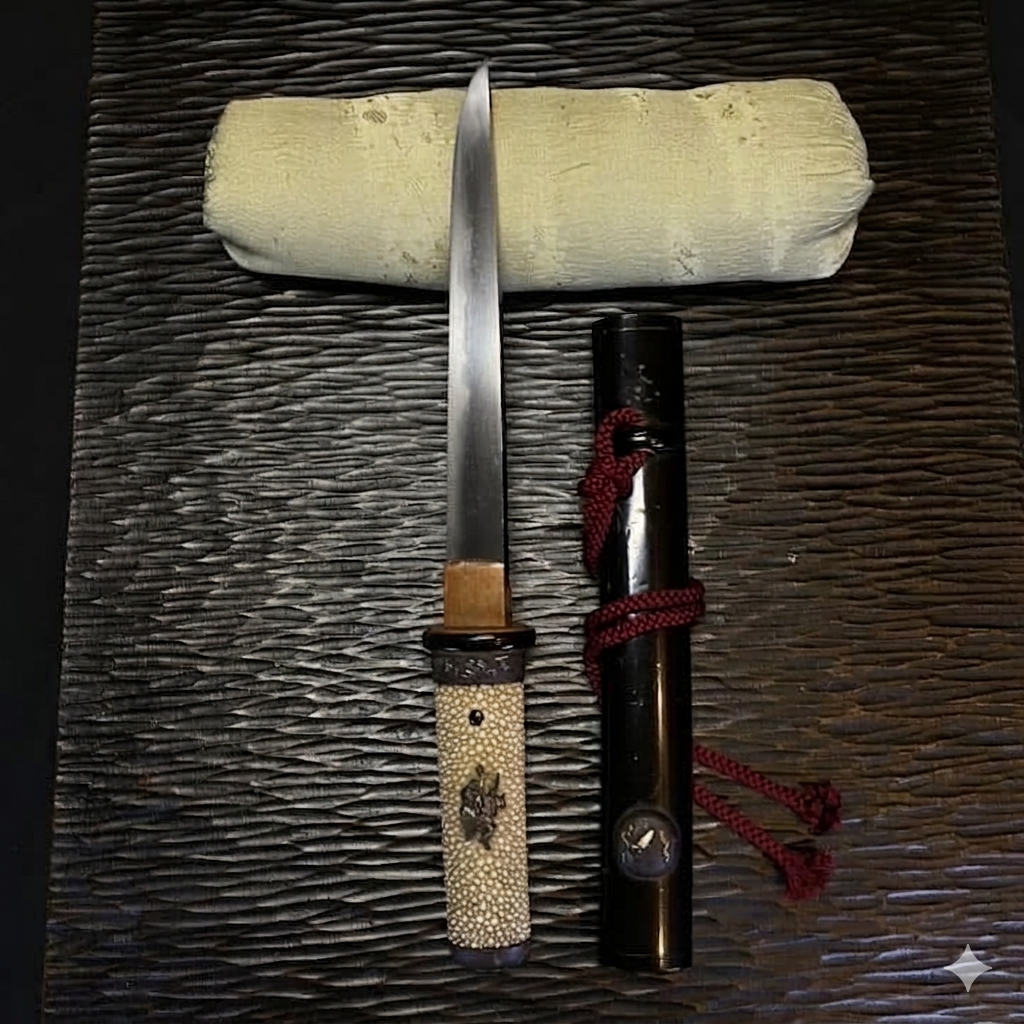
This is a very small Tanto/ Kaiken mounted in a equally lovely Koshirae —— the blade is short and narrow, that only has a Moto-haba of 18mm and Nagasa of less than 15.5cm (~6 inches), but it's also not overly thin, with a Moto-gasane of ~6mm, which combined with the Sugata, it overall looks delicate but also solid and not "fragile" at all. Due to the tiny size of the blade, clear demonstration of detailed Hamon activities is very difficult under my current setup, but if you look closely you can still tell that the blade has a lovely Hamon with rich activity. The Koshirae is mounted with custom made tiny sized fittings, they are about half the size of ordinary fittings. The Saya also has a round iron Saya-Kanagu buckle installed and used as 返り角Kaeri-zuno. Based on the overall style, I personally attribute both the blade and Koshirae to late Edo to Meiji Period, more study awaiting. Overall, a very beautiful and interesting set of art work with fine craftmanship, excellent for collection and a solid candidate for a Shinsa submission —— both blade and Koshirae.

The Masanari Dragon
#040A Convergence of Steel and Myth
Masanari (正成) A Convergence of Steel and Myth A masterclass in material harmony and historical storytelling. At its core rests a heavily patinated Edo-period blade, defined by a quiet suguha (straight) temper line and precise futasuji-hi (double grooves), forged and signed by the swordsmith Masanari (正成). Generations later, this historic steel was mounted in an extraordinarily rare, late Edo-era kibori (fully carved wood) koshirae. The continuous sculptural form of a dragon flows seamlessly from the gold-eyed tsuka down through the meticulously scaled saya. The structural restraint of the mounting is striking. The kinetic energy of the deeply textured wood is anchored entirely by solid silver: a structural pin, a habaki intricately chased with celestial clouds, and flawlessly smooth junction fittings. This unadorned silver acts as ma (negative space), providing a necessary visual pause that elevates the surrounding detail without overwhelming the eye.

Omote (Right): Chōhan- 長藩
#041Chōshū Iron Tsuba with Dragon and Clouds by Ono Mitsutaka This exceptional iron tsuba exemplifies the technical mastery of the Chōshū school during the Edo period. Signed by Ono Mitsutaka, the guard features a dynamic, continuous ryū (dragon) motif that masterfully weaves through turbulent, swirling clouds from the omote (front) to the ura (back). Mitsutaka utilized the sukidashibori technique, painstakingly carving away the background to leave the dragon and atmospheric elements in bold, three-dimensional relief. The sharp, crisp chisel work on the dragon’s scales and claws contrasts beautifully with the fluid, rhythmic lines of the cosmic clouds. The rich, dark iron patina further enhances the depth and power of the composition, making it a definitive example of high-level Chōshū metalwork. Material/Technique: Iron, sukidashibori (high-relief carving) -Dimensions: 7.27 cm x 6.99 cm x 0.5 cm -Weight: 115.0 grams

Forged in the Tempest: The Raw Power of the Iron Dragon
#042Forged in the Tempest
Forged in the Tempest: The Raw Power of the Iron Dragon While some samurai sword fittings aim for smooth, polished perfection, this antique tsuba (sword guard) commands attention through a completely different aesthetic: raw, untamed, elemental power. Forged from heavy iron (tetsu), this piece leans heavily into the Japanese concept of wabi-sabi—finding deep, profound beauty in the rustic, the weathered, and the impermanent. Its heavily pitted, textured surface isn't a flaw; it's a deliberate atmospheric choice that makes the piece feel incredibly ancient and battle-ready. Storm Warnings: The Details The maker of this tsuba used the rough iron canvas to tell a story of a fierce tempest: The Emerging Beast: A serpentine Ryu (dragon) writhes through the dense, textured metal, appearing as if it is actively breaking through a heavy storm cloud. Striking Gold: The genius of this piece lies in its restraint. The artisan used brilliant gold inlay purely for emphasis. The dragon's piercing eyes, sharp claws, and the crackling tendrils of lightning/energy pop violently against the dark, earthy iron. The Hidden Depths: Notice the scattered gold droplets along the bottom edge, resembling sea spray or sparks caught in the wind. The reverse side subtly continues the story, with glimpses of claws and swirling clouds etched into the dark metal. A Mark of True Utility Take a look at the central hole (the nakago-ana, where the sword tang passes through). You'll notice a distinct copper-colored insert at the bottom. This is called sekigane. Because iron is incredibly hard, a perfectly fitted iron tsuba could eventually wear down or damage the softer steel of the sword's tang over years of use. Sword mounters would insert these softer copper pieces to customize a perfect, snug fit without risking the blade itself. It’s a beautiful reminder that this was a functional piece of armor, not just a static work of art. It is a stormy, brooding masterpiece of iron and gold. Do you find yourself drawn more to the raw, rustic energy of iron tsuba like this one, or do you prefer the smooth, refined elegance of polished alloys? -Dimensions: 7.0 cm x 0.4 cm -Weight: 141.4 grams $450.00

Whispers of the Storm: The Art of the Shakudo Tsuba
#043The Art of the Shakudo Tsuba
Whispers of the Storm: The Art of the Shakudo Tsuba There is a quiet, enduring power held within the steel and fittings of a traditional samurai sword, and this magnificent tsuba (sword guard) is a perfect testament to that artistry. Crafted from shakudo—a classic Japanese alloy of copper and a small percentage of gold—the metal has been treated to achieve its signature deep, purplish-black patina. This dark canvas provides a striking backdrop for the incredible details etched into its surface. A Tale of Two Faces This piece tells a dynamic, elemental story across its two sides, brought to life through masterful carving techniques: The Depths: One side features an elegant, hypnotic expanse of churning water. The fine, sweeping lines capture the violent yet rhythmic motion of ocean waves crashing and curling over themselves. The Heavens: Turn it over, and the tempest is revealed. A fierce Ryu (dragon) emerges from the stylized rain and swirling clouds, descending toward the turbulent waves below. In Japanese mythology, dragons are revered water deities, symbolizing strength, wisdom, and raw natural power. Historical Details Notice the beautiful asymmetry of the hitsu-ana (the secondary holes flanking the center). One remains open to accommodate a kozuka (small utility knife), while the other has been carefully plugged with a brilliant gold-colored inlay—a practice known as ume-gane. This was often done when a tsuba was remounted onto a sword that did not require a kogai (hairpin/skewer tool), showcasing the adaptability and ongoing life of the piece through the centuries. Framed by a wonderfully textured rim, the stark contrast between the bright gold plug and the dark, stormy shakudo makes this tsuba an absolute standout. It is more than just a piece of armor; it is a canvas of storm and myth, frozen in time. -Material: Shakudo -Dimensions: 7.3 cm x 6.9 cm x 0.47 cm -Weight: 141.4 grams

Forged in fire, devoured by time
#044Forged in fire, devoured by time
Forged in fire, devoured by time This iron tsuba bears the brutal scars of centuries. Deeply pitted and choked with heavy rust, it’s a relic that has survived the harsh elements and the bloody realities of the samurai's path. Yet, beneath the decay, an ancient dragon still writhe through iron clouds. Eaten by earth and oxidation, its scales are scarred and claws dulled, but the mythical beast refuse to be erased. It coils around the central void—a final, rusted vanguard still fiercely guarding a blade long turned to ash. The warrior turns to dust, but the beast in the iron endures.

Masatoshi Tsuba with Kao
#045The Art of the Metal Brush
The Art of the Metal Brush: A Masatoshi Copper Tsuba There is a profound, understated beauty in metalwork that manages to capture the fleeting fluidity of an ink painting. This beautiful copper tsuba (sword guard), signed by Masatoshi (政壽) with his kao (monogram), is a prime example of that delicate balance. The piece is executed using the masterful katakiribori (片切彫) technique. By using an angled chisel, the artisan creates asymmetrical cuts that vary in depth and width. This method perfectly mimics the swelling and tapering strokes of a traditional sumi-e calligraphy brush. It is an incredibly unforgiving technique—metal cannot simply be erased or painted over, meaning every strike of the hammer must be deliberate, confident, and precise. A Striking Duality in Design The Omote (Front): The primary face features a dynamic engraving of a dragon weaving through swirling clouds and driving rain. The deep, varied chisel cuts give the mythical creature an incredible sense of motion and fierce energy, which stands out beautifully against the warm, earthy patina of the copper plate. The Ura (Back): The reverse side offers a serene, quiet contrast with a delicate, blossoming branch—likely plum (ume). The stillness and negative space of the floral motif perfectly balance the turbulent storm of the front. What makes a piece like this so highly appreciated by collectors is that it doesn't rely on flashy gold or silver overlays to demand your attention. Instead, it rests entirely on the artist's absolute mastery of the chisel and the rich, natural aging of the copper. It is a grounded, deeply historic piece of functional art that speaks volumes through its raw craftsmanship.

Unleashing the Dragon
#046A Masterpiece in Miniature
Unleashing the Dragon: A Masterpiece in Miniature When it comes to Japanese sword fittings (tosogu), sometimes the most captivating pieces are the smallest. Check out this incredible Tanto-sized Tsuba signed by Kajiyashiki (鍛冶屋敷). The Details Dynamic Motif: The artist didn't just carve a Japanese Dragon (Ryu); they brought it to life. The dragon refuses to be contained to a single side, with its intricately scaled body and clawed feet coiling organically around the rim, flowing seamlessly from the omote (front) to the ura (back). Rich Patina: The piece features gorgeous, earthy copper tones (likely yamagane or suaka) with an incredible, naturally aged patina. You can spot subtle, authentic wear and the shadow of the seppa (washers), showing it was truly mounted and used. Masterful Layout: Designed for a tanto (dagger), this tsuba proves you don't need a massive katana-sized canvas to showcase explosive movement. The way the negative space of the hitsu-ana (the left opening for a utility knife) balances the heavy, textured carving of the dragon on the right is a masterclass in asymmetrical harmony. The Mark of the Maker: The omote side proudly bears the beautifully chiseled signature (mei) of Kajiyashiki, sitting elegantly next to the central tang hole (nakago-ana). It is not just a handguard meant to protect the wielder's fingers; it is a pocket-sized talisman of strength. The fierce expression of the dragon and the deep, rustic texture make this an absolute standout piece of metallurgical art.

The Roar of Owari Iron: A Yamakichibei Masterpiece
#047The Roar of Owari Iron: A Yamakichibei Masterpiece
Yamakichibei — 山吉兵 The Roar of Owari Iron The Yamakichibei smiths were not court artisans. They were armorers — descended from a lineage that served Oda Nobunaga, the most ruthless and transformative warlord in Japanese history. Nobunaga's armies unified a fractured nation through absolute force, and the smiths who supplied his warriors forged iron not for ceremony but for war. That heritage lives in this iron. This tsuba showcases the timeless Ryu-ko (龍虎) motif — the Dragon of the Heavens and the Tiger of the Earth — locked in eternal combat, a symbol of the balance between opposing forces: heaven and earth, strength and cunning, yin and yang. In Yamakichibei's hands, the subject is not symbolic — it is visceral. Bold takabori (高彫, high-relief carving) makes the celestial beasts erupt from the metal, practically three-dimensional against the dense, jet-black Owari iron ground. Against that dark canvas, the delicate remnants of gold inlay still glow on the dragon's features — the only concession to beauty in an otherwise uncompromising piece. The contrast is everything: brutal iron and radiant gold, martial function and profound artistry. Owari iron is unlike any other. Dense, dark, and deliberate — it was never meant to be soft. In the Yamakichibei tradition, it becomes something beyond a sword fitting. It becomes a statement of power.

Emerging from the storm
#048There is a quiet, enduring strength in this antique iron sword guard (鍔, tsuba). Forged in the classic four-lobed mokko-gata shape, its rugged, heavily textured iron (鉄, tetsu) surface provides a beautiful, dramatic canvas for the dragon (龍, ryū) weaving through the sky. I absolutely love how the silver-accented clouds (雲, kumo) seem to practically glow against the deep, jet-black background, wrapping seamlessly from the front of the piece all the way to the reverse. It’s a stunning piece of tosogu that perfectly balances raw, weathered character with delicate, deliberate craftsmanship.

Hidemoto Tsuba with Kao
#049An exquisite craftsmanship of dragons and rayskin
This exquisite tanto-sized tsuka (sword hilt) is a stunning example of Mid-Edo period craftsmanship, highlighting the dynamic deep-carving techniques characteristic of the Mino school. Key Features: Fittings (Fuchi-Kashira & Menuki): The metal fittings are executed in classic Mino-bori style, featuring intricately carved, high-relief gold dragons writhing across a dark, finely stippled nanako (fish-roe) ground. The matching golden dragon menuki (handle ornaments) are nestled securely under the wrap. Handle Wrap (Tsuka-maki): The hilt is tightly bound with a vibrant, meticulously braided multi-colored cord, expertly wrapped to expose the foundation of nodular white samegawa (rayskin) underneath. Signature: The fuchi (collar) is distinctly signed Hidemoto (秀元) and includes the maker's kao (personal monogram).

The Coiled Ryu: An Edo Period Iron Tsuba: Attributed to Goto School
#050In the quiet density of iron, the celestial dragon stirs.
In the quiet density of iron, the celestial dragon stirs. Artistic Harmony & Flow This exceptional Mumei (unsigned) iron tsuba showcases the masterfully restrained power characteristic of the Gotō School. The obverse presents a dynamic, high-relief (takabori) carving of a mythical Ryu (dragon), its serpentine body weaving effortlessly through openwork sukashi negative space. With fluid grace, the dragon loops around the nakago-ana (blade aperture), its claws clutching the edge and its head emerging amidst stylized, roiling clouds near the rim. The reverse side beautifully complements the front, revealing the continuation of the dragon's scaled tail and coils, creating a seamless three-dimensional narrative when viewed from either side. Material & Patina • Base: Dense, richly textured forged iron with a deep, chocolate-brown ishime (stone-like) surface. • Accents: Subtle, masterful applications of gold and silver nunome-zōgan (overlay) bring life to the dragon's piercing eyes, sharp claws, and the shifting textures of its scales. • Securing Elements: The nakago-ana features copper sekigane (filler plugs) at the apex, showing evidence of careful custom fitting to a treasured samurai blade. Symbolism In Japanese lore, the dragon is a benevolent force—a ruler of water, rain, and clouds, symbolizing ultimate protection, courage, and profound wisdom. Carried into battle or worn in times of peace, this tsuba served not just as a functional guard for the hand, but as a spiritual talisman for the warrior, wrapping the sword's hilt in a perpetual loop of celestial strength.

The Coiled Ryu & The Hidden Pin
#051The Coiled Ryu & The Hidden Pin
A striking Edo-period tsuka featuring an uncommon, combat-practical hira-maki (flat-wrap) style, executed in an aged, weathered cream silk cord. The wrap leaves a window near the fuchi to expose the textured, pebble-grained samegawa (rayskin) underneath. Nested securely beneath the cords is a masterfully sculpted, darkened menuki depicting a fierce, undulating Japanese dragon (ryu). This powerful motif carries seamlessly through to the gold-accented fuchi and kashira, where the mythical beast weaves effortlessly through stylized, swirling cosmic clouds. Look closely at the pristine, unbroken lines of the wrap—there is no visible mekugi-ana (peg hole). This points to the sophisticated design of a kakushi-mekugi (hidden peg), where the bamboo pin is intentionally concealed beneath a fold of the silk to ensure a completely smooth, unhindered grip for the swordsman. A beautiful harmony of rugged utility, elegant artistry, and functional mystery.

Yūraku-sai Sekibun Tsuba
#052Clash of the Titans

The 1st gen. Sekibun (赤文) – his first name was Shōzō
#053The Journey to Kyōto

Emerging From The Depths
#054This unsigned late-Edo period tsuba (鍔) perfectly captures the raw, martial power and dynamic energy characteristic of the Mito (水戸) School. Crafted from a dense, solid iron plate (tetsu - 鉄), the turbulent waves and swirling storm clouds are rendered in bold, heavy relief (takabori - 高彫). What truly makes this piece glow against the darkness is the brilliant application of gold overlay (nunome-zogan - 布目象嵌). The dragon’s piercing eyes, horns, claws, and the scattered sea spray catch the light beautifully, striking a fierce, high-contrast balance against the dark, unyielding iron patina. Mito artisans were absolute masters of this aesthetic—capturing mythological subjects with a robust, masculine energy that appealed heavily to the late samurai class. It is a stunning study in how deeply carved iron and flashes of gold can bring a mythological tempest to life. Specs: Material: Iron (tetsu - 鉄) with gold overlay (nunome-zogan - 布目象嵌) Technique: High-relief carving (takabori - 高彫)

A breathtaking iron tsuba alive with motion — crashing waves carved i
#055A moment captured in metal
A breathtaking iron tsuba alive with motion — crashing waves carved in deep relief, scattered droplets of gold, and dragons emerging through the turbulent sea like forces of nature themselves. The composition is extraordinary. One dragon descends from the heavens while another disappears beneath the waves, creating a powerful sense of movement that continues across both sides of the plate. The flowing water lines carry the eye endlessly around the surface, transforming iron into something almost fluid. Touches of gold iroe illuminate the scene with remarkable restraint, allowing the dark patina and sculptural carving to dominate the atmosphere. The result is both dramatic and refined — a perfect expression of Edo period tosogu artistry. A tsuba that feels less like a sword fitting and more like a living moment captured in metal.

Hamamono 浜物 Tsuba
#056Maru-gata solid silver tsuba with coiling ryū — Meiji Period
This is an impressive maru-gata (round) tsuba crafted in solid silver, featuring a powerful and dynamic ryū (dragon) design is a masterful example of Hamamono—artistic metalwork produced in port cities like Yokohama during the late Edo and Meiji periods to meet the global demand for Japanese "exotic" luxury. The piece is executed in takabori (high-relief carving), where the dragon’s body twists and loops to form the outer rim of the tsuba, creating a sense of fluid motion and strength. The term Hamamono is written in kanji as: 浜物 Breakdown: • 浜 (Hama): This means "beach," "shore," or "harbor." In this context, it specifically refers to Yokohama, which was the primary international trading port of the era. • 物 (Mono): This simply means "thing," "item," or "object." Together, it literally translates to "harbor things" or "beach goods," identifying them as items purchased by travelers and collectors at the port. Design & Artistry The dragon is rendered with meticulous detail, showcasing deep-set eyes, flowing whiskers, and sharp claws grasping a nyoi-hōju (sacred flaming jewel) near the bottom. Its scales are individually articulated, catching the light across the silver surface to highlight the musculature of the mythical beast. The openwork (sukashi) elements between the coils of the dragon’s body give the piece a light, airy quality despite its substantial material. Technical Details • Material: Solid Silver (Gin). • Subject: Coiling Dragon (Ryū). • Style: Takabori Sukashi (High-relief openwork). • Motif: The dragon clutches a nyoi-hōju (sacred jewel) near the base, symbolizing prosperity and power. • Central Feature: The nakago-ana (blade hole) is framed by a polished, plain silver plate, providing a smooth visual anchor that contrasts beautifully with the complex, textured carving of the surrounding dragon. The reverse side of the tsuba continues the dragon's form with equal attention to detail, ensuring the design is cohesive and visually striking from every angle. A Relic of the Meiji Transition This tsuba represents that historic shift—a bridge between the functional discipline of the sword-smith and the refined decorative aesthetic of the Meiji-era artisan. They are "souvenirs," yes—but often created by the same hands that once forged the guards for the Shogun’s retainers. It stands as a stunning testament to a time when Japanese craftsmanship first took the world stage as a symbol of elegance and mystery. -Material: Solid Silver -Dimensions: 8.84cm x 8.10cm x .85cm -Weight: 224gm

The Celestial Dragon Amidst Roaring Waves (Nami Ryū-zu / 波龍図)
#057The Celestial Dragon Amidst Roaring Waves
A breathtaking testament to the legacy of the Gotō school. Executed on a dense, midnight-black shakudō ground, this matching fuchi-kashira set showcases the pinnacle of mainstream samurai metalwork (kodogu). The kashira features a powerful, writhing dragon dynamically bursting forth from deeply sculpted, churning waves, while the fuchi continues the narrative seamlessly, depicting the beast's body submerged in the crashing crests. The artist utilizes masterfully controlled takabori (high-relief carving) to give the mythical beast immense physical presence, while the rolling waves are defined with sharp, fluid line work. Kin-zōgan (fine gold inlay) is expertly applied to highlight the dragon’s features and the droplets of sea spray, creating a brilliant contrast against the dark, patinated alloy. Fuchi: L 39 x W 23 x D 10 mm (1.5" x 0.9" x 0.4") Kashira: 37 x 19 mm (1.4" x 0.8") Nakago: hole 28 mm

Keio ni nen shogatsu kichi jitsu A lucky day in the first month of Keio 2 1866
#058A Masterpiece of Bakumatsu Kinko Metalwork
Ujiharu- 氏治 • This artisan is part of the Hamano (浜野) school lineage, specifically associated with the late-Edo metalworkers who specialized in high-relief carving (takabori) and mixed-metal inlay. Ujiharu's work is characterized by the dynamic, almost "painterly" quality of the carving, which was popular during the Bakumatsu era (the final years of the Shogunate). • Date: 慶應二年正月吉日 (Keiō ni-nen shōgatsu kichi-jitsu). • Keio 2 (1866): This is a critical year in Japanese history, just two years before the Meiji Restoration. 1866 was a time of immense social upheaval and civil unrest (the Boshin War was looming). • Lucky Day: The term Kichi-jitsu (lucky day) was a common auspicious way to date a custom-ordered piece, rather than naming a specific calendar day. Design and Motifs The style of this tsuba is known as Mokko-gata (four-lobed shape), resembling a cross-section of a quince fruit. The Dragon and Waves (Ryu to Nami) The primary motif is a Dragon weaving through turbulent Waves. • The Dragon: In Japanese culture, the dragon is a symbol of power, wisdom, and protection. During the turbulent 1860s, these symbols were often chosen by Samurai to represent strength in the face of political chaos. • The Carving Style: The deep, energetic carving seen here—where the dragon's body appears to dive in and out of the metal surface—is a hallmark of late Edo craftsmanship. Notice the fine detail in the scales and the "splashing" water droplets (represented by small raised dots or granules). Material The base metal appears to be Shibuichi (an alloy of copper and silver) or a patinated Yamagane (mountain copper). The dark, rich patina highlights the contrast between the polished highlights of the waves and the darker recesses of the scales. Historical Context 1866 was a year of "The Great Change." While this tsuba was being crafted, Japan was grappling with the arrival of Western powers and internal rebellion. It is very likely that a piece this ornate and dated so specifically was a custom commission for a high-ranking samurai or a wealthy patron who wanted a protective talisman (the dragon) during an era of extreme uncertainty. This is a beautiful example of "Bakumatsu-kinko" (late Edo metalwork), where the artisan moved away from the austere styles of the past toward more flamboyant, expressive art.

The Dragon of the Roaring Tide
#059The Dragon of the Roaring Tide Radiant in its golden hue, this brass tsuba captures a dramatic encounter between the celestial and the elemental. A dragon—powerful and sinuous—emerges from a mist of fine nanako (fish-roe) stippling, its claws poised above a sea of meticulously carved, swirling waves. The composition is a masterclass in the Mito School style, where the warmth of the polished metal serves as a canvas for a story of eternal motion. On the reverse, the turbulence of the water continues, leading the eye into a deep, concentric whirlpool that speaks to the unstoppable force of nature. Certified by the NBTHK, this piece is not merely a guard, but a shimmering gateway into the late Edo period’s fascination with myth and the sea. Artifact Details • Origin: Mito School (Mito-mono) • Motif: Namitōju-ryū (Dragon chasing the tide/jewel amidst waves) • Material: Brass (Shinchū) with fine katakiri-bori engraving • Authentication: NBTHK Kanteisho (Hozon Tosogu) • Aesthetics: A harmonious blend of "The Dragon and the Deep," symbolizing wisdom and the command over the life-giving waters.

This Unryu (Dragon in Clouds) themed tsuka is a masterclass in Edo-period craftsmanship.
#060Bridge between the soul of the samurai and the edge of the steel
The way the dragon weaves through the roiling clouds of the fuchi and kashira, highlighted by subtle gold nunome-zogan, creates a sense of movement that feels alive even centuries later. The deep navy jabara-maki wrap and the prominent nodes of the samegawa speak to the high status this piece once held. It’s not just a handle; it’s a bridge between the soul of the samurai and the edge of the steel. Highlights: • Motif: Amaryu (Rain Dragon) among swirling clouds. • Material: High-grade Shakudo with gold relief. • Wrap: Midnight silk in a precision-tight diamonds. • Aesthetic: Dark, moody, and undeniably powerful.

Emerging From The Depths
#061Master of the Unseen
In Japanese lore, the dragon is a master of the unseen, moving seamlessly through clouds, mist, and deep waters. The curation of this spectacular tsuka mirrors that exact mythology, hiding its treasures in plain sight. The handle forces the viewer to become an explorer. As you trace the tight, traditional diamond folds of the dark leather wrap, the brilliant gold of the dragon menuki suddenly reveals itself, gleaming out from the textured rayskin like a hidden relic. But the true anchor of this composition is the kashira (pommel cap). Heavily patinated and beautifully weathered, the iron cap features a low-relief dragon winding through the metal. The craftsman’s genius lies in the restraint: by applying gold accents only to the vital lines of the creature's face, the dragon appears to be actively breaching the surface of a dark, primordial sea. To hold a piece like this is to hold a masterfully preserved story—one where iron, gold, and leather conspire to capture the eternal spirit of the dragon.

This is an exceptional example of a fuchigashira (matched set of hilt fittings) by the founder of the Yanagawa school, Yanagawa Naomasa (1692–1757)
#062Dragon motif set in shakudō with nanako ground
1st gen. Yanagawa, 1692-1757 - Edo The Yanagawa school, centered in Edo, is renowned for its elegant, pictorial soft-metal work. Naomasa was a pupil of the master Yokoya Sōmin, and his work is celebrated for perfectly inheriting and refining the Yokoya style, characterized by sophisticated nanako (fish-roe) grounds and masterful high-relief takabori (high relief carving) with fine iroe (colored metal inlays). Description of the Fuchigashira The set features a classic and powerful thematic execution typical of Naomasa's best work: • Technique: The base is shakudō (a copper-gold alloy) finished with a fine nanako ground, which provides a rich, textured dark surface. The high-relief elements are rendered in gold (kin-iroe), emphasizing the vitality and movement of the subject. • Motif: The fuchi (the ferrule near the handguard) and kashira (the pommel cap at the end of the hilt) depict a dynamic dragon. The dragon is a classic subject for the Yanagawa school, often rendered with a sense of "pictorial" life, where the creature appears to wrap around or emerge from the surface. The carving shows remarkable detail in the scales, claws, and fierce expression of the dragon, hallmarks of Naomasa’s ability to create a sense of depth and weight within a small space. • Signature (Mei): The fuchi is signed 柳川直政作 (Yanagawa Naomasa saku — "Made by Yanagawa Naomasa"). The presence of a clear, authentic signature by the first-generation master significantly elevates the historical and artistic value of this set. Historical Context: The Yanagawa School Naomasa is widely considered the most talented maker of the Yanagawa lineage. His contributions were vital to the prosperity of the Yokoya tradition; after his training, many famous schools—including the Inagawa, Sano, Ishiguro, Kikuoka, and others—descended from his influence. His work is often described as rikuyoku (powerful and dignified), a direct inheritance of his master Sōmin’s style. Collectors treasure these pieces because they balance technical precision—the incredibly uniform nanako ground—with the artistic flair of the dynamic gold-inlaid motifs. This piece is a testament to the mid-Edo period’s zenith in metalworking, where the fuchigashira were not merely functional components but miniature canvases for master craftsmen. Given the quality of the carving and the clarity of the signature, this is a refined artifact that captures the essence of the Yanagawa school's aesthetic brilliance.

Mino no Kami Fujiwara Masatsune – 3rd gen., Kan'ei (1624–1644), Owari
#063NBTHK Tokubetsu Kicho Token
(美濃守藤原政常), “Masatsune” (政常), real name Nando Tarōsuke (納戸太郎助), he was actually the son of Daidō (大道) but was adopted by the 1st gen. Masatsune after the unexpected death of his own son Tarōsuke, he received the honorary title Mino no Kami in Genna five (元和, 1619) and died in the second year of Kanbun (寛文, 1662), he worked in the style of the 1st gen. but cannot compete in terms of quality. We know a lot of kozuka from him and also excellently executed horimono of a Fudō-Myōō or a suken in the hi. He also signed with a thick chisel whereas he placed the mei at katana and wakizashi on the shinogi-ji of the tang and at tanto centrally on the nakago, wazamono, jō-saku. NBTHK Tokubetsu Kicho Token (Green)

Robust and Powerful Submerged Dragon Design - Iron with Gold and Silver Inlay.
#064An extraordinary and commanding presence
This impressive tsuba, signed "Yasukatsu Saku," features a bold and dynamic depiction of a submerged dragon, meticulously crafted with sharp claws and a fierce expression. The tsuba, offers an extraordinary and commanding presence. Product Highlights: * Material: High-quality iron, showcasing the fine texture and durability typical of superior craftsmanship. * Design: The powerful and detailed depiction of the dragon, with its piercing eyes and sharp claws, is a testament to the artisan's skill. The gold and silver inlay adds a striking contrast, enhancing the overall impact of the design. * Size: With a long diameter exceeding 9cm, this large tsuba is truly a standout piece, offering both visual appeal and substantial weight. Dimensions: * Height: Approximately 9.15 cm (3.60 inches) * Width: Approximately 8.84 cm (3.48 inches) * Thickness: Approximately 0.48 cm (0.19 inches) Weight: Approximately 189.5 grams (6.68 oz)

Mastery in Iron: The Echizen Kinai Dragon
#065A textbook example of the Unryu motif
Take a closer look at the "handwriting" of a master. This tsuba isn't just a guard; it’s a textbook example of the Echizen Kinai School, a lineage of smiths who became legendary during the Edo period for their "Dragon and Cloud" (Unryu) motifs. The Kinai Blueprint What makes this piece so specific? It’s all in the Maru-bori (carving in the round). Unlike flatter designs, this dragon’s body is the structure. • The Rim: Notice how the dragon’s tail and scales actually form the outer edge (mimi) of the guard, rather than just sitting inside a frame. • The Face: Kinai dragons are famous for these features—the prominent, upturned nose, fierce bulging eyes, and flowing whiskers that blend seamlessly into the swirling clouds. • The "Life" in the Metal: That tiny flash in the eye is Ten-zogan (gold dot inlay). A master smith hammered a gold wire into the iron to give the creature a soul. Built for the Daisho The distinct shapes of the side holes (hitsu-ana) tell us this belonged to a high-ranking samurai. The semi-oval on the left housed the Kozuka (utility knife), while the lobed opening on the right was tailored for the Kogai (hair-arranging tool). Pieces this refined were often part of a matched Daisho set—the ultimate status symbol of the warrior class. Dating to the mid-to-late Edo period (1750–1850), this tsuba represents a time when the sword moved from the battlefield to the court, evolving from a simple weapon into "gentlemanly jewelry" of the highest order.

The Spirit of the First Generation
#066An exquisite testament to the Ichiryū school, this iron tsuba pulses with the legacy of Tomoyoshi (First Generation). The dragon, a creature of celestial power, is rendered with such fluid precision that it seems to ripple within the iron, its form weaving through the negative space in a dance of shadows and steel. The signature, 一柳友善作 (Ichiryū Tomoyoshi saku), is more than a name—it is a seal of authenticity from a master who understood that a warrior’s guard should be as formidable as it is poetic. In this piece, the ferocity of the dragon is balanced by the delicate grace of the artisan's chisel, capturing a moment of eternal movement frozen in time. Artifact Details • Artisan: Ichiryū Tomoyoshi (1st Gen) • Signature: 一柳友善作 (Ichiryū Tomoyoshi saku) • Design: Ryu (Dragon) in openwork sculptural relief • Essence: A masterwork of the late Edo period, blending protection with high artistry.

Aizu Shōami School- 会津 正阿弥
#067Iron mokko-gata guard carved in flowing relief with multiple dragons in continuous motion. The composition wraps the plate in a rhythmic, almost circular energy—each figure individually worked yet unified across the surface. The iron carries a warm, well-developed patina, with subtle variation and depth that speaks to both age and handling. Copper sekigane remain in place, evidence of use and adjustment over time. A decorative yet disciplined example of late Edo craftsmanship—where movement, balance, and surface detail take precedence over excess. Quietly alive in the hand.

Dynamic Dragon Tsuba
#068A masterful depiction of a dragon weaving through clouds and waves
This exceptional Japanese tsuba (sword guard) showcases the masterful artistry of traditional samurai sword fittings. Sculpted from dark metal, the high-relief carving features a dynamic dragon (ryu) weaving through swirling, stylized clouds and waves—a classic motif symbolizing power, wisdom, and protection. Intricate Craftsmanship: The front face highlights the dragon's meticulously textured scales and fierce expression. Prominently engraved beside the central opening is the signature (mei) reading Choshu Nobuhisa saku (長州信久作), identifying the piece as the work of the artisan Nobuhisa from the renowned Chōshū province. Continuous Design: The fluid composition wraps elegantly around to the reverse side, showing the dragon's body and tail disappearing into the mist, demonstrating the maker's sophisticated understanding of three-dimensional space. Functional Elegance: The piece features the standard central nakago-ana (the wedge-shaped opening for the sword's tang) and a single kozuka-hitsu-ana (the side opening meant to accommodate a small utility knife), perfectly balancing martial utility with sculptural beauty.
![Omote (Right): Chōshū jū (Resident of Chōshū)- 長州住 - [ ] Ura (Left): Mitsutaka saku (Made by Mitsutaka)- 光高作](https://base44.app/api/apps/6a3c389c5e07478e1a008611/files/mp/public/6a3c389c5e07478e1a008611/9b5cc0c04_Image.png)
Omote (Right): Chōshū jū (Resident of Chōshū)- 長州住 - [ ] Ura (Left): Mitsutaka saku (Made by Mitsutaka)- 光高作
#069Cloud and dragon tsuba design
Chōshū Mitsutaka (光高) 3rd–4th generation Late Edo period (circa 1800–1860) This cloud and dragon tsuba design by Mitsutaka 光高, a master craftsman from Chōshū (modern Yamaguchi Prefecture). He was a disciple of Tomokata, the 6th head of the Okamoto family, and specialized in cloud and dragon designs. Size is approximately 73 mm in height, 70 mm in width, and the height of the seppa-dai (washer base) is approximately 6 mm. NBTHK Tokubetsu Hozon Token.

A masterful study in texture and motion.
#070High-relief dragon inlay on textured iron
This deeply textured iron (鉄, tetsu) tsuba (鍔) features a dynamic dragon (龍, ryu) weaving effortlessly through the forged plate. The classic mokko-gata (four-lobed) silhouette frames a rugged, hammered surface that serves as a perfect, unyielding canvas for the high-relief inlay (高象嵌, taka-zogan). Notice how the dragon’s serpentine form gracefully breaks the surface tension, appearing to dive in and out of the iron across both the omote (front) and ura (back). The subtle interplay of the dark alloys against the raw, dark iron—punctuated by the warm gold and copper accents on the whiskers and flames—demonstrates an exceptional architectural command of material, light, and composition. A brilliant example of how traditional metalworkers breathed life and kinetic energy into functional art.

Rendered in a controlled, calligraphic line style
#071A finely worked late Edo period tsuba in patinated copper alloy (likely yamagane), decorated with paired dragons in gold hira-zōgan (flat inlay). The composition depicts one ascending and one descending dragon, symbolizing balance and opposing forces—commonly associated with control of water, storms, and the harmony of heaven and earth. The dragons are rendered in a controlled, calligraphic line style with elegant flow and restrained anatomical detail—hallmarks of Kyoto Shoami workmanship. The open ground and balanced composition reflect refined urban taste rather than high-relief master school carving. The plate shows natural age, surface wear, and sekigane adjustments, consistent with historical mounting and use. The gold inlay remains intact and clearly legible. Attribution: Kyoto Shoami school Signature: Mumei (unsigned) Period: Late Edo (18th–early 19th century) Material/Technique: Copper alloy plate with gold hira-zōgan inlay Motif: Paired dragons (duality, harmony, elemental balance) A strong example of Edo-period decorative sword fittings, valued for its elegant composition and classical dragon imagery within the Kyoto Shoami tradition.

Tsutsui Clan
#072Powerfully carved cloud dragon with gold cloth inlay
A member of the Tsutsui Clan and his family. A resident of Hikone, Goshu. He also left behind many tsuba with scenes of warrior battles. This piece features a powerfully carved cloud dragon, with gold cloth inlay in places. NTHK.

A remarkable example of dynamic composition on a four-lobed (mokko-gata - 木瓜形) tsuba.
#073Twin dragons in high relief with inome cutouts
Twin dragons (ryu - 龍) are rendered in bold high relief (takabori - 高彫), their intricate scales and serpentine forms commanding the front (omote) before seamlessly wrapping over the rim to the back (ura). This continuous design is anchored by a deeply textured, hammered surface that beautifully highlights the rich, dark patina of the metal. Accented by the subtle inclusion of traditional inome (boar's eye - 猪目) cutouts at the top and bottom poles, it stands as a striking and highly deliberate piece of historical metalwork.

Enameled Hirado Kinishige
#074Copper alloy tsuba with dragon motifs and jade enamel
The island of Hirado is situated west of Kyushu, its has a capital city bearing the same name. It was ruled for nearly 800 years by the Matsura Daimyo family. The place served as a trade post with China since ancient times and, from 1550 to 1641, served as the main port of entry for foreign trade into Japan. Following the Imjin War, a group of Korean potters were taken to the island, where they started to produce porcelain that became known as Hirado Ware. Another product made in Hirado was sword mounts bearing a signature "Kunishige". The work done here was often done in soft metal, mostly copper alloy. The designs often incorporated Chinese style dragon chasing pearls and Western elements. A particularly fine example of the work signed with Hirado Kunishige. The copper alloy tsuba is carved with a fine chisel, showing a very steady and controlled hand. The decor consists of a dragon on the Omote (表) front and two on the Ura (裏) back. They have well-defined bodies and facial features. The dragon's eyes are inlaid with gold. Very unusual is the addition of green Jade enamel in the negative space. It is one of only very few pieces by this workshop to have this finish, which seems to indicate it was only briefly experimented with. The Korean pottery tradition that was established on Hirado likely had something to do with it, as it is distinct from the more opaque enamel favored in China.

Elegance of the Hirado School
#075Cloud and Dragon motif
Captivated by the intricate craftsmanship of this Hirado Kunishige tsuba. This Edo-period masterpiece showcases the dynamic "Unryu" (Cloud and Dragon) motif, a signature style of the Hirado school in Hizen province. The high-relief carving (takabori) brings the scene to life, as a dragon masterfully weaves through stylized clouds to pursue the flaming jewel. Struck in a beautiful copper alloy, the piece carries a rich, golden patina that stands out brilliantly against a stark, minimalist background. This piece is officially recognized with NBTHK Hozon papers, authenticating it as a genuine work worthy of preservation. The reverse side continues the story with additional auspicious "Precious Objects," proving that in the world of tosogu, every millimeter is a canvas for history. NBTHK Hozon Token.

Ichihira Ippei of the Yado clan
#076This tsuba inherited the family headship in the seventh year of the Kyoho era and resided in Nagato Province, beautifully carved to depict a dragon ascending a waterfall. The eyes, whiskers, and polka dots are inlaid with gold. NTHK.

Sōryū / Goryū dragon tsuba featuring an extraordinary asymmetrical composition
#077NBTHK Hozon-certified sōryū / goryū dragon tsuba featuring an extraordinary asymmetrical composition — three dragons animate the omote, while two powerful dragons emerge on the reverse. The design creates a continuous sense of movement around the plate, as if the dragons are circling through clouds beyond the iron surface itself. Deeply carved scales, flowing whiskers, and restrained gold iroe accents contrast beautifully against the immaculate nanako ground, giving the piece remarkable dimensionality and life. The mokkō-gata silhouette and rich patina further elevate the work, balancing power with refinement in classic Edo period taste. NBTHK Hozon Token.

A Masterpiece in Copper: The Cloud Dragon Tsuba
#078This exceptional Unryū-zu (Cloud Dragon) tsuba, captures the divine power and fluid grace of the mythical dragon as it weaves through a celestial firmament. Crafted from refined suaka (unalloyed copper), the piece showcases a masterful use of takabori (high-relief carving) to bring the dragon’s form to life. The artistry is further elevated by: • Intricate Details: The dragon's fierce expression and sharp claws are highlighted with delicate kin-iro-e (gold accents), creating a striking contrast against the warm, polished copper ground. • Dynamic Composition: As seen in the dragon’s body appears and disappears through swirling, deeply carved clouds, suggesting immense scale and movement. • Historical Pedigree: The reverse side, shown, bears the signature of the master craftsman Hamano Naotoki, accompanied by his personal kaō (monogram). • Guaranteed Authenticity: This work is accompanied by a Hozon Tosogu (Preservation Tosogu) certificate from the Nihon Bijutsu Token Hozon Kyokai (NBTHK), dated April 27, 2011 (Heisei 23), confirming its status as a significant piece of Japanese art. Whether viewed from the front or the back, this tsuba stands as a testament to the sophisticated metalworking traditions of Japan, blending protective function with breathtaking aesthetic beauty. NBTHK Hozon Token.

Omote (Right): Kikuchi Tsunemitsu- 菊池序光 Ura (Left): Bamen Tsunemasa- 馬面序政
#079Tsunemitsu– his first name was Izaemon (伊左衛門) was one of the most outstanding students of Tsunekatsu. This might be the reason why some counted him as his actual successor and 2nd gen. of the Kikuchi Family. His strong points were excellently carved and elegant kebori. He used the Gō Seirandō (青藍堂) and it is said that in his early years he signed his name with the characters (常光). He had one son who followed him as 2nd gen. Izaemon Tsunemitsu. The Bamen school goes back to the Armourer Family of the same name which was, according to transmission, a branch of the famous Myōchin Family (明珍). Bamen was written with the characters (馬面) and (馬免). The origins of the Bamen-katchūshi lie in Toyohara (豊原), in Echizen province, namely at the time of Oda Nobunaga (織田信長, 1534-1582). When the latter burned down the local Toyohara-dera (豊原寺) in 1575, the family moved in the following year to the nearby village of Maruoka (丸岡). Towards the end of the Edo period and with the strongly decreasing demand for newly produced armours and helmets, many of the Bamen members had to change jobs. Some of them became gunsmiths (teppō-shi, 鉄砲師), others arrow smiths, and Tsunemasa – whose first name was Ichijūrō (市十郎) – entered an apprenticeship with Kikuchi Tsunekatsu. However, Tsunemasa did not continue the kinkō craft of his master but continued the tradition of the Bamen Family, being the forging of iron and the opening of ji-sukashi. He was strongly influenced by the then very popular sukashi-tsuba of the Akasaka School (赤坂) and the fine ito-sukashi of the Itō School (伊藤). Tsunemasa was born in the first year of Kanpō (1741) but his year of death is unknown. On the basis of pieces signed with his age we can say that he was at least active until the age of 75, which means at least until the Bunka era (1804-1818).

The Dragon’s Realm
#080Caught in a timeless dance of iron and gold, a majestic dragon weaves through churning waves and gathering storm clouds. This Edo-period tsuba (sword guard) showcases the masterful contrast of rugged, patinated iron against delicate gold-rimmed hitsuana (openings), embodying the fierce elegance of the samurai spirit. On the reverse, the craftsman’s signature stands anchored amidst the swirling tempest, a quiet testament to an enduring legacy.

A Masterpiece in Iron: The Rare Four-Clawed Dragon by Sunagawa Masanori
#081A Masterclass in Ironwork Featuring a Rare Four-Clawed Dragon
When we examine the artistry of the samurai sword guard (tsuba), we are looking at a masterclass in storytelling through metallurgy. This stunning octagonal iron piece by Sunagawa Masanori (砂川正矩) is a perfect example of why these functional guards are revered as high art. Backed by an official NBTHK Hozon (Worthy of Preservation) certificate from Heisei 30 (2018), this tsuba represents a beautiful duality of Japanese mythology and natural landscapes, but it hides a very specific, rare detail that sets it apart from the rest. The Omote (Front): A Break in Tradition Carved in deep, expressive relief, the front of the tsuba features a fierce dragon twisting through a turbulent sky of swirling clouds (Unryu-zu). But if you look closely at the dragon's gripping talon, you will notice something highly unusual: it has four claws. In traditional East Asian iconography, the number of claws on a dragon carries heavy symbolic weight: Five claws: Strictly reserved for the Chinese Emperor. Three claws: The standard depiction for Japanese dragons. Four claws: Often associated with nobility, high-ranking officials, or specific mythological lineages (sometimes linked to Korean dragons or Chinese nobility). Seeing a four-clawed dragon on a Japanese tsuba is a brilliant rarity. It suggests the artist, Masanori, was intentionally playing with imperial iconography or commissioning this for a samurai of a very specific, elevated status. It makes an already beautiful carving an absolute conversational centerpiece. The Ura (Reverse): The Sacred Coast Flipping the tsuba reveals a stark, grounding contrast to the chaotic energy of the dragon. The reverse side depicts a meticulously carved seascape. Crashing waves break against rugged coastal crags, highlighting two prominent peaks joined by what appears to be a sacred shimenawa rope. This is a classic homage to Meoto Iwa (the Married Couple Rocks) in Mie Prefecture, representing the union of the creator kami, Izanagi and Izanami. The juxtaposition is poetic: the heavens above, ruled by the fierce, four-clawed dragon, and the earth below, anchored by the sacred, eternal rocks weathering the sea. At a Glance Swordsmith/Maker: Sunagawa Masanori (砂川正矩) Material: Iron (Tetsu) Shape: Octagonal (Hakkaku-gata) Motif: Cloud Dragon (Unryu) & Sacred Rocks (Meoto Iwa) Authentication: NBTHK Hozon Token (Preservation paper, issued August 2018) This piece is more than just a hand guard; it’s a beautifully preserved narrative of myth, status, and masterful ironwork! NBTHK Hozon Token.

One of the two best students of Araki Tomei
#082When discussing the absolute pinnacle of late-Edo period metalwork, the name Araki Tomei immediately commands respect. But to truly appreciate the depth of Tomei's influence, one has to look at the exceptional hands he trained. Enter Inoue Akiyoshi (井上明義 / 明祥)—widely celebrated as one of Tomei’s two greatest students. This magnificent iron tsuba (sword guard) perfectly encapsulates why Akiyoshi earned that reputation. The Motif: Hatō Tama-oi Ryū (Waves and Dragon Chasing a Pearl) The composition of this piece is a masterclass in dynamic tension and spatial awareness. The Omote (Front): Features deeply carved, turbulent waves (hatō) surging toward the bottom left, accompanied by a solitary, gleaming golden pearl (tama). The negative space is perfectly balanced by Akiyoshi's elegant signature and kakihan (monogram). The Ura (Back): The payoff. Hidden on the reverse side is an exquisite, high-relief dragon (ryū) bursting from the crashing tide. The use of mixed-metal inlay (zōgan iroe) on the dragon's face, horns, and scales creates a breathtaking contrast against the dark, forged iron. The dragon is relentlessly pursuing the pearl depicted on the opposite side, tying the whole piece together in a continuous narrative. Technical Specifications (Per the NBTHK Certificate) The accompanying NBTHK certificate (Nihon Bijutsu Token Hozon Kyokai) validates the piece with the following details: Shape: Mokkō-gata (Four-lobed/melon shape) Material: Tetsu-ji (Iron base) Technique: Takabori (High-relief carving) with Zōgan iroe (Colored metal inlay) Rim: Uchikaeshi-mimi (Hammered-back rim, giving it a subtle, organic frame) Mei (Signature): Akiyoshi (明祥) with kao (artist's seal) Why This Piece Matters Akiyoshi didn't just copy his master; he internalized the Tomei school's dedication to hyper-detailed naturalism and applied it to classical mythological motifs. The iron base on this tsuba isn't just a canvas; it's textured and forged to feel alive, while the precision of the gold and silver inlay work on the dragon shows a jeweler's touch. Pieces like this blur the line between a functional weapon fitting and pure fine art. A true testament to the golden age of Japanese tosogu (sword fittings)! NBTHK Hozon Token.

More Than Just Armor: The Anatomy of a Samurai Masterpiece
#083A masterclass in samurai jewelry
At first glance, this intricate metalwork looks like a delicate medallion, but it was forged for a warrior. This is a tsuba (the hand guard of a Japanese sword), and it is a masterclass in how samurai culture perfectly balanced lethal function with high art. Here is what makes this specific piece a metallurgical triumph: The Metal (Shakudo): The deep, inky black canvas of this tsuba isn't painted—it's shakudo. This traditional Japanese alloy mixes copper with a small percentage of gold. When treated with a specific chemical bath (rokusho), the metal develops a striking, purplish-black patina that refuses to fade. The Technique (Sukashi): The negative space is just as important as the metal itself. The artist used sukashi (openwork carving) to meticulously cut away the iron, creating a three-dimensional silhouette of dragons writhing through clouds. The Accents: To make the piece truly pop, the artisan applied brilliant gold inlay to the dragons' horns, scales, and flames. This creates a brilliant contrast against the matte, dark shakudo, transforming a functional piece of armor into a status symbol. The Anatomy: Look at the three distinct openings. The large central hole (nakago-ana) is where the tang of the sword blade passes through. The two lobed cutouts on either side are hitsu-ana. These allowed the samurai to draw small utility tools—like a small knife (kozuka) or a skewer/hairpin (kogai)—that were stored in the sword's scabbard, without having to unsheathe the actual sword. The Symbolism: The dragons (ryu) looping endlessly around the center are not just intimidating; in Japanese mythology, they are fierce water deities representing wisdom, strength, and protection. It is a millimeter-perfect testament to an era where the sword was considered the soul of the samurai—and the tsuba was its jewelry.

会津 (Aizu) — the Aizu domain/region in present-day Fukushima
#084正阿弥 (Shōami) — the Shōami School of sword fittings makers
Featured here is an exquisite Late Edo period Japanese tsuba, or sword guard, produced by the Aizu Shōami School (会津 正阿弥), a lineage active in present-day Fukushima. This particular piece is Mumei (無銘), or unsigned, a common characteristic for historical sword fittings which places the focus entirely on the craftsmanship. Included is a certificate of recognition from the NBTHK (Nihon Bijutsu Tōken Hozon Kyōkai)—the Society for the Preservation of Japanese Art Swords—validating its school attribution and the authenticity of the material, a necessary step to distinguish high-quality period pieces from modern reproductions. The tsuba demonstrates the defining features of Shōami metalwork, most notably dynamic Sukashi (openwork) combined with Taka-bori (high-relief carving). Crafted from iron, the surface has taken on a dark, rich brown patina characteristic of genuine historical tsuba, known to antique collectors as sabi. It is decorated with a pair of highly dimensional, coiled dragons with scales rendered in detailed relief. Their features, including claws, spines, and whiskers, are highlighted with delicate, selective gold overlay (nunome), while larger, textured patches of gold accentuate the design. Typical for the Edo period, the tsuba is designed with multiple apertures: the central nakago-ana (slot for the main sword tang) and two auxiliary slots to accommodate a kozuka (small knife) and a kōgai (hairpin/utility spike). Identification Guide for Authenticity: Historical tsuba are often differentiated from reproductions by the character of their patina. Genuine iron develops a hard, stable, dark, and slightly granular texture over centuries. Many low-quality reproductions will instead have a soft, unnatural looking, or chemically blackened finish that lacks the depth and historical resonance seen in this Aizu Shōami example. The accompanying NBTHK certificate is essential, as it provides standardized, professional validation from the premier organization dedicated to Japanese tsuba identification. NBTHK Kichō

Unleash the Beast!
#085A roaring, wearable statement of power
Get ready to have your mind blown by the sheer ferocity and craftsmanship of this incredible tsuba (sword guard). If a piece of metal could roar, this one would shake the earth! Here is a breakdown of why this dragon tsuba is an absolute, top-tier masterpiece of Japanese metallurgy: The Dark Void (Shakudo): That stunning, deep purplish-black background isn't painted on—it's shakudo. This is a legendary samurai alloy of copper mixed with a small percentage of pure gold, which is then chemically treated with a special bath (rokusho) to achieve that dark, velvety patina. It is the ultimate high-contrast canvas designed specifically to make precious metals explode visually. The Golden Wyrm: Look at the unbelievable detail in the high-relief gold inlay. Every single overlapping scale, the wild horns, and the razor-sharp claws of the dragon are meticulously chiseled. It doesn't just sit on the metal; it commands it. The 3D Illusion: The true genius of this piece is the dynamic composition. The artisan didn't just paste a dragon onto a flat disk. They carved deep, rugged, textured gouges into the shakudo to make it look like the dragon is violently tearing through stormy skies—or physically weaving in and out of the steel itself! One side shows the fierce head and claws breaking through, while the reverse shows the coiled, armored body slipping back into the darkness. This wasn't just a hand guard to keep a samurai's fingers safe; this was a roaring, wearable statement of power, immense wealth, and undeniable swagger. Imagine staring down a samurai, and as they grip their katana, this is what is staring back at you!

Deep in the detail of this Edo-period sukashi tsuba.
#086A quintessential piece for those who appreciate the evolution of Japanese metalwork
The iron is exceptionally well-forged, showcasing the characteristic patina that only centuries of careful handling can produce. The sukashi (openwork) design is balanced with a bold, rhythmic flow, and the crispness of the mei (signature) remains remarkably sharp for its age. A quintessential piece for those who appreciate the evolution of Japanese metalwork from martial utility to refined, sculptural art. -Material: Brass -Dimensions: 6.9cm x 5.9cm x bout .55cm -Weight: 76g

Capturing the glow
#087An incredible energy in the way this dragon emerges from deep, jet-black negative space
There is an incredible energy in the way this dragon (Ryū - 龍) emerges from the deep, jet-black negative space. Masterfully composed from a rich palette of dark shakudo (赤銅), brilliant gold, and warm red copper, the fierce, coiling form is captured in stunning high-relief detail. This masterful metallurgy creates a striking visual contrast that absolutely demands attention. Notice how the dragon intricately weaves through the dark, swirling clouds, wrapping powerfully around the central seppa-dai (切羽台). The mei (銘) on the reverse reads Bushū jū Masayasu saku (武州住 正保作) — "Made by Masayasu, resident of Bushū province." Masterworks like this perfectly showcase the dynamic openwork (sukashi) and mixed-metal artistry that makes the Bushū school's aesthetic so enduringly captivating. A truly stunning piece of tosogu history. -Material: Shakudo/Gold/Red Copper -Dimensions: 8.5cm x 7.7cm x .50cm -Weight: 139g

Hamidashi tsuba
#088A masterpiece of the hidden dragon waiting to ascend
This is an unsigned, long, oval-shaped iron tsuba (sword guard) with a design of a hidden dragon. It features high-relief carving, hair-like engraving, gold inlay, and intricate metalwork on an iron base. A magnificent golden hidden dragon is carved into the small tsuba. It is recommended for a dignified tanto (short sword) mounting. A hidden dragon (senryu) is a dragon that lies hidden in the depths of the water or in the dust, waiting for an opportunity to ascend to the heavens. It also refers to a hero or ruler who has the ability but has not yet revealed himself, waiting for the right opportunity , making this a masterpiece imbued with a promising future. A "hamidashi tsuba" (or "kuidashi tsuba") is a small tsuba made to protrude slightly from the edge of the scabbard or handle. It is mainly found on tanto mountings. Despite its small size, it has practical functionality and has been used as decoration for small swords, existing since ancient times in the history of Japanese tanto.

Caught in a dance of iron and gold
#089The legendary Tamatori-ryu, captured in the exquisite artistry of the Mito school. A masterpiece of relief and inlay, now officially recognized by the NBTHK. Timeless craftsmanship in the palm of my hand. NBTHK Hozon Token.

Senryu-zu (coiled dragon)
#090It is identified as a Mumei (unsigned) work from the Mito school, featuring a Senryu-zu (coiled dragon) design. The details specified—Tetsu-ji (iron base), Uchikaeshi-mimi (turned-over rim), and Takabori-zogan (high-relief inlay)—speak to the exceptional craftsmanship of the era. -Dimensions: 8.86cm x 8.86cm x .71cm -Weight: _g NBTHK Hozon Token.

A Fine Shibuichi Tsuba
#091An atmospheric study of martial strength and ephemeral beauty
This exquisite shibuichi tsuba is a masterclass in the refined aesthetic sensibilities of the late Edo period. The plate is treated with a rich ishime-ji (stone-grain) finish, creating a rugged, atmospheric texture that beautifully captures the subtle, grey-toned patina unique to the shibuichi alloy. The composition centers on the evocative imagery of horses—a subject deeply rooted in the martial and cultural traditions of the samurai. Through iroe-takazogan, the artist, Mitsutomo, employs a sophisticated palette of copper and gold to bring the horses to life in high relief. The meticulous detailing of the manes and musculature stands in elegant contrast to the organic, textured field of the plate. The inclusion of delicate sakura (cherry blossom) motifs adds a layer of poignant symbolism, bridging the gap between the strength of the warrior and the ephemeral, fleeting nature of life itself. Signed by the artist Mitsutomo (満友), this piece reflects a high level of craftsmanship, indicating its status as a bespoke work rather than a mass-produced fitting. It is a stunning example of how the tsuba transitioned into a vessel for narrative and pictorial art, designed not just for the preservation of the sword, but as a medium for the connoisseur’s appreciation of metalwork excellence. Material: Shibuichi, Gold, Copper Technique: Ishime-ji surface with iroe-takazogan (high-relief inlay)

The Dance of the Iron Steeds
#092A silent guardian of the blade, where strength meets the grace of the wind
This exquisite Japanese Tsuba (sword guard) is a masterclass in metalwork, capturing the raw vitality of two horses mid-gallop. Rendered in the maru-gata (round) style with intricate sukashi (openwork), the design transcends mere protection, turning the hilt of a katana into a canvas of motion. Artistry and Symbolism The craftsmanship showcases a stunning interplay of materials and textures: • Dynamic Composition: Two spirited horses curve around the seppa-dai (central opening), their flowing manes and powerful musculature suggesting a rhythmic, circular chase. • Luxurious Inlays: The horses’ bodies are speckled with gold nunome-zōgan (damascene inlay), while the prominent gold-washed pouches on either side add a regal, tactile contrast to the dark, weathered iron. • The Rim: A delicate gold-gilt border (fukurin) encircles the piece, framing the wildness of the steeds with a touch of formal elegance. "In the stillness of the iron, the horse finds its gallop—a silent guardian of the blade, where strength meets the grace of the wind." In Japanese culture, the horse is a symbol of stamina, loyalty, and high spirit. This piece doesn't just guard the hand; it honors the bond between a warrior and the living energy of the world around them. -Material: Iron/Gold, Fukurin (Gold Rim) & Hitsube (Ajiro inlay pattern) -Dimensions: 7.1cm x 7.4cm x _cm -Weight: 115.8gm

Masterpieces in Miniature: Dragon and Waves Fuchikashira
#093Elemental power in sculpted metal
The fluid energy captured in this matching fuchikashira set shows incredible craftsmanship. Emerging from a chaotic sea of deeply sculpted, churning waves, a powerful dragon (ryū) twists across the dark, textured ground. The Artistry & Details The Kashira: Features the dragon’s head and upper torso breaking through the crest of a massive swell. The high-relief work (takabori) brings an incredible dimensionality to the face, horns, and defensive claws, all accented in brilliant gold. The Fuchi: Continuously carries the narrative around the hilt collar, where the dragon's undulating, scaled body and tail dive in and out of the cresting waves. The Contrast: The rich, dark patina of the base metal provides a perfect canvas, making the gold highlights and polished wave edges pop dramatically under the light. The sheer movement chiseled into such a confined space highlights the mastery of the metalworker, transforming functional sword fittings into a breathtaking narrative of elemental power. How do you prefer your dragon motifs—subtly weaving through clouds, or crashing through the waves like this set?

Capturing a Moment in 1837
#094Commemorating the first trial cut by Ōho Hachirō
This masterpiece Fuchi, crafted in the Tenpō era (1837), is more than just a sword fitting—it’s a historical record. Signed by the master Hara Masami (Juzan) of the Hamano School, it commemorates a “first trial cut” (haizan) performed by Ōho Hachirō. The artistry features a powerful dragon emerging from high-relief waves, executed in a stunning combination of Shakudō, gold, and silver. The background is finished in meticulous Nanako-ji (fish-roe pattern), a testament to the patience of Edo-period artisans. • Artist: Hara Masami (Juzan) • Date: Spring, Tenpō 8 (Year of the Rooster) • Theme: Dragon among churning waves • Technique: Takabori (high relief) with gold/silver iroe

Artisanal Masterpiece: Kenryū Dragon & Waves Fuchi-Kashira
#095This exceptional matched set (daisho koshirae fittings) exemplifies the pinnacle of late Edo-period metalwork. Executed in the dynamic style associated with the Hamano School, the set features a powerful Dragon and Wave motif, deeply carved in high-relief (takabori). Key Details • Artisan: Signed Kenryū (賢龍), a name synonymous with the expressive realism and bold textures of the Hamano lineage. • Motif: A mythical dragon (ryu) and Kirin emerging from turbulent, crashing waves—a theme representing strength, wisdom, and the indomitable spirit. • Material: Darkly patinated alloy (likely shakudo), providing a high-contrast foundation that makes the meticulously polished scales and frothing water "pop" against the shadowed recesses. • Craftsmanship: Note the intricate undercutting of the waves and the fluid, organic movement that wraps seamlessly around the edges of both the fuchi and kashira. The Signature (Mei) The ten-gane (top plate) of the fuchi bears the two-character signature of Kenryū. The calligraphy is rendered in a confident, semi-cursive style, serving as a testament to the artist's pedigree and the piece's authenticity as a commissioned work of art. This set is a superb example of how functional sword furniture was elevated to the status of fine sculpture, blending protective symbolism with unmatched Japanese metallurgy.

An exceptional iron Unryū-zu Kozuka (雲龍図小柄) depicting a dragon weaving dynamically through swirling clouds.
#096High-relief iron dragon carving
The piece features masterful high-relief carving out of a polished iron ground (鉄磨地 鋤出高彫), lending incredible sculptural depth and movement to the dragon's form as it emerges from the metal. The butt-end (kojiri) bears the chiseled signature of Kazutoyo (和豊). Accompanied by official NBTHK Hozon Tosogu papers confirming its authenticity and historical significance. NBTHK Hozon Token.

The Dragon's Grip: Antique Silver-Plated Habaki
#097A miniature canvas of legendary art
Bring a touch of mythic power to your blade with this stunning Japanese habaki (sword collar). More than just a functional wedge to keep your sword snug in its scabbard, this piece is a miniature canvas of legendary art. The Details The Motif: A fierce, heavily embossed Japanese dragon weaving seamlessly through a sea of stylized storm clouds. Look closely and you can see the incredibly crisp detail on its scales and claws. The Finish: A brilliant silver plating over a solid metal base. The bottom view beautifully reveals the warm, contrasting copper/brass alloy core. The Craftsmanship: Deep, high-relief engraving gives the entire piece an exquisite, tactile depth that catches the light from every angle. Perfect for collectors looking to elevate a custom build, replace a missing fitting, or simply own a beautiful piece of tosogu history. Approximately 2.75cm x 2.55cm x 0.98cm (thickness)

The Dragon and the Tempest
#098This remarkable piece of Japanese sword equipment is a masterclass in fine sculpture and kinko (soft metal) art from the Mid to Late Edo Period (approx. 18th to 19th Century). Forged from a base of dark-patinated red copper, the surface features magnificent high carving, depicting a turbulent seascape of swirling, rhythmic waves. This deeply carved, dynamic treatment of the water strongly reflects the stylistic hallmarks of the Omori School (大森派)—or the bold mythological interpretations of the Mito School (水戸派)—giving the tsuba (sword guard) an incredible sense of depth and motion. Weaving powerfully through this stormy ocean is a magnificent golden wave dragon. Its head emerges fiercely from the churning waters at the bottom right, while the upper left and right sections showcase the powerful, intricately carved scales of its twisting body and tail in stunning high relief. This mythical beast is brought to life through masterful gold and silver inlay. Adding to the piece's asymmetrical beauty is one of the hitsu-ana (accessory openings), which has been carefully plugged with a brilliantly textured golden plate. This vibrant inlay stands in stark, breathtaking contrast to the dark copper waters surrounding it, resulting in an authentic era piece that perfectly balances martial utility with exquisite, storytelling artistry. Piece Specifications Category: Japanese Sword Equipment / Metalwork Art Era / School: Mid to Late Edo Period (18th - 19th Century) / Omori School (大森派) or Mito School (水戸派) influence Materials & Techniques: Red Copper, High Carving, Fine Sculpture, Gold and Silver Inlay Motif: Wave Dragon Figure Dimensions: Width 6.8cm x 7.4cm, Thickness 0.6cm
Smith Biographies
Sadamitsu
貞光While the Gassan school was famously revived in Osaka during the late Edo period by Gassan Sadayoshi, a smith signing specifically as **Sadamitsu (貞光)** during the Edo era remains an obscure or undocumented figure in primary historical records such as the *Tōkō Taikan* or *Nihon Tōkō Jiten*. The name "Sadamitsu" is most prominently associated with the school’s 20th-century resurgence, serving as the early art name for the 2nd generation Gassan Sadaichi (1907–1995), a Living National Treasure who trained under Gassan Sadakatsu [5], [16]. Works produced under the Gassan banner are defined by the school's "top secret" *ayasugi-hada* (a distinctive, undulating wavy grain) and masterful *horimono* (engravings), techniques that were meticulously restored during the 19th-century *Shinshinto* movement [9], [10]. For a collector, a Gassan-style blade from the Edo period would typically be attributed to the school's revivalist pillars like Sadayoshi or Sadakazu; therefore, a piece signed "Sadamitsu" from that era would be considered a highly unusual find, likely representing a minor student or a transitional artisan working within the school's rigorous tradition of imperial craftsmanship [11], [17]. Regardless of the specific era, the Gassan name commands immense respect among scholars for its unique metallurgical "rolling waves" and its status as one of the few ancient lineages to survive into the modern age with its secret traditions intact [6], [12].
In this collection: Sadamitsu- 貞光
Yasuchika
安親 越前明珍Yasuchika was a specialized artisan of the **Echizen Myōchin** school, a provincial branch of the illustrious Myōchin armoring lineage that flourished in Echizen Province during the mid-to-late Edo Period [1], [8]. Drawing upon his school’s ancestral mastery of iron, his *tosogu* (sword fittings) are characterized by a formidable sculptural presence, featuring high-relief carving (*takabori*) and dense, well-forged iron that retains the rugged integrity of samurai armor [2], [10]. He is most recognized for his dynamic, "coiled" depictions of dragons and mythical motifs, a thematic hallmark of the Echizen region that reflects the stylistic influence of the contemporary Kinai and Akao schools [2], [8]. While less documented in mainstream literature than the famous Nara-school Yasuchika, this Echizen master is highly regarded by serious collectors for his technical precision and his ability to translate the martial strength of the Myōchin tradition into refined, evocative metalwork [1], [10].
In this collection: Echizen Myōchin Yasuchika Tsuba
Tofuji
外藤The name **Tofuji (外藤)** is most prominently associated with a superior Nanbokucho-era master, though the lineage persisted into the Edo period within the **Seki Zenjo (善定)** school of Mino Province, where documented examples remain relatively obscure compared to their medieval predecessors. These smiths adhered to the core **Mino-den** tradition, typically producing blades characterized by a robust *itame* grain and a distinctive *togari-ba* (pointed) or *gunome-midare* hamon, reflecting a lineage focused on the "not to bend, not to break" utility favored by the samurai class [4], [6], [8]. While the early Tofuji is recognized by scholars as a *Jo-saku* (superior) artisan, Edo-period iterations are less frequently cited in major compendiums like the *Nihon Tōkō Jiten*, often appearing as functional, resilient weaponry rather than high-art commissions [4], [10]. For the serious collector, a Tofuji blade represents a tangible link to the Seki smithing hub's enduring legacy of producing combat-ready swords that balanced practical durability with the traditional aesthetics of the Zenjo lineage [6], [9].
In this collection: Mino no kuni Seki-ju Tofuji saku- 美濃國関住外藤作
Tsuchiya Shōmin
正珉Tsuchiya Shōmin was a skilled metalwork artist active during the mid-19th century (Bakumatsu period), operating within the **Yanagawa school** tradition that traced its stylistic lineage back to the prestigious Yokoya masters [5][6]. His work is characterized by a sophisticated synthesis of the Yanagawa school’s technical precision and the naturalistic, pictorial sensibilities of the Nara school, often executed in soft metal alloys such as *sentoku* (a type of brass) [5][8]. He is particularly noted for evocative landscape compositions—such as autumn scenes—where he utilized delicate textures and nuanced engraving to achieve a lyrical, atmospheric effect [5]. While he remains a relatively obscure figure compared to the primary Tsuchiya Yasuchika line, his surviving pieces are valued by serious collectors for their refined craftsmanship and their embodiment of the stylistic fluidity prevalent in late Edo period *tosogu* [5][9].
Sōmin
宗珉Yokoya Sōmin (1670–1733), the third-generation master of the Yokoya school, was a revolutionary artisan active in Edo who fundamentally transformed the landscape of Japanese metalwork [1], [3]. Initially trained in the rigid *Iebori* (house carving) traditions of the Gotō family, Sōmin eventually renounced his official shogunal duties to establish the *Machibori* (town carving) movement, catering to the vibrant aesthetic tastes of the merchant class with a style defined by realism and artistic freedom [3], [6]. He is most celebrated for perfecting *katakiri-bori*, a dynamic engraving technique that utilizes a slanted chisel to replicate the expressive, varying line weights of ink-brush painting, often applied to motifs like *shishi* (lions) and peonies with unprecedented fluidness [2], [7], [17]. Regarded by scholars and collectors as a peerless genius, Sōmin’s influence was so profound that he is historically positioned as the initiator of a metalwork renaissance, with later masters like Kanō Natsuo considering him the ultimate standard of excellence in *tosogu* history [4], [5], [6].
Hiroga
廣賀Hiroga (廣賀), also known as Hiroyoshi, was the preeminent master of the Saono (道祖尾) school based in Kurayoshi, Hōki Province, during the late Muromachi and early Edo periods [16][17]. Originally migrating from Yamashiro, the Hiroga lineage is defined by its rigorous adherence to the Sōshū-den tradition, with the school’s founder reportedly studying under the celebrated master Sōshū Tsunahiro during the Tenbun era [9][16]. His blades are characterized by a robust Sōshū flavor, typically exhibiting a rich display of *nie* (crystalline structures) and a powerful, utilitarian aesthetic that distinguished the school from the earlier, more delicate Ko-Hōki traditions [16][22]. Highly regarded by serious collectors for their technical mastery and sharp, practical edges, Hiroga’s works represent a prestigious regional synthesis of Sōshū innovation within the San’in region [17][21].
Taizan Motohide
泰山元秀**Taizan Motohide (泰山元秀)** was a skilled metalwork artisan of the **Akagiken** (赤城軒) school, active during the late **Edo Period** (circa 1830s) in the **Mito region** of **Hitachi Province**. He is historically documented as a pupil of Seiunsai and was known in personal life as Sato Gensuke, practicing within a lineage that frequently utilized the *gō* (art name) "Akagiken" to denote their affiliation with the broader Mito tradition of *kinko* (soft metalwork). His work is characterized by the defining traits of the Mito school, particularly the use of high-relief carving (*takabori*) and intricate gold and silver inlays (*iroe zogan*) on grounds of *shakudo* and *shibuichi*. The Akagiken artisans were notably celebrated for their technical versatility, often emulating the sophisticated stylistic nuances of the **Nara** and **Yokoya** schools; as such, Motohide’s repertoire often features powerful thematic motifs such as the dragon and tiger (*ryuko*) or refined botanical compositions that reflect the tastes of the *bushi* class. While less prolific than the primary Mito masters, Motohide remains a significant figure for serious collectors of *tosogu*, representing the high level of provincial craftsmanship that flourished just before the Meiji transition. His signatures are relatively rare, and his pieces are valued for their robust execution and adherence to the classical aesthetics of the late Tokugawa era.
In this collection: Akagiken Taizan Motohide- 赤城軒泰山元孚
Goto Mitsuyoshi
後藤光美Goto Mitsuyoshi (後藤光美, 1783–1835), historically recognized as Shinjo, the 15th mainline head of the illustrious Goto family, was a preeminent metalwork artist active in Edo during the late Tokugawa shogunate. Succeeding his father, Keijo (Mitsumori), he was a master of the Ie-bori (mainline) tradition, specializing in the classic combination of rich shakudō and nanako grounds adorned with exquisite iro-e takabori (colored high-relief carving). His work occasionally reflects the evolving tastes of the late Edo period through delicate kebori (fine engraving) and polished surfaces, featuring motifs such as peonies and ox-herding boys. Today, he is regarded by serious collectors as a vital link in the Goto succession, with his signed works serving as essential benchmarks for the 'Okite' (standard) of late-period orthodox metalwork.
In this collection: Tsuba with Dragon Motif and Goto Mitsuyoshi Signature
Hidetoshi
英寿Active during the mid-to-late 19th century in Mito, Hidetoshi (英寿) was a distinguished master of the Tamagawa school who worked under the studio name Seiryūken (青柳軒) [6][7]. Emerging from the prestigious Tamagawa lineage—a dominant force in late Edo metalwork founded by Gunji Yogoro—his work epitomizes the robust "Mito-bori" aesthetic through deep, expressive carving and a mastery of iron-ground compositions [11][12]. He is particularly celebrated for his *takaniku-bori* (high-relief) depictions of dynamic motifs such as dragons and waves, often set against meticulously executed *nanako-ji* (fish-roe) grounds and enriched with sophisticated gold and *shakudō* inlays [6][7][12]. While his output is relatively rare compared to the school's founders, Hidetoshi’s extant *tsuba* and *kodogu* are highly regarded by serious collectors for their technical precision and their embodiment of the vigorous artistic spirit of the Bakumatsu era [8][9].
In this collection: Late Edo – Mito – Tamagawa School – gō Seiryūken (青柳軒)
Hiroyoshi
廣賀Hiroyoshi (廣賀), also frequently read as **Hiroga**, represents a prestigious lineage of smiths active in Hōki Province (modern-day Tottori) from the late Muromachi through the early Edo period, specifically centered in the forging hub of **Kurayoshi** [10], [14]. The school is traditionally divided into the Saono and Mita branches; the latter was founded by Heibei Hiroga, who is documented as a disciple of the famed Soshū master **Tsunahiro**, effectively transplanting the powerful Soshū-den traditions to the San'in region [14]. His work is characterized by a robust, *nie*-laden *hamon*—often a mix of *gunome-midare* or *hitatsura* (full tempering)—reflecting his Soshū roots, paired with a dense *itame* or *mokume hada* that occasionally exhibits the "blackish" steel quality typical of Hōki blades [10], [14]. While some later Edo-period descendants are categorized as rural smiths, the early masters of this line are highly regarded by scholars for maintaining the grand, energetic aesthetic of the Momoyama transition, with fine examples frequently earning *Tokubetsu Hozon* status for their technical merit and historical integrity [12], [14]. Although the user associates him with the Horikawa school, historical records primarily define him through the **Hōki-Hiroga** lineage, which remained a dominant force in provincial sword-making for several generations [14].
In this collection: Houki no Kuni Kurayoshi Hiroyoshi Saku- 伯耆國倉吉住廣賀作
Ichiryū Tomoyoshi
一柳友善Ichiryū Tomoyoshi (V) was a prominent master of the Mito school in Hitachi Province, active during the late Edo period as the successor to a lineage originally founded by Hirano Ryōsuke [3, 8]. He is celebrated for his masterful *takabori* (high-relief) carving, typically executed on *shakudo nanako* or polished iron plates and frequently embellished with fine gold and silver *iroe* accents [3, 8, 11]. His work is defined by the powerful *unryū* (dragon in clouds) motif, characterized by fluid, dynamic movement and meticulous attention to scales and atmospheric depth [9, 11]. Highly esteemed by modern collectors and scholars, his pieces frequently achieve *Tokubetsu Hozon* status, reflecting a technical virtuosity that ranks the Ichiryū line among the superior (*Jōkō*) artisans of the Mito tradition [3, 9].
Kamiyama Keigyoku
神山 珪玉Kamiyama Keigyoku (神山 珪玉) is a rare and enigmatic female *tosogu* (sword fitting) artisan active during the late Edo period, whose work is distinguished by its refined execution and evocative subject matter [Keigyoku Wolf Tsuba, female tosogu artist! - Tosogu - Nihonto Message Board](https://www.militaria.co.za/nmb/topic/29452-keigyoku-wolf-tsuba-female-tosogu-artist/). While her specific artistic lineage and province remain undocumented in standard references, her surviving *tsuba* are noted for a "subtle elegance" and high technical proficiency characteristic of the *machibori* (independent town carver) tradition [Keigyoku Wolf Tsuba, female tosogu artist! - Tosogu - Nihonto Message Board](https://www.militaria.co.za/nmb/topic/29452-keigyoku-wolf-tsuba-female-tosogu-artist/). She is particularly recognized for poignant thematic motifs, such as the "lean wolf on a battlefield," which collectors and scholars interpret as both a literary allusion to the haiku of Matsuo Basho and a possible social critique of the late Tokugawa shogunate [Keigyoku Wolf Tsuba, female tosogu artist! - Tosogu - Nihonto Message Board](https://www.militaria.co.za/nmb/topic/29452-keigyoku-wolf-tsuba-female-tosogu-artist/). Though she remains an obscure figure in broader histories, Keigyoku holds a specialized standing among serious collectors who prize the extreme scarcity of authenticated metalwork produced by female artists during the samurai era.
In this collection: Kamiyama Keigyoku Tsuba
Katsumasa
勝政The smith **Katsumasa (勝政)** is an undocumented figure within the Edo period record, lacking a verifiable provincial attribution or school lineage in authoritative historical texts. While the name is prominently associated with the 20th-century Seki tradition—specifically the Kojima lineage of Gifu—there is no established record of an Edo-era predecessor of significant standing among the major *Gokaden* schools [[2]](https://www.militaria.co.za/nmb/topic/25658-ww2-japanese-sword-identification) [[15]](https://katana-sword.com/products/antique-japanese-katana-sword-signed-kojima-katsumasa-with-iron-landscape-tsuba). Consequently, his artistic motifs and stylistic hallmarks remain undefined, placing him among the obscure *waki-mono* (peripheral) smiths whose works are rarely cataloged by modern scholars or collectors [[1]](https://nihontoclub.com/smiths/KAT75) [[11]](https://tokyo-nihonto.com/pages/swordsmith/katsumasa-kat75?srsltid=AfmBOor0kr0r3ZV3XhLEKNsbn3nGgY4z0Ft8Fzh0jSZsPqnOjf_upDWs). For the serious connoisseur, a blade bearing this signature from the Edo period represents a scholarly enigma that must be evaluated based on its intrinsic metallurgical merits rather than a documented pedigree.
In this collection: Katsumasa- 勝政
Kunisada
国定Izumi no Kami Kunisada (1589–1652), historically revered as **"Oya-Kunisada"** (Parent Kunisada), was the foundational architect of the **Osaka Shinto** school and a premier disciple of the Kyoto master Horikawa Kunihiro [1][11][13]. After migrating to Osaka around 1620 alongside his contemporary Kawachi no Kami Kunisuke, he refined the robust, aggressive *Keicho-shinto* style into a sophisticated aesthetic characterized by a dense, sparkling *ko-itame* grain and a luminous *hamon* rich in *nie* [4][6][13]. His blades are highly esteemed by serious collectors for their exceptional functional performance, holding an ***Owazamono*** (great sharpness) rating, and for their historical role in establishing Osaka as a premier center of sword production during the early Edo period [3][10][17]. As the father and teacher of the legendary Inoue Shinkai, Kunisada’s legacy is defined by a masterful transition from martial utility to refined artistry, with his later works—often signed under the priestly name **"Dowa"**—representing the pinnacle of his technical and stylistic evolution [6][13][15]. *(Note: While your request specifies the kanji "国定," historical records for the founder of the Osaka Shinto school and the "Izumi no Kami" title holder use the kanji **"国貞"**. The biography above refers to this seminal master, as he is the documented figure matching your school and period details [11][13].)*
In this collection: Kawachi Daijō Fujiwara Kunisada- 河内大掾藤原国定
Masayuki
正行Hōki no Kami Masayuki (正幸, often appearing in records as 正行) was a preeminent master of the **Satsuma school** during the late Edo period, active from the mid-18th century until his death at age 86 in 1818 [1, 14]. Originally signing as the third-generation Masayoshi, he was a student of his father and the master Masachika, eventually serving as the official smith (*Satsuma Kanko*) for the Shimazu clan before receiving the prestigious *Hōki no Kami* title in 1789 [1, 4]. His workmanship is defined by a powerful Sōshū-influenced aesthetic, characterized by massive proportions with wide *mihaba* and *ō-kissaki*, and a flamboyant *hamon* of *togari-gonome* rich in *ara-nie* and active *sunagashi* [1, 10]. A rare scholar-artisan who authored a definitive treatise on swordsmithing and trained over forty disciples, he is celebrated alongside Oku Motohira as one of the "Twin Stars" of Satsuma and holds a prestigious *jōjō-saku* (superior-high) rating among modern connoisseurs [1, 4]. While the prompt lists his province as unknown, he is historically inseparable from **Satsuma Province** (modern-day Kagoshima), where he was recognized as a premier talent of the Shintō and Shinshintō transition [1, 4, 14].
In this collection: Masayuki- 正行
Kazutoyo
和豊Signed 戸尻銘和豊 (Kazutoyo, tojiri-mei — inscription on the inside of the nakago). Period and school details under research.
In this collection: An exceptional iron Unryū-zu Kozuka (雲龍図小柄) depicting a dragon weaving dynamically through swirling clouds.
Seiryūken Eiju
青龍斎 英寿Seiryūken Eiju (青龍斎 英寿) was a late Edo-period *tosogu* (sword fitting) artisan active in Mito Province, where he worked within the stylistic traditions of the Sekijōken and Hitotsuyanagi schools during the region's artistic zenith in the Bakumatsu era [[8]](https://jameelcentre.ashmolean.org/collection/7/10237/10379) [[12]](https://www.facebook.com/NCJSC/posts/announcing-our-monthly-meeting-theme-mito-swords-and-tsuba-mito-was-the-capitol-/4495390553885500/). His work is defined by a robust, masculine aesthetic, characterized by high-relief carving (*takabori*) on dense iron plates, often featuring dynamic renderings of dragons and mythical beasts [[5]](https://www.youtube.com/shorts/ZDGdFt64UIs) [[7]](https://nihontofrance.com/tosogu-2/dragon-seiryuken-eiju-tsuba/?lang=en). He frequently employed sophisticated *nunome-zōgan* (gold foil inlay) to provide a luxurious contrast against the dark, rugged patina of his ironwork, a hallmark of the technical virtuosity found in high-level Mito craftsmanship [[8]](https://jameelcentre.ashmolean.org/collection/7/10237/10379) [[11]](https://japaneseswordindex.com/tsuba/tsubaera.htm). While he is distinct from the Tetsugendō-school master of a similar name (Seiryūken Eiju 成龍軒 栄寿), this Mito-based artisan is esteemed by serious collectors for his ability to synthesize the strength of the Mito school with the refined detail of the Nara tradition [[1]](https://www.militaria.co.za/nmb/topic/41370-seiryuken-eiju-tsuba-again/) [[12]](https://www.facebook.com/NCJSC/posts/announcing-our-monthly-meeting-theme-mito-swords-and-tsuba-mito-was-the-capitol-/4495390553885500/).
In this collection: Seiryuken Eiju- 青龍軒 英寿
Shigemitsu
重光Shigemitsu is an obscure swordsmith associated with the **Naminohira school** of **Satsuma Province**, active during the transition from the mid-to-late Edo period (Shinshinto era). While the Naminohira lineage is celebrated for its nine-century continuity and conservative **Yamato-den** roots, Shigemitsu remains a lesser-documented figure compared to the mainstream *Yuki* (行) and *Yasu* (安) lineages that dominated the school's output in southern Kyushu [3], [6], [7]. His work likely adheres to the school’s traditional aesthetic, characterized by a refined *masame* or *itame* grain and a steady *suguha* (straight) hamon, reflecting the "quiet tides" (*naminohira*) motif favored by the Shimazu clan and naval officers for its auspicious connotations [3], [11], [12]. Though specific records of his individual generation and province of residence are sparse, his blades are appreciated by serious collectors for their connection to the resilient Satsuma forging tradition and the school's historical standing as a "frontier" bastion of classical Japanese metallurgy [10], [12].
In this collection: Shigemitsu- 重光
Tomomitsu
知光The artisan **Tomomitsu (知光)** is an obscure figure of the Edo period whose specific school, province, and lineage remain undocumented in major historical chronicles such as the *Nihon Toko Jiten* or *Toko Taikan*. He is distinct from the celebrated Nanbokucho-era Bizen smiths (typically written as 倫光) or the Bungo Takada smiths (友光), and his lack of entry in primary genealogical records suggests he may have been a minor provincial swordsmith or a maker of *tosogu* (sword fittings) working outside the major metropolitan guilds. Consequently, there are no defining stylistic hallmarks, thematic motifs, or notable techniques attributed to him in scholarly literature, leaving his historical standing as a peripheral participant in the vast metalworking traditions of the era. For the serious collector, works bearing this signature represent the enigmatic "unlisted" output of the late feudal period, requiring rigorous physical appraisal and *kantei* (formal attribution) in the absence of documented historical records.
In this collection: The Soul of the Samurai: A Daisho Masterpiece by Tomomitsu Saku (知光作)
Tōtō Jūnin Hirotoshi
東都住 仙龍斎 弘利Tōtō Jūnin Senryūsai Hirotoshi (東都住 仙龍斎 弘利) was a skilled *tosogu* (sword fittings) artisan active in the "Eastern Capital" of Edo during the late Edo period, likely the 19th century [8], [22]. While his specific school affiliation and lineage remain undocumented in major historical genealogies, his work demonstrates the high level of technical proficiency characteristic of independent Edo-based craftsmen who catered to the refined tastes of the late shogunate [8], [16]. He is recognized for his mastery of soft-metal alloys—specifically *shakudo*, *shibuichi*, and *sentoku*—often utilizing *takazogan* (high-relief inlay) and *iro-e* (colored metal) techniques to create depth and contrast [8], [22]. His thematic repertoire frequently included whimsical and narrative motifs, such as the "Mouse's Wedding" (*Nezumi no Yomeiri*), executed with a precision that marks him as a notable, if somewhat obscure, figure among collectors of late Edo period metalwork [22].
Hamano Naoyuki
濱野吉兵衛尉満Hamano Naoyuki (1754–1829), active in Edo under the art name Zuiundō, was a preeminent master of the Hamano school and a direct pupil of Hamano Noriyuki [[1]](http://nihontofrance.com/tosogu-2/tsuba-naoyuki-2/?lang=en), [[4]](https://www.metmuseum.org/art/collection/search/25738). His oeuvre epitomizes the school’s transition into the late Edo period, characterized by a vigorous application of *taka-nikubori* (high relief) and *iroe taka-zōgan* (multi-colored metal inlay) often set against rich *shakudō* or iron grounds [[9]](https://www.christies.com/en/lot/lot-4962485), [[11]](https://yakiba.com/kozuka-hamano-noriyuki/). Naoyuki is celebrated for his sophisticated treatment of classical Chinese themes and historical figures, a stylistic hallmark that earned him a *Jōkō* (Superior Artisan) ranking in the *Kinkō Meikan* [[1]](http://nihontofrance.com/tosogu-2/tsuba-naoyuki-2/?lang=en), [[4]](https://www.metmuseum.org/art/collection/search/25738). Today, his work is highly sought by collectors for its technical virtuosity and its embodiment of the *machibori* (townsman carving) movement’s expressive power [[11]](https://yakiba.com/kozuka-hamano-noriyuki/).
In this collection: Zuiundō- 瑞雲堂 Hamano Naoyuki w/ Kāo- 濱野吉兵衛尉満
Masanari
正成Masanari (正成) is an obscure artisan of the Edo period whose specific school affiliation, provincial residence, and artistic lineage remain undocumented in primary historical registries such as the *Nihonto Meikan*. While the name appears in the broader annals of Japanese craftsmanship, the lack of extant, authenticated works prevents a definitive analysis of his stylistic hallmarks, preferred motifs, or technical idiosyncrasies. He is regarded by scholars and serious collectors as a "lost" craftsman of the Pax Tokugawa, representing the many skilled individuals whose names survive in records but whose specific artistic voices have been silenced by time. This Masanari should not be confused with the celebrated lacquer artist Shiomi Masanari (塩見政誠), as the smith or metalworker in question lacks the documented pedigree and surviving corpus associated with such established Edo-period masters [7], [10].
In this collection: The Masanari Dragon
Gōzan Masayuki
峩山政之Gōzan Masayuki (峩山政之) was a specialized *tosogu* (sword fitting) artisan of the Gōzan school active in Edo during the Bunka era (1804–1818). He is primarily recognized for his sophisticated *kinkō* (fine metal) work, often utilizing copper-based alloys such as *yamagane* to execute powerful, high-relief carvings of traditional motifs, most notably the *Unryū* (Cloud Dragon) [8]. His style is characterized by a robust, evocative quality that balances the ruggedness of the base metal with the precision of late-Edo craftsmanship, frequently punctuated by a distinctive *kaō* (monogram) [8]. Though relatively obscure in mainstream historical records compared to the major metropolitan lineages, Masayuki is esteemed by discerning collectors for his expressive, dynamic metalwork that captures the artistic vigor of the late Edo period.
In this collection: Bunka Shinmoushun, Gōzan Masayuki- 文化辰孟春 峩山政之 花押
Mitsuhiro
光廣Mitsuhiro (光廣) was the foundational master of the **Yagami School**, active during the mid-to-late 18th century in the Yagami district of **Hizen Province**, a region uniquely shaped by the international trade culture of nearby Nagasaki [1][6][8]. While scholars identify three generations of the lineage—with the second generation often cited as the school’s technical pinnacle—the Mitsuhiro name is synonymous with a sophisticated synthesis of traditional Japanese metalwork and continental Chinese aesthetics [8][9]. He is most renowned for his virtuosity in **nikubori ji-sukashi** (three-dimensional openwork), particularly his iconic "Thousand Monkeys" (*senbiki-zaru*) and "Hundred Boars" motifs, which feature densely packed, lifelike figures carved with remarkable depth and anatomical precision [3][6][7]. His work frequently incorporates **Nanban** (Southern Barbarian) stylistic elements, such as scrolling foliage and dragons chasing movable iron "pearls," often accented with gold *nunome-zōgan* and characterized by distinctive thin metal linings within the *hitsu-ana* and *seppa-dai* [8][10]. Among serious collectors, Mitsuhiro is esteemed for this high-relief carving and his ability to translate the exotic influences of the Nagasaki gateway into the rigid medium of the iron *tsuba*, marking him as a pivotal figure in late-Edo period decorative metalwork [6][8].
In this collection: Hishu Yagami Sumi Mitsuhiro- 肥州矢上住 光廣 Masterwork of Hizen Province: The Sōryū (
Gotō Mitsusada
後藤光貞Gotō Mitsusada (後藤光貞), historically documented in authoritative records as the 15th generation head of the Shirobei main line, **Gotō Mitsuyoshi** (後藤光美, art name **Shinjō**), was a preeminent metalworker active in Edo during the early 19th century [1], [2]. Serving as an official artisan to the Tokugawa Shogunate, he maintained the rigorous *Ie-bori* (house style) tradition, specializing in the classic combination of deep black *shakudō* with a meticulously punched *nanako* (fish-roe) ground [16], [18]. His work is characterized by elegant, high-relief *takabori* carvings and vibrant *iro-e* (colored metal) inlays, often depicting traditional themes such as *shishi* (lion dogs) and dragons with a refinement that bridged classical Muromachi roots with the technical precision of the late Edo period [1], [18]. Despite his relatively short life—dying at the age of 41—Shinjō is esteemed by collectors for his technical mastery and for fathering the prolific 16th generation master, Hōjō (Mitsuaki) [1], [2].
In this collection: The Narrative Design: The Dragon Gate (Tōryūmon) · The Narrative Design: The Dragon Gate (Tōryūmon)
Masatoshi
政壽The smith Masatoshi, signing with the characters **政壽**, is an undocumented or highly obscure figure within the Mishina school, distinct from the celebrated first-generation master Etchū no Kami Masatoshi (正俊) who was active in Kyoto during the early 17th century [1][2]. While the Mishina lineage is defined by the migration of the master Kanemichi and his four sons from Mino to Yamashiro in 1593, this specific artisan does not appear in primary references such as the *Fujishiro* or *Tōkō Taikan*, suggesting they may have been a later-generation student or a localized practitioner [1][8]. In the absence of verified works, one might infer a style consistent with the school’s broader traditions—characterized by a mastery of the *Gokaden* (five traditions) and a preference for *nie*-laden *hamon*—yet their specific motifs and regional activity remain speculative [1][10]. For the serious collector, this Masatoshi represents a genealogical outlier whose historical standing is currently unranked among scholars due to a lack of documented extant blades and verifiable records.
In this collection: Masatoshi Tsuba with Kao
Kajiyashiki
鍛冶屋敷While **Kajiyashiki (鍛冶屋敷)** is not recorded as a specific master swordsmith in major *nihonto* or *tosogu* chronicles, the name itself is a rare and evocative term meaning "Blacksmith’s Estate" or "Forge Residence," suggesting a locational signature or a minor provincial artisan rather than a recognized lineage [4]. During the Edo period, this designation was most prominently associated with the specialized gunsmithing compounds of Sakai in Izumi Province, where the "Teppo Kajiyashiki" served as vital hubs for the production of matchlock firearms and related metalwork [6][8]. Because no individual smith by this name appears in authoritative indices like the *Nihonto Club* or the works of Markus Sesko, any extant pieces bearing this mark are considered obscure artifacts of the broader *kajiya* (blacksmith) tradition rather than products of a documented school [1][9]. For the serious collector, such a work represents a fascinating, if undocumented, piece of regional metalworking history, likely originating from a family or estate identified by their prestigious role in feudal Japan's industrial landscape [4][7].
In this collection: Unleashing the Dragon
Yamakichibei
山吉兵Yamakichibei, born Yamasaka Kichibei, was a preeminent *tsubakō* of the Owari school who transitioned from the Momoyama period to the early Edo era, moving his workshop from Kiyosu to the castle city of Nagoya around 1610 [[5]](https://www.tsubaotaku.com/galleries/tsuba-gallery-6), [[6]](http://www.nihonto.us/YAMAKICHIBEI%20LS041.htm), [[11]](https://nihontowatch.com/artists/yamakichibei-ITA006). Traditionally regarded as an armorer (*katsushi*) for the Oda clan, the school’s lineage—particularly the first and second generations—is defined by a powerful forging style that bridges the gap between functional battlefield utility and the refined *wabi* aesthetic of the Tea Ceremony [[1]](https://www.militaria.co.za/nmb/topic/25412-yamakichibei-tsuba/), [[2]](http://www.jp-sword.com/files/tsuba/yamakichibei.html), [[9]](https://www.militaria.co.za/nmb/topic/50714-established-ideas-that-need-to-change-3-pre-edo-period-schools-reliance-on-nbthk-papers). His work is celebrated for its superlative iron quality, often described by scholars as possessing a "lapis lazuli" luster, and is characterized by expressive *tekkotsu* (iron bones), *tsuchime* (hammer marks), and distinctive radial *yasurime* (file marks) [[7]](https://tsuba.info/schools), [[8]](https://www.touken.or.jp/Portals/0/pdf/english/tobi_translation/775_NBTHK_August_2021.pdf), [[10]](https://nihontowatch.com/schools/NS-Yamakichi). Today, Yamakichibei is ranked among the elite masters of *tosogu* alongside Nobuiye and Hōan, though serious collectors must exercise caution as his iconic style and signatures were extensively imitated throughout the later Edo period [[4]](https://jssus.org/2016V48_4_Haynes.html), [[6]](http://www.nihonto.us/YAMAKICHIBEI%20LS041.htm), [[11]](https://nihontowatch.com/artists/yamakichibei-ITA006).
In this collection: The Roar of Owari Iron: A Yamakichibei Masterpiece
Baigetsu
梅月Baigetsu (梅月) is an enigmatic and largely undocumented artisan of the late Edo period (c. 1800), whose specific provincial origins and formal lineage remain absent from authoritative historical records. While the name is preserved in regional contexts such as Echizen [13] and Shimo-Suwa [17], no primary sources link these to a specific school of swordsmithing or metalwork. Within the historical framework of the late Edo era, such an artisan would have contributed to the highly developed field of *tosogu* (sword fittings), which flourished under continued samurai demand for ornamental metalwork [9][11]. For the serious collector, Baigetsu represents the "arcane and obscure" tier of craftsmanship [1], where historical standing is defined by the rarity of the signature and the thematic execution of the artist's namesake motifs—the plum blossom (*ume*) and the moon (*tsuki*).
In this collection: Magnificent Dragon & Waves Tsuba by Baigetsu (Circa 1800)
Jakushi- 若芝
若芝Founded in Nagasaki, Hizen Province, by the painter Kawamura Jakushi (Kizayemon) in the late 17th century, this school represents a sophisticated bridge between Chinese pictorial arts and Japanese *tosogu* [1](https://jameelcentre.ashmolean.org/collection/7/10237/10369), [6](https://www.aoijapan.net/tsuba-jakushi-landscape-of-cove). Drawing from his training under the Chinese Obaku Zen monk Itsunen, the first-generation Jakushi pioneered a "painterly" style that translated *suiboku* (ink wash) aesthetics onto iron grounds through innovative etching and fine chisel work [6](https://www.aoijapan.net/tsuba-jakushi-landscape-of-cove), [9](https://www.samuraimuseum.jp/shop/product/the-one-and-only-tsuba-clock-with-nbthk-certificatet-15/). The school is renowned for its evocative Chinese-style landscapes and powerful "dragon in clouds" (*unryu*) motifs, often enlivened by meticulous *nunome-zogan* (gold overlay) and soft metal incrustations that mimic the texture of precious metal washes [1](https://jameelcentre.ashmolean.org/collection/7/10237/10369), [19](https://www.tsubaotaku.com/_files/ugd/eb3941_48e6ac32d9e942efa1d72c033751e38f.pdf). Spanning eight generations until the late 19th century, Jakushi works are highly prized by collectors for their unique Nagasaki-specific fusion of continental Ming/Qing influence and traditional Japanese metalworking mastery [7](https://www.anticstore.art/88411P), [10](https://en.wikipedia.org/wiki/Edo_period).
In this collection: Jakushi- 若芝
Hidemoto
秀元Hidemoto (秀元) of the Mino School during the Edo period is an obscure figure who remains largely undocumented in the primary annals of Japanese swordsmithing and metalwork. While the name Hidemoto is historically prominent in the Mino province—most notably as an early alias of the daimyo Saitō Toshimasa—there is no established lineage, artistic training, or defined stylistic corpus attributed to a master smith of this name in authoritative records [[1]](https://www.megagame-makers.org.uk/download/Sengoku/SAITO.pdf), [[3]](https://context.reverso.net/translation/english-japanese/kaneshige). Consequently, he lacks the historical standing and recognized thematic motifs associated with the great Mino-den masters such as Kanemoto or Kanesada [[8]](https://www.samuraimuseum.jp/shop/japanese-swordsmith/). For the serious collector, any work bearing this signature would be considered a rare, localized artifact of the Mino tradition, requiring rigorous *shinsa* (appraisal) to determine its specific provenance and quality.
In this collection: Hidemoto Tsuba with Kao
Toshū Myōchin Ki Munehide
土州 明珍 紀宗英Myōchin Ki Munehide (明珍紀宗英) was a metalworker of the Tosa-Myōchin tradition, active in Kōchi, Tosa Province, during the late Edo period. The Tosa-Myōchin were a regional branch of the Myōchin lineage, celebrated for their skill in forging iron armor and sword fittings. A Japanese maker’s reference identifies 宗英 (Munehide) as an earlier signature of the artist who later signed 宗栄. It records that he used the clan name Ki (紀) and describes him as a skilled craftsman. His work included paulownia and cloud-and-dragon designs, executed with fine engraving, small openwork, and relief carving.
In this collection: 雲龍波濤図 — Dragon amid Clouds and Surging Waves
Kenryū
賢龍Signed 賢龍 (Kenryū). Period and school details under research.
In this collection: Artisanal Masterpiece: Kenryū Dragon & Waves Fuchi-Kashira
Juzan Hara Masami
寿山原政美Active during the Genroku era (元禄). Known work dated Genroku 11, Year of the Tiger (1698, 戊寅). Signed with the art name Juzan (寿山). The inscription 寿山原政美圖 appears on the ura (裏) of the tang alongside a tameshigiri record.
Ōho Hachirō
大保八郎Named tameshigiri tester recorded on the ura (裏) mei of a Genroku-period blade by Juzan Hara Masami. The inscription reads 大保八郎拝斬始鎮之 — 'Ōho Hachirō, first ritual test-cut, subduing [the blade].' Not a swordsmith; recorded as the tester who performed the inaugural cutting ceremony.
In this collection: Capturing a Moment in 1837
Mitsutomo
満友The artisan **Mitsutomo (満友)** is an undocumented figure in the authoritative chronicles of Late Edo period *nihonto* and *tosogu*, with no verifiable record of his lineage, training, or regional activity in standard references such as the *Nihon Toko Jiten* or *Tosogu Meikan*. While the name "Mitsutomo" is historically prominent due to the second Owari *daimyō*, **Tokugawa Mitsutomo** (1625–1700), who was a celebrated patron of the arts and swordsmiths like the Nobutaka line, there is no evidence of a professional smith or metalworker using these specific kanji (満友) during the 19th century [[2]](https://en.wikipedia.org/wiki/Tokugawa_Mitsutomo) [[4]](https://www.samuraimuseum.jp/shop/product/antique-japanese-sword-wakizashi-unsigned-nobutaka-nthk-kanteisho-certificate) [[5]](http://sanmei.com/contents/media/O19181_W8077_PUP_E.htm). Other artisans with phonetically identical names, such as **Kikuoka Mitsutomo** (光朝) of the Kikuoka school or **Goto Renjo Mitsutomo** (光倫), are well-documented, but they utilize different kanji and belong to earlier generations or distinct traditions [[9]](https://www.bonhams.com/auction/30444/lot/185/goto-renjo-mitsutomo-1628-1708-edo-period-1615-1868-late-17thearly-18th-century-3/) [[11]](https://markussesko.com/wp-content/uploads/2023/11/tosoguclassroom-volume3-contents.pdf). Consequently, any work bearing the signature "満友" lacks a recognized stylistic profile or historical standing, and for the serious collector, such a piece must be evaluated purely on its intrinsic technical merit rather than a documented artistic pedigree.
In this collection: A Fine Shibuichi Tsuba
Masayasu
武州住 正保作Masayasu (正保) was a metalwork artisan of the **Bushū-Itō school**, active in Edo (Musashi Province) during the mid-to-late Edo period. He operated within the "Bushū-bori" tradition, a lineage renowned for its sophisticated iron *tsuba* (sword guards) featuring intricate *ito-sukashi* (fine thread-like openwork) and *ji-sukashi* (positive openwork) that often depicted naturalistic or geometric motifs [14]. His technical execution is defined by the use of high-quality, well-forged iron with a deep, lustrous patina and remarkably clean, sharp edges in the decorative cutouts, reflecting the "Edo-chic" aesthetic favored by the contemporary samurai class [12], [14]. While Masayasu is a more specialized figure within the Itō genealogy compared to grandmasters like Masatsune, his work is highly regarded by discerning *tosogu* collectors for its technical discipline and faithful adherence to the Musashi metalworking tradition [14].
In this collection: Capturing the glow
Bushū jū Masayasu
武州住 正保作Bushū jū Masayasu (武州住 正保) was a refined *tosogu* (sword fittings) artisan of the **Bushū-Itō school**, active in Musashi Province during the mid-to-late Edo period [12], [13]. As a member of this influential lineage, he was trained in the sophisticated metalworking traditions of Edo, specializing in the production of high-quality iron *tsuba* that catered to the aesthetic tastes of the ruling samurai class [12]. His workmanship is defined by the school's signature **fine openwork (*ito-sukashi*)**, often featuring elegantly rendered motifs such as the *myōga* (ginger) crest, stylized fans, or geometric patterns executed with crisp, precise chiseling [12], [13]. While he is a more specialized figure compared to the school's primary masters like Masatsune, his pieces are esteemed by discerning collectors for their technical integrity and their quintessential embodiment of the "Bushū style" aesthetic [12].
Efu Sumi Toshimasa
江府住 利政Efu Sumi Toshimasa (江府住 利政) is an obscure artisan whose specific biography remains undocumented in major reference compendiums; however, his signature identifies him as a resident of Edo (江府, *Efu*), likely active during the late Edo period or the Meiji transition [My First Nihonto Katana. Well I finally took the plunge](https://www.militaria.co.za/nmb/topic/30362-my-first-nihonto-katana-well-i-finally-took-the-plunge/) [Efu Ju Masa? Tsuba - Translation Assistance](https://www.militaria.co.za/nmb/topic/27439-efu-ju-masa-tsuba/). While he lacks a verified lineage, the name Toshimasa is stylistically consistent with the Ishiguro school of *tosogu* (sword fitting) makers, who were celebrated in the capital for their intricate *takabori* (high-relief carving) and vibrant mixed-metal inlays [Toshimasa - Civil and Military Officers - Japan - Meiji period (1868–1912)](https://www.metmuseum.org/art/collection/search/55266). Because he does not appear in primary registries such as the *Toko Taikan*, he is regarded by scholars as a skilled but unrecorded workshop craftsman whose historical standing is defined by the technical execution of the "Edo style" rather than a celebrated pedigree.
In this collection: Deep in the detail of this Edo-period sukashi tsuba.
Inoue Akiyoshi
井上明義Inoue Akiyoshi (井上明義) is an undocumented figure in the provided historical records, as the specific combination of the Inoue surname and the "明義" kanji does not appear in standard references such as the *Tōkō Taikan* or Fujishiro’s rankings. While a swordsmith named Akiyoshi was active in Musashi Province during the Kansei era (1789–1801) and is recognized by scholars like Hawley, there is no verifiable link in the current data connecting him to the Inoue lineage or this specific signature [[1]](https://tokyo-nihonto.com/fr/pages/swordsmith/akiyoshi-aki123?srsltid=AfmBOopjmIn237XDl-OJwtvQkwqbuNdOujcJyCnkfz7IP4eQvBXebUB-). Extant works signed "Akiyoshi" are noted for their technical complexity, featuring active *hamon* and dense *nie* activity, yet the artist remains a "phantom" to collectors due to the lack of documented training or established thematic motifs [[10]](https://www.militaria.co.za/nmb/topic/52832-akiyoshi/?do=findComment&comment=551236). For the serious connoisseur, he represents a peripheral artisan whose historical standing is defined by rarity and the absence of a clear school affiliation, distinguishing him from well-documented masters like Inoue Shinkai [[4]](https://www.samuraimuseum.jp/shop/product/antique-japanese-sword-katana-signed-by-inoue-shinkai-nbthk-tokubetsu-kicho-certificate/?srsltid=AfmBOoq6MlMezD9qSGJvrvvlrTHkEVCgleniDqm9Ot6koCumgyyIcLq0)[[9]](https://nihonto.com/shinkai/).
In this collection: One of the two best students of Araki Tomei
Sunagawa Masanori
砂川正矩Sunagawa Masanori (砂川正矩) was a distinguished 19th-century *tosogu* (sword fittings) artisan based in Edo, representing the Sunagawa school that branched from the celebrated Akasaka lineage [2][3]. His work is characterized by a sophisticated synthesis of the structural compositions of the Akasaka masters and the refined, fluid carving techniques associated with the Kinai school [2]. Typically working in high-quality iron, Masanori is noted for his "clearly cut reliefs" and superior surface finish, often employing *sukashi* (openwork) to depict classical motifs such as heraldic *aoi* (hollyhock) and delicate floral arrangements [2][11]. Among serious collectors, he is esteemed for his technical precision and for maintaining the elegant, transitional aesthetic that defined the Sunagawa school’s output during the late Edo period [2][11].
Masanori Sunagawa
正矩Masanori Sunagawa (正矩) was a distinguished *tsubako* (sword-fitting maker) and the fourth-generation head of the Sunagawa school, active in Edo during the mid-19th century **Bakumatsu** era [10]. His lineage is closely associated with the **Bushū** and **Itō** traditions, reflecting a stylistic heritage that prioritized refined ironwork and intricate carving techniques [14]. Masanori is recognized by collectors for his technical proficiency in creating *tsuba* that captured the decorative aesthetic of the late Edo period while maintaining the structural integrity required of functional armor [2], [10]. Though he operated during the twilight of the samurai era, his work remains a documented fixture in scholarly catalogs and major auctions, representing the final, sophisticated flourishing of the Sunagawa school before the Meiji transition [10], [14].
In this collection: A Masterpiece in Iron: The Rare Four-Clawed Dragon by Sunagawa Masanori
Ichiyanagi Tomoyoshi
柳 友善Ichiyanagi Tomoyoshi (also frequently read as Hitotsuyanagi) was a distinguished *tosogu* (sword fitting) artisan of the late Edo period, serving as a retained craftsman for the Hirano clan in Mutsu Province [Menuki : Mumei(Hitotsuyanagi Tomoyoshi) | Japanese Sword Online Museum](https://www.aoijapan.net/menuki-mumeihitotsuyanagi-tomoyoshi/). He was a central figure of the Ichiyanagi school, a lineage that branched from the Mito tradition and maintained a reputation for technical precision during the twilight of the samurai era [Related by Whole/Part – Japanese sword fittings – Works – Toledo Museum of Art](http://emuseum.toledomuseum.org/objects/related/58881/japanese-sword-fittings/0;jsessionid=E4B21D3EAC76E5E41A68123BF791119F). His work is characterized by powerful high-relief carving (*takabori*) and intricate *iroyama* (colored metal inlays), frequently featuring dynamic motifs such as *amaryu* (rain dragons) and *shishi* (lion-dogs) on rich *shakudo* or *shibuichi* grounds [Menuki : Mumei(Hitotsuyanagi Tomoyoshi) | Japanese Sword Online Museum](https://www.aoijapan.net/menuki-mumeihitotsuyanagi-tomoyoshi/). Among serious collectors, Tomoyoshi is esteemed for his ability to balance the bold, expressive energy of the Mito style with a refined delicacy that represents the technical peak of Bakumatsu-era metalwork.
In this collection: Ichiyū Tomoyoshi Tsuba · The Spirit of the First Generation · The Dragon’s Realm
Kikuchi Tsunemitsu
菊池序光Kikuchi Tsunemitsu (菊池序光) was a distinguished *tosogu* (sword fitting) artisan of the late Edo period, active primarily between 1775 and 1800 [10]. As the preeminent pupil of Kikuchi Tsunekatsu, the founder of the Kikuchi school, he is frequently recognized by scholars as the lineage’s second-generation master [10]. His work is characterized by a refined mastery of soft-metal alloys, often featuring intricate carvings on *ishime-ji* (stone-textured) grounds that demonstrate the school's transition toward the decorative elegance of the late 18th century [9], [10]. Collectors highly value his *fuchi-kashira* for their precise execution and fluid composition, marking him as a pivotal figure who solidified the Kikuchi school’s reputation for technical excellence within the competitive artistic landscape of Edo [10].
In this collection: Omote (Right): Kikuchi Tsunemitsu- 菊池序光 Ura (Left): Bamen Tsunemasa- 馬面序政
Hamano Naotoki
浜野直特Hamano Naotoki (浜野直特) was a *kinkō* (metalwork) artisan active in Edo during the late Edo period, working within the prestigious Hamano school founded by the legendary master Hamano Shozui [[3]](https://www.militaria.co.za/nmb/topic/11315-the-hamano-school-and-the-varieties-of-expression/), [[12]](https://shibuiswords.com/hamano.htm). While he is a relatively obscure figure in historical records compared to primary luminaries like Hamano Naoyuki, he followed the school's tradition of expressive *takabori* (high-relief carving) and rich *iro-e* (colored metal) inlays, often featuring mythological or historical motifs [[10]](https://www.militaria.co.za/nmb/topic/39510-hamano-noriyuki-kozuka-fukurojuro/), [[19]](https://art.thewalters.org/browse/creator/hamano-naoyuki/). His work typically utilizes *shibuichi* and iron grounds, maintaining the bold, narrative-driven aesthetic that distinguished the Hamano lineage from its Nara school origins [[4]](https://www.militaria.co.za/nmb/topic/33647-interesting-hamano-shozui-tsuba-theme-of-time/), [[13]](https://www.metmuseum.org/art/collection/search/25776). For the serious collector, Naotoki represents the high technical standard maintained by secondary masters of the Hamano school during the 19th century, though his specific biographical details remain sparsely documented in major scholarly compendiums.
In this collection: A Masterpiece in Copper: The Cloud Dragon Tsuba
Hirado Kunishige
平戸市國重Active in Hizen Province during the mid-Edo period, specifically the Kyōho era (1726–1736), Hirado Kunishige was the preeminent master of the Hirado school, though the stylistic diversity of his signatures suggests he may have overseen a highly productive workshop or atelier rather than working solely as an individual artisan [[2]](https://www.mandarinmansion.com/glossary/hirado-kunishige). His work represents the quintessential expression of the *Nanban* (foreign) aesthetic, characterized by a sophisticated synthesis of Chinese-style dragons chasing pearls and the exotic, fashionable inclusion of Western-inspired Roman script [[2]](https://www.mandarinmansion.com/glossary/hirado-kunishige) [[14]](https://www.legacyswords.com/portfolio/kunishige-kozuka/). Utilizing primarily brass and copper alloys, Kunishige employed deep, precise carving often enhanced by green patination in the recesses, gold inlay, and, in rare masterworks, vibrant cloisonné enamel [[2]](https://www.mandarinmansion.com/glossary/hirado-kunishige). Lauded as "first-class" in the 1781 *Sōken Kishō*, his innovative style significantly influenced major Kyoto schools such as Ichinomiya Nagatsune, and his finest extant pieces are highly prized by modern collectors, with select examples achieving *Juyō* status from the NBTHK [[2]](https://www.mandarinmansion.com/glossary/hirado-kunishige).
In this collection: Enameled Hirado Kinishige · Elegance of the Hirado School
Hirotoshi
仙龍斎 弘利Senryūsai Hirotoshi (仙龍斎 弘利) was a skilled *kinko* (soft metal) artisan active in Edo during the mid-to-late 19th century, operating within the prestigious Hamano school lineage founded by the master Shozui [Japan: Its History, Arts, and Literature/Volume 7/Chisellers](https://en.wikisource.org/wiki/Japan:_Its_History,_Arts,_and_Literature/Volume_7/Chisellers) [Hamano Institution](https://shibuiswords.com/hamano.htm). His work is characterized by the school’s signature *takabori* (high-relief carving) and sophisticated *iro-e* (polychromatic inlay) techniques, often utilizing *shakudō* and *shibuichi* alloys to create dramatic, pictorial depth [The Hamano School and the varieties of expression](https://www.militaria.co.za/nmb/topic/11315-the-hamano-school-and-the-varieties-of-expression/). He frequently signed his pieces as "Tōtō Jūnin" (Resident of the Eastern Capital), specializing in evocative narrative motifs drawn from Chinese mythology and Japanese history that are distinguished by meticulous attention to expressive facial detail [Artwork by Hamano School](https://art.thewalters.org/browse/creator/hamano-school/) [A Hamano School Tsuba](https://www.christies.com/lotfinder/Lot/a-hamano-school-tsuba-edo-period-19th-4962485-details.aspx). While Hirotoshi remains a somewhat specialized figure compared to the school's early patriarchs, his technical precision and adherence to the bold "Eastern Kinko" aesthetic make his signed works highly valued by collectors of late Edo period *tosogu* [MITO SCHOOL - Tosogu](https://www.militaria.co.za/nmb/topic/4003-mito-school).
In this collection: Tōtō Jūnin- 東都住 Senryūsai Hirotoshi saku- 仙龍斎 弘利作
Yūraku-sai Sekibun
赤文Yūraku-sai Sekibun (1790–1875), born Katsura Shōzō in Echigo Province, stands as the preeminent founder of the Shōnai-Hamano lineage, having synthesized the rigorous traditions of the Hamano school in Edo with the refined sensibilities he acquired during his formative studies in Kyoto [[4]](https://nihonto.com.au/product/second-generation-sekibun-dragon-tsuba/) [[10]](http://www.nihonto.us/SEKIBUN%20TSUBA.htm). In 1824, his technical virtuosity secured him the patronage of the Sakai Daimyō of the Shōnai fief, where he became celebrated for a bold, energetic style that seamlessly transitioned between rugged iron and sophisticated soft-metal alloys like *shibuichi* and *shakudō* [[3]](http://www.connoisseurarms.com/meito.html) [[10]](http://www.nihonto.us/SEKIBUN%20TSUBA.htm). His oeuvre is defined by masterful *katakiribori* (incised carving) and high-relief motifs—most notably his iconic, powerful tigers and dragons—often accented with precise gold and silver inlays and fluid grass-script signatures influenced by the calligrapher Kameda Bōsai [[2]](https://www.instagram.com/p/DYc3vDhjxzX/) [[4]](https://nihonto.com.au/product/second-generation-sekibun-dragon-tsuba/). Today, Sekibun is regarded by scholars and serious collectors as a top-tier artisan of the late Edo period, with his rare, authentic works occasionally achieving the prestigious NBTHK *Jūyō Tosogu* designation [[3]](http://www.connoisseurarms.com/meito.html) [[10]](http://www.nihonto.us/SEKIBUN%20TSUBA.htm).
In this collection: Yūraku-sai Sekibun Tsuba · The 1st gen. Sekibun (赤文) – his first name was Shōzō
Gotō Denjō
後藤伝乗Gotō Denjō (Mitsuyasu) served as the fourth-generation head of the **Gotō Kibei** branch, a prestigious collateral lineage of the main Gotō family, active in Edo during the mid-Edo period (late 17th to early 18th century) [2], [6]. Trained in the rigorous *iebori* (house style) traditions established by the branch founder Mitsunaga, Denjō upheld the family’s role as official metalworkers to the Shogunate, specializing in *mitokoromono* (sets of three sword fittings) that bridged classical Muromachi-era austerity with the sophisticated elegance of the Genroku era [8]. His work is characterized by masterful *takabori* (high-relief) carving on deep-black *shakudō nanako* grounds, frequently employing traditional motifs like *shishi* (lions) or dragons executed with precise gold *iro-e* (colored inlay) [6], [8]. Among serious *tosogu* collectors, Denjō is esteemed for his technical fidelity to the Gotō aesthetic, and his authenticated works—often bearing his distinct *kao* (monogram)—are considered significant examples of the Kibei branch's artistic maturity [4], [6].
In this collection: The Celestial Dragon Amidst Roaring Waves (Nami Ryū-zu / 波龍図)
Mumei
無銘Mumei (無銘) denotes a blade or fitting without a maker's signature. Unsigned works may be the product of a master who chose not to sign, an apprentice piece, or a work whose tang was shortened over time, removing the original inscription.
In this collection: KAGAGUSOKU YOROI- Early Edo Period · SAGEMONO: Inro (提物:印籠) A storm captured in gold. · Forged in fire, devoured by time · Attributed to Yanagawa School (Den Yanagawa - 伝 柳川 · Katanakake- 刀掛け · Edo-period horse menuki (馬目貫) · Ryū Menuki (Dragon Menuki) 龍目貫 — Late Edo period, copper-based kinko work · Coiled with energy and carved with remarkable vitality · Mumei Tsuba · Forged in the Tempest: The Raw Power of the Iron Dragon · Whispers of the Storm: The Art of the Shakudo Tsuba · Forged in fire, devoured by time · The Coiled Ryu: An Edo Period Iron Tsuba: Attributed to Goto School · The Coiled Ryu & The Hidden Pin · A breathtaking iron tsuba alive with motion — crashing waves carved i · Hamamono 浜物 Tsuba · Emerging From The Depths · Mastery in Iron: The Echizen Kinai Dragon
Ujiharu
氏治Active in Edo during the mid-to-late 19th century, Ujiharu was a dedicated practitioner of the Hamano school, developing his craft under the lineage of Hamano Noriyuki. His work epitomizes the spirited *Bakumatsu* aesthetic, characterized by robust *takabori* (high-relief) carving and the sophisticated application of *iro-e* (colored metal) inlays to bring narrative and naturalistic themes to life. While he remains a relatively niche figure compared to the school’s early patriarchs, Ujiharu is respected by collectors for his technical precision and his adherence to the Hamano tradition of dynamic, expressive composition. His surviving *kodogu* serve as refined examples of the late Edo period's *kinko* mastery, reflecting the heightened artistic energy of the capital before the Meiji transition.
In this collection: Keio ni nen shogatsu kichi jitsu A lucky day in the first month of Keio 2 1866
Yanagawa Naomasa
柳川直政作Yanagawa Naomasa (1692–1757), the foundational master of the Yanagawa school in Edo, was a preeminent *tosogu* (sword fitting) artisan who bridged the formal *iebori* traditions of the Yoshioka school with the innovative *machibori* (town carving) style of his mentor, Yokoya Sōmin [2], [6], [12]. His oeuvre is defined by a sophisticated synthesis of high-relief carving and pictorial elegance, typically rendered in deep, lustrous *shakudō* with a particular mastery of *shishi* (lion dog), peony, and equestrian motifs [3], [6], [12]. As the first-generation progenitor of a lineage that rivaled the Gotō and Nara schools in influence, Naomasa’s work is highly prized by collectors for its technical virtuosity and its role in establishing the exuberant, merchant-class aesthetic of the mid-Edo period [6], [12]. His historical standing is cemented by his role as a prolific educator, whose school produced numerous influential branches, including the renowned Ōmori and Kikuoka traditions [6], [7].
In this collection: This is an exceptional example of a fuchigashira (matched set of hilt fittings) by the founder of the Yanagawa school, Yanagawa Naomasa (1692–1757)
Masatsune
美濃守藤原政常Mino no Kami Fujiwara Masatsune (2nd generation) was a prominent figure of the Owari-Seki school active during the Genna to Kanbun eras, continuing a prestigious lineage that served the Owari Tokugawa family in Nagoya [1], [7]. Following the tradition of the first generation—who was the adopted son of the famed Sagami no Kami Masatsune—this smith refined the utilitarian Mino style into a sophisticated Shinto aesthetic characterized by a dense, well-forged *ko-itame* hada and a brilliant *suguha* or gently undulating *notare* hamon executed in *ko-nie deki* [1], [15]. His blades often exhibit the robust *sugata* typical of the Kanbun Shinto period, featuring a thick *kasane* (thickness) and shallow *sori* (curvature) that reflect the practical, martial preferences of the mid-17th century samurai [15]. While the school is historically celebrated for masterful *naginata*, *yari*, and *kogatana*, the 2nd generation's rare *daito* are highly esteemed by collectors for their dignified presence and technical excellence, marking him as a pillar of Edo-period craftsmanship [7], [15].
In this collection: Mino no Kami Fujiwara Masatsune- 美濃守藤原政常 · Mino no Kami Fujiwara Masatsune – 3rd gen., Kan'ei (1624–1644), Owari
Monju Yasukatsu
文殊安勝Monju Yasukatsu (文殊安勝) was a swordsmith of the **Kishū Monju school** active in Kii Province during the mid-Edo period (circa late 17th to early 18th century), belonging to a lineage that famously served the Kishū Tokugawa family [5], [8]. As a practitioner of the **Yamato Tegai tradition**, his work is defined by a disciplined adherence to classical aesthetics, typically featuring a refined *masame-hada* (straight grain) and a bright, *nie*-laden *suguha* (straight) or gentle *notare* hamon [8], [10]. While he is a more specialized figure compared to the school’s celebrated founder, Nanki Shigekuni, Yasukatsu is respected by collectors for his technical consistency and his role in preserving the "archaic elegance" of the Yamato-den within the Shinto era [10]. His blades are characterized by a robust yet graceful *sugata* (shape), reflecting the functional excellence required of a school that originated from the elite smiths of the Tokugawa *Gosanke* [5], [10].
Yasukatsu
Yasukatsu is an obscure swordsmith of the **Monju school**, a lineage that transitioned from the ancient Yamato Tegai tradition to **Kii Province** (Nanki) during the early Edo period [1], [9]. While he remains undocumented as a primary master in major historical compendiums, he operated within the conservative artistic framework established by the school’s spiritual progenitor, Tegai Kanenaga, and the Shinto-era luminary Nanki Shigekuni [9]. His work is characterized by a strict adherence to **Yamato-den** aesthetics, typically featuring a powerful high *shinogi* (ridge line) and a refined forging pattern of *ko-itame* mixed with *masame hada* [1]. Defining stylistic motifs of this school include a disciplined, straight *suguha hamon* and a "meaty," robust blade shape that favors functional strength over ornamental excess [1], [9]. For the serious collector, a blade by Yasukatsu represents the "archaic elegance" of the Monju group, valued for its stoic preservation of classical Nara-period craftsmanship well into the Shinto era [9].
In this collection: Robust and Powerful Submerged Dragon Design - Iron with Gold and Silver Inlay.
Chōshū Nobuhisa
長州信久Chōshū Nobuhisa (長州信久) is an obscure artisan of the Edo period associated with the Chōshū school of *tosogu* (sword fittings) makers based in Nagato Province [10][12]. While specific biographical details are not extensively documented in major historical indices, he operated within the Hagi-based tradition known for "Chōshū-bori," a style characterized by robust iron *tsuba* featuring raised relief and precise openwork [5][8]. His work typically reflects the school’s defining aesthetic: the use of dense, well-refined iron plates decorated with botanical motifs or classical landscapes, often executed with a sober yet elegant finish [5][9]. For the serious collector, Nobuhisa represents the specialized provincial craftsmanship of a domain that remained a vital center for metalwork and martial culture throughout the Tokugawa era [11][12].
In this collection: Dynamic Dragon Tsuba
Yoshihiro
吉廣Yoshihiro (吉廣), active in Hizen Province during the Genroku era (1684–1704), was a prominent swordsmith of the **Hizen Tadayoshi school** who received the prestigious title of *Ise Daijo* [1](https://tokyo-nihonto.com/pages/swordsmith/yoshihiro-yos110?srsltid=AfmBOopX5lWOOI7ThJ5311jh0bdil1XbMjg2KsqJWnVgctWK98AC62Iy), [8](https://www.samuraimuseum.jp/shop/product/antique-japanese-sword-katana-signed-by-yoshihiro-nbthk-hozon-certificate/?srsltid=AfmBOoqEu8JOKKYL14gpYvXgd8O9Vx7QKF1_CTy3RuZrwGzmNxi-R_YB). His work is defined by the classic Hizen aesthetic, featuring a remarkably refined *konuka-hada* (fine, flour-like grain) and a bright, elegant *suguha* or *notare hamon* typically executed in *nie-deki* [1](https://tokyo-nihonto.com/pages/swordsmith/yoshihiro-yos110?srsltid=AfmBOopX5lWOOI7ThJ5311jh0bdil1XbMjg2KsqJWnVgctWK98AC62Iy), [8](https://www.samuraimuseum.jp/shop/product/antique-japanese-sword-katana-signed-by-yoshihiro-nbthk-hozon-certificate/?srsltid=AfmBOoqEu8JOKKYL14gpYvXgd8O9Vx7QKF1_CTy3RuZrwGzmNxi-R_YB). Rated as ***Jo-saku*** (superior workmanship) by Fujishiro, he is esteemed by collectors for his technical precision and his ability to uphold the high standards of the Tadayoshi lineage during the mid-Edo period [1](https://tokyo-nihonto.com/pages/swordsmith/yoshihiro-yos110?srsltid=AfmBOopX5lWOOI7ThJ5311jh0bdil1XbMjg2KsqJWnVgctWK98AC62Iy). His signed blades, often inscribed *Hizen kuni ju Ise Daijo Fujiwara Yoshihiro*, remain highly regarded as quintessential examples of the Hizen tradition's sophisticated beauty [1](https://tokyo-nihonto.com/pages/swordsmith/yoshihiro-yos110?srsltid=AfmBOopX5lWOOI7ThJ5311jh0bdil1XbMjg2KsqJWnVgctWK98AC62Iy).
In this collection: Tsutsui Clan
Okugawa Yasumitsu
奥川 康光Okugawa Yasumitsu (奥川 康光) is an undocumented figure within the provided historical records of Early Edo period swordsmiths and metalworkers, lacking a verified lineage or presence in major artistic chronicles. While the Early Edo period was a time of significant commercial prosperity and artistic flowering for artisans, no specific stylistic hallmarks or technical motifs are currently attributed to this name in scholarly literature [Historical Background of the Edo Period (1615–1868) - Education - Asian Art Museum](https://education.asianart.org/resources/historical-background-of-the-edo-period/) [Edo period - Wikipedia](https://en.wikipedia.org/wiki/Edo_period). For the serious collector, Yasumitsu remains an obscure artisan whose historical standing is not yet established through extant works or documented training. Consequently, he represents the many unnamed or minor craftsmen of the 17th century whose specific contributions to the *nihonto* or *tosogu* traditions remain largely unrecorded in the surviving canon.
In this collection: Daisho Koshirae — Kanbun 7 (1667)
Sakushū Tomokiyo
作州住友清Sakushū Tomokiyo (作州住友清) was a provincial swordsmith active in Mimasaka Province during the mid-to-late 19th century, primarily during the **Shinshinto** era. He remains a relatively obscure and undocumented figure in major chronicles, distinct from the more frequently cited Tomokiyo lineages of Choshu or the Nakamura family of Satsuma [2]. His artistic output typically aligns with the **Bizen-den** revivalist styles prevalent in the Mimasaka region, likely influenced by the Yokoyama school, and is characterized by a refined *itame-hada* (wood-grain pattern) and *hamon* (temper line) of *suguba* (straight) or *gunome-choji* (clover-tree blossoms). Among serious collectors, he is regarded as a competent regional artisan whose work reflects the technical stability and aesthetic trends of late Edo-period provincial smithing, though his blades are rare in the current market.
In this collection: Ichihira Ippei of the Yado clan
Kanemichi
兼道Kanemichi (兼道), the seminal founder of the Mishina school, was a master of the Seki tradition in Mino Province during the late Muromachi period who claimed lineage as the ninth-generation descendant of the legendary Shizu Kaneuji [1, 5]. His career is distinguished by his service as the personal swordsmith to Oda Nobunaga and a prestigious imperial commission for Emperor Ōgimachi in 1569, which earned him the honorific character "Dai" (大) and led to his later signature, Daido (大道) [3, 8]. Stylistically, his work bridges the utilitarian *koto* and refined *shinto* eras, characterized by robust, functional forms with a *ko-itame* grain and *nie*-rich *hamon* in *gunome-midare* or *suguha* that often emulate the Shizu style [8, 10, 13]. As the progenitor of the "Kyoto Gokaji" (Five Swordsmiths of Kyoto) through his four illustrious sons, Kanemichi is revered by collectors as the primary catalyst for the migration of the Mino tradition to the capital, forever altering the trajectory of Japanese swordmaking [6, 8].
In this collection: Koto End of Muromachi period (Eiroku era about 450 years ago) Mino
Sukemitsu
助光Sukemitsu (助光), active during the Tenpo and Kaei eras (mid-19th century) of the late Edo period, was a practitioner of the Bizen-den and a member of the **Yokoyama school**, which spearheaded the revival of Bizen Province’s smithing traditions during the Shinshinto era [11], [18]. His work is characterized by a robust *sugata* with a thick *kasane* and a flamboyant *choji-midare hamon* typical of the Yokoyama lineage, often executed with the bright, clear *nioiguchi* that defines the school's aesthetic [3], [18]. While he is less documented than his illustrious Muromachi-era namesakes—such as the Eikyo-period Sukemitsu who worked alongside Norimitsu—he is respected by serious collectors for maintaining the technical integrity of the Osafune tradition during the twilight of the samurai era [3], [14], [15]. His blades typically feature a fine, dense *itame hada* that often approaches *muji* in appearance, reflecting the highly refined steel production techniques prevalent in Bizen during the late Edo period [11], [17]. Though he remains a relatively niche figure in the shadow of masters like Yokoyama Sukekane, his extant works are valued as precise examples of the Bizen-den’s endurance and stylistic evolution [14], [18].
In this collection: Sukemitsu- 助光
Chōshū Tomonobu
長州友信Chōshū Tomonobu (長州友信), most commonly identified as a member of the **Nakai family** within the Chōshū school, was a skilled artisan of sword fittings (*tosogu*) active in Nagato Province during the mid-to-late Edo period. Trained in the rigorous traditions of the Nakai lineage, his work is defined by the masterful manipulation of *tetsu-ji* (iron), typically featuring elegant *yo-sukashi* (positive silhouette) and refined *nikubori* (fleshy, high-relief carving) that exemplifies the Chōshū aesthetic [3]. His thematic motifs frequently drew from classical nature, such as gnarled pines, flowering plum branches, and traditional landscapes, executed with a precision that balances the inherent strength of the iron with a delicate, painterly sensibility [3], [7]. While he remains a more specialized figure compared to the school's primary masters, Tomonobu is regarded by scholars and serious collectors as a sophisticated practitioner whose works represent the technical maturity and stylistic grace of late Chōshū metalwork.
In this collection: Emerging from the Depths: The Power of Chōshū Tomonobu
Chōshū Mitsutaka
光高Chōshū Mitsutaka, often identified with the Ono family, was a proficient *tosogu* (sword fitting) artisan active in Nagato Province during the mid-to-late Edo period [17][18]. While specific details of his personal lineage remain relatively obscure in the broader historical record, his work is firmly grounded in the Chōshū school’s tradition of utilizing dense, high-quality iron as a canvas for sophisticated sculptural carving [13][17]. His stylistic hallmarks include the use of *nikubori sukashi* (sculptural openwork) and *takabori* (high relief), frequently featuring classical thematic motifs such as fierce dragons or refined botanical subjects [18][20]. Among collectors, Mitsutaka is regarded as a disciplined practitioner of the Chōshū aesthetic, valued for his ability to maintain robust material integrity while achieving the crisp, confident detailing characteristic of the region's master smiths [17][19].
In this collection: Omote (Right): Chōhan- 長藩 · Omote (Right): Chōshū jū (Resident of Chōshū)- 長州住 - [ ] Ura (Left): Mitsutaka saku (Made by Mitsutaka)- 光高作