Masterpieces

Mino no Kami Fujiwara Masatsune- 美濃守藤原政常
Mino no Kami Fujiwara Masatsune- 美濃守藤原政常 政常Masatsune was the son of the famous 美濃Mino school smith 大道Daido (early Mei 兼道Kanemichi), with an original Mei of 兼常Kanetsune. He was adopted by the 1st gen 相模守政常Sagami no Kami Masatsune and inherited the 政常Masatsune Mei, as his son. The 2nd gen 相模守政常Sagami no Kami Masatsune, passed away at young age. Thus, in some context, he (Mino no Kami Masanori) were referred to as “the 2nd gen Masanori”, and in the others, he was referred to as “the 3rd gen Masanori”. He was rewarded with the title of 美濃守Mino no Kami during 2nd year of 寛文Kanbun (1662), Together with the 2nd gen, he was listed as 上作Josaku (“upper rank”) within the 新刀位列Shinto Iretsu (“Shinto smith ranking”). Acording to some writings, he was considered as a 業物Wazamono ranking smith, as the entire 相模守政則Sagami no Kami Masanori smithline were recorded as 業物Wazamono smith in Edo period’s test cutting record with no specification on generation. Additional info on 1st gen Sagami no Kami Masanori: During 19th year of 天正Tensho, he was summoned by the famous late Warring States period 大名Daimyo 福島正則Fukushima Masanori and became a 抱工Kakae-ko (formally designated/ supported smith) of him due to the great skill in Nihonto smithing. It was recorded that the 政Masa character in the Mei 政則Masanori was given by Daimyo 福島正則Fukujima Masanori to reward his great skill in Nihonto smithing. Together with 信高Nobutaka and 氏房Ujifusa, they were known as the 尾張三作Owari Sansaku (“The Three Greatest Smith of Owari”). Sayagaki Mino no Kami Fujiwara Masatsune 銘 美濃守藤原政常 長さ 二尺?寸六分 Nagasa 2 Shaku 4 Sun 6 Bu Koshirae- NBTHK Tokubetsu Kicho Token (Green) Tachi- NBTHK Hozon Token

Magnificent Dragon & Waves Tsuba by Baigetsu (Circa 1800)
A canvas of martial elegance
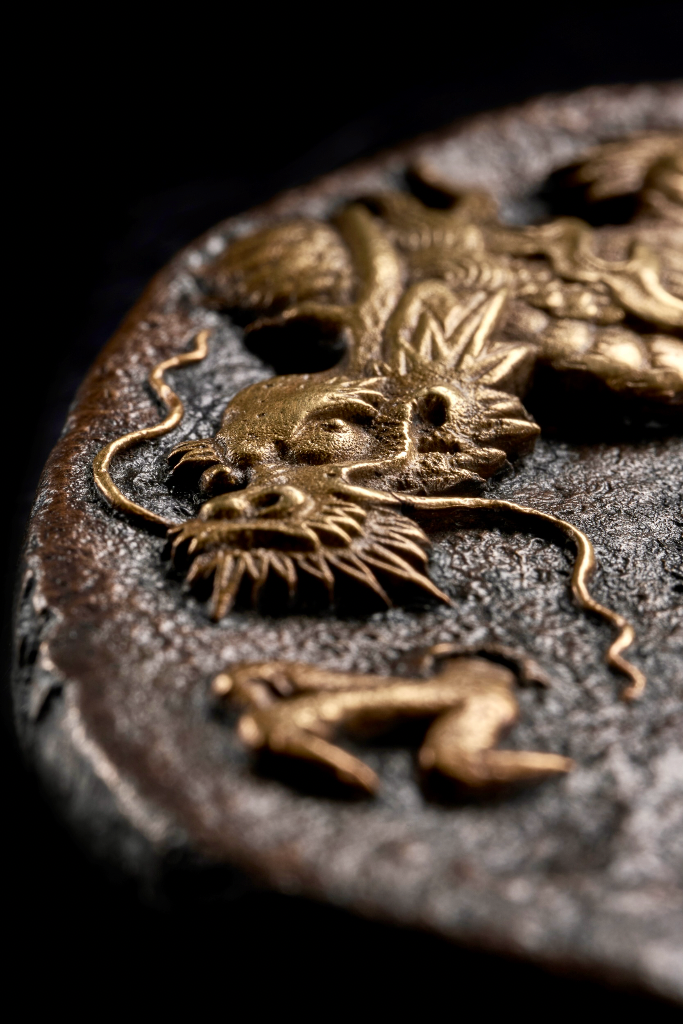
Baigetsu saku- 梅月作 Magnificent Dragon & Waves Tsuba by Baigetsu (Circa 1800) A spectacular example of late-Edo period Japanese metalwork, this masterfully carved tsuba (sword guard) captures the awe-inspiring power of a dragon writhing through tempestuous waves and swirling clouds. Crafted from brass (sentoku) in a round form with a slightly raised border (tate-maru-gata with taka-mimi), the piece utilizes dynamic high-relief carving (maru-bori) and elegant openwork (yo-sukashi). The artist’s exceptional skill is evident in how the kinetic composition faithfully continues from the obverse to the reverse. Exquisite gold and silver inlay (ten-zogan) highlights the dragon’s scales and the crashing surf, bringing an extraordinary sense of life and movement to the mythical beast. Technical Details & Historical Notes Signature: Signed “Baigetsu saku” (梅月作) — Haynes reference H 00164.0. According to Wakayama, this maker’s name is notably linked to a dragon-motif fuchigashira (hilt collar and pommel cap), which may have been the original companion fittings to this very guard. Features: Includes both kozuka and kogai hitsu-ana (accessory openings). Significance: A very rare and important example combining bold sukashi design with refined metallic detailing, elevating functional armor to a museum-quality canvas of martial elegance. Pedigree & Provenance Published: Prominently illustrated and described in the late scholar Robert E. Haynes’ seminal reference, “Gai So Shi - Study Collection of Japanese Sword Fittings” (Nihon Art Publishers, 2010, No. 160). Provenance: Formerly a prized possession within the esteemed M. Tomkinson Collection (Inv. No. 265), widely regarded as one of the most historically significant early Western collections of Japanese art.

KAGAGUSOKU YOROI- Early Edo Period
The armor of the warrior's resolve
Produced in the wealthy and culturally refined Kaga Domain during the Edo period, this extraordinary Kagagusoku Yoroi represents the pinnacle of Japanese martial artistry. Artisans of the Kaga region—supported by the immense wealth of the ruling Maeda clan—were celebrated across Japan for their exceptional metalwork, seamlessly blending robust battlefield functionality with sophisticated aesthetic elegance. At the absolute center of this suite is a magnificent, three-dimensional ryū (dragon) mounted directly onto the dark russet-iron dou (cuirass). In traditional Japanese culture, the dragon is a venerated water deity, symbolizing fierce protection, immense power, and the unwavering resolve of the warrior class. The intricate chasing of the dragon's scales, its coiled whiskers, and the sweeping dynamism of its horns are a masterclass in metalcraft, perfectly encapsulating the story of the samurai told through crafted metal. Above the cuirass sits the imposing suji-bachi kabuto, a multi-plate helmet engineered with distinct raised ridges designed specifically to deflect downward sword strikes. It is crowned by sweeping kuwagata (frontal crests) that dramatically expand the warrior's silhouette, projecting an aura of commanding authority. Beneath the helmet, the menpo (facial armor) was engineered for psychological warfare; its fierce expression, deeply contoured cheeks, and bristling mustache made from natural animal hair were crafted to unnerve adversaries long before blades ever crossed. Contrasting the unyielding, jet-black and dark russet iron is the remarkable odoshi (silk lacing). Arranged in meticulous, alternating tiers of forest green, pale cream, and subtle gold, these vital cords bound the kusazuri (skirt panels) and shikoro (neck guard) together. This provided the samurai with essential flexibility and shock absorption while offering a brilliant visual contrast that would identify the wearer on a chaotic battlefield. Preserved alongside its original yoroi-bitsu (armor storage box)—which bears a faded gold mon (family crest) indicating the aristocratic lineage of its original owner—this complete suit stands not just as a weapon of war, but as a profound historical record of Kaga craftsmanship and the enduring identity of the warrior elite. Family crest: Maru Ni Mitsu Gashiwa Mon(Oak in circle) meaning: The oak leaf which died in autumn does not shed their leaves until a sprout appears in spring. From this characteristic, Oak leaf is symbol of "The history of the clan does not break off". Oak is the shinboku (sacred tree) (species of evergreen sacred to Shinto). Reference./ Busho who used this crest: Shima clan, Hagiwara cran, Tsuboi cran, Watanabe clan, Makino clan, Yamauchi, clan, Kubota clan, Osada clan,etc. Size: Kabuto/Height: 18.11 in(46cm)/ width: 13.39 in(34cm)/ Depth: 14.17 in(36cm) Menpo/Height: 10.24 in(26cm)/ width: 9.06 in(23cm)/ Depth: 5.12 in(13cm) Do /Height: 31.5 in(80cm)/ Width: 14.17 in(36cm)/ Girth: 42.52 in (108cm) Sode/ Height: 11.42 in(29cm)/ Width: 10.63 in(27cm) Kote/ Length: 26.38 in(67cm) Haidate/ Height: 23.62 in(60cm) / Width: 27.56 in(70cm) Sune/ Height: 11.81 in(30cm) Box/Height: 23.62 in(60cm)/ width: 20.08 in(51cm)/ Depth: 18.11 in(46cm) Weight: 19500 g

Daisho Koshirae — Kanbun 7 (1667)
A remarkable dragon daishō koshirae preserving the spirit of the early Edo samurai tradition.
A remarkable dragon daishō koshirae preserving the spirit of the early Edo samurai tradition by Okugawa Yasumitsu- 奥川 康光. Kanbun shichi nen hachi gatsu hi (a day in the eighth month of the year 1667) 寛文七年八月日 Anchored by a dated tsunagi inscription reading: 寛文七年八月日 — Kanbun 7 (1667) This extraordinary paired set carries more than visual power; it carries continuity. The deeply sculptural dragon tsuka, dynamic dragon tsuba, and aged lacquer saya reveal generations of preservation, refinement, and reverence within a hereditary warrior tradition. Though the original blades are no longer present, the koshirae themselves survive as profound historical objects — eloquent remnants of a once complete daishō carried during the formative decades of Tokugawa Japan. The dragons surge across the mountings with remarkable cohesion and movement, embodying authority, vigilance, and protection — symbols long associated with elite samurai identity. Every surface, every worn edge, every layer of patina speaks to centuries of life and stewardship. Sets of this caliber and coherence rarely survive intact. An early Edo-associated daishō of exceptional atmosphere, historical resonance, and museum-level presence. 寛文七年八月日 Kanbun 7 — 1667

SAGEMONO: Inro (提物:印籠) A storm captured in gold.
A storm captured in gold.
SAGEMONO: Inro 提物(印籠) Mumei- 無銘 Wave and Dragon Motif Inro (Nami Ryū Zu Inro) From a curatorial perspective, a notable detail immediately emerges when pairing this piece with the tomobako (storage box) you shared previously. The calligraphy on the box lid explicitly translates to 浪龍図鐔 (Nami Ryū Zu Tsuba—Wave and Dragon Motif Tsuba). Because the object pictured here is an inro (a traditional tiered carrying case) and not a sword guard, it is highly likely that this is a "married" set. A previous collector likely paired this exceptional inro with the box because their motifs match perfectly. Despite the box originally belonging to a tsuba, the piece itself is a magnificent example of Edo-period craftsmanship that bridges the worlds of lacquerware and tosogu artistry. It serves as a highly compelling subject for high-contrast documentation or inclusion in a specialized exhibition catalog like The Black Book of the Dragon Tosogu. Here is a detailed curatorial description: Form and Construction This is a sophisticated five-case (four compartments plus a lid) gold lacquer inro. The cases fit together seamlessly, held by a purple silk cord (himo) that runs through the side channels (himo-toshi), allowing the tiered compartments to slide open. Lacquer Work (Maki-e) The foundational ground of the inro is finished in luminous gold lacquer. The surface is decorated with dynamic, stylized waves (nami) and swirling storm clouds, rendered using gold and silver dust sprinkled into the lacquer—a technique known as maki-e. The continuous flow of the clouds and water across the segmented cases demonstrates precise alignment and masterful planning by the lacquer artist. Metalwork Inlay (Kanagu) The focal point of the inro is the spectacular metalwork dragon (ryū) applied in high relief (takabori). The dragon weaves in and out of the lacquer clouds, breaking the boundaries of the individual cases. Material: The dragon appears to be crafted from shakudo (a copper-gold alloy patinated to a deep, purplish-black), creating a striking visual contrast against the gold background. Detailing: The scales, claws, and facial features of the dragon are sharply chiseled with the same precision expected from high-level sword fittings. Gold accents highlight the dragon's eyes and horns, bringing a fierce vitality to the mythical creature. It is quite common for master machibori (town-carving) sword fitting artisans to have collaborated with lacquerers to produce metal inlays for high-end inro like this one. Provenance Context While the tomobako may be a later marriage to this inro, the box itself carries significant historical weight. The underside of the lid bears the character 光 (Mitsu / Kō) followed by a highly stylized 花押 (Kaō / monogram). This indicates that the box—and the dragon tsuba it originally held—was formally appraised and authenticated by a mainline grandmaster of either the Gotō family (the Shogunate's premier metalworkers) or the Hon'ami family (the foremost sword appraisers in Japan).