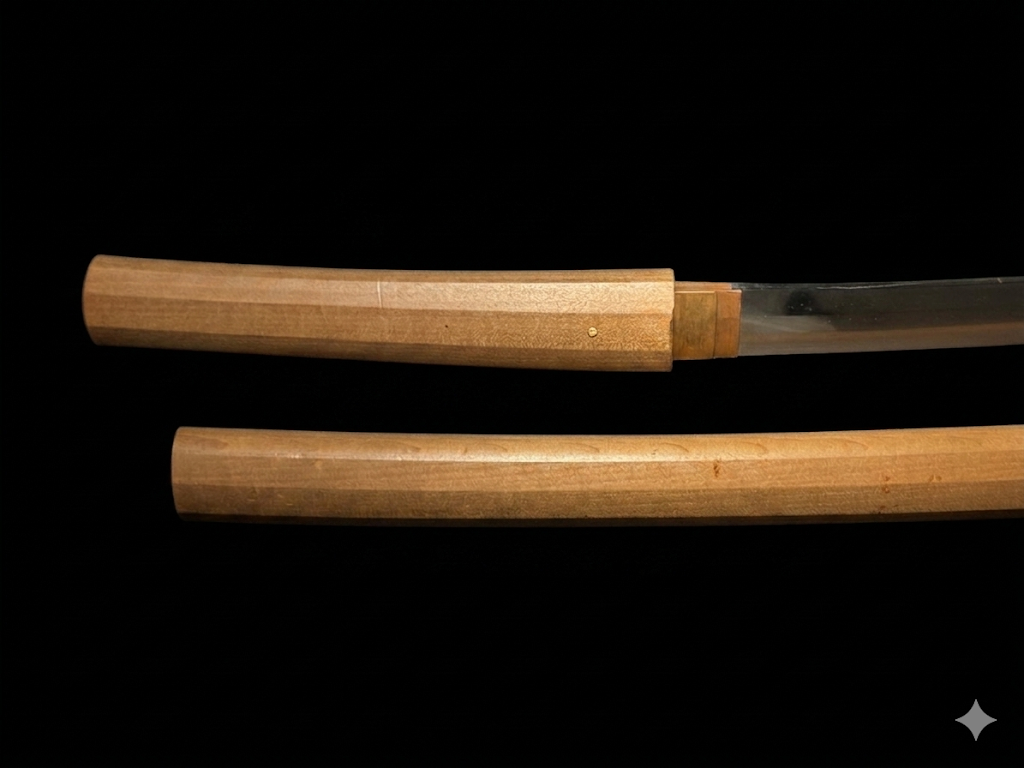


Kawachi Daijō Fujiwara Kunisada- 河内大掾藤原国定
The smith bears the honorary title Kawachi Daijō, a court rank reflecting recognized skill and standing. The inclusion of Fujiwara follows established convention among Edo-period smiths, linking their work to classical lineage.
Kawachi Daijō Fujiwara Kunisada- 河内大掾藤原国定 The smith bears the honorary title Kawachi Daijō, a court rank reflecting recognized skill and standing. The inclusion of Fujiwara follows established convention among Edo-period smiths, linking their work to classical lineage. School & Period • Tradition: Aizu Shintō • Period: Early to mid Edo (Kanbun-era style) 1661 - 1673 • Province: Aizu (present-day Fukushima) The Aizu school is known for producing practical, well-forged blades with disciplined workmanship. While less flamboyant than Osaka Shintō, Aizu blades are valued for their structural integrity, refined control, and functional elegance. Sugata (Shape) The blade exhibits a Kanbun Shintō sugata, characterized by: • Relatively shallow sori • A controlled, compact curvature • Balanced proportions consistent with mid-Edo preferences This form reflects the shift toward more practical, wearable swords during the period. Hamon (Temper Line) The hamon appears to be: • Suguha-based, with gentle variation • Clean and consistent, with a restrained aesthetic • Representative of disciplined Aizu workmanship Rather than dramatic activity, the emphasis is on precision and clarity, a hallmark of the school. Jihada (Grain) The blade shows a tight ko-itame hada, typical of well-forged Shintō work. The surface appears even and controlled, indicating: • Competent forging • Good material consistency • No visible structural concerns Boshi (Tip Temper) The boshi is properly formed and consistent with the overall hamon, maintaining: • Continuity of the temper line • Clean turnback • No visible irregularities Condition The blade is in healthy condition, with: • No visible fatal flaws • Intact geometry • Stable nakago consistent with age The current polish is good but not at the highest level, and does not fully reveal all internal activity. A higher-level polish could further enhance visibility of the jihada and hamon. NBTHK Hozon Token.
7 high-resolution detail views — use zoom viewer to inspect hamon, jihada, and metalwork
Kunisada
国定Izumi no Kami Kunisada (1589–1652), historically revered as **"Oya-Kunisada"** (Parent Kunisada), was the foundational architect of the **Osaka Shinto** school and a premier disciple of the Kyoto master Horikawa Kunihiro [1][11][13]. After migrating to Osaka around 1620 alongside his contemporary Kawachi no Kami Kunisuke, he refined the robust, aggressive *Keicho-shinto* style into a sophisticated aesthetic characterized by a dense, sparkling *ko-itame* grain and a luminous *hamon* rich in *nie* [4][6][13]. His blades are highly esteemed by serious collectors for their exceptional functional performance, holding an ***Owazamono*** (great sharpness) rating, and for their historical role in establishing Osaka as a premier center of sword production during the early Edo period [3][10][17]. As the father and teacher of the legendary Inoue Shinkai, Kunisada’s legacy is defined by a masterful transition from martial utility to refined artistry, with his later works—often signed under the priestly name **"Dowa"**—representing the pinnacle of his technical and stylistic evolution [6][13][15]. *(Note: While your request specifies the kanji "国定," historical records for the founder of the Osaka Shinto school and the "Izumi no Kami" title holder use the kanji **"国貞"**. The biography above refers to this seminal master, as he is the documented figure matching your school and period details [11][13].)*