Step into the dramatic artistry of the Hirado School in Hizen province. Signed b
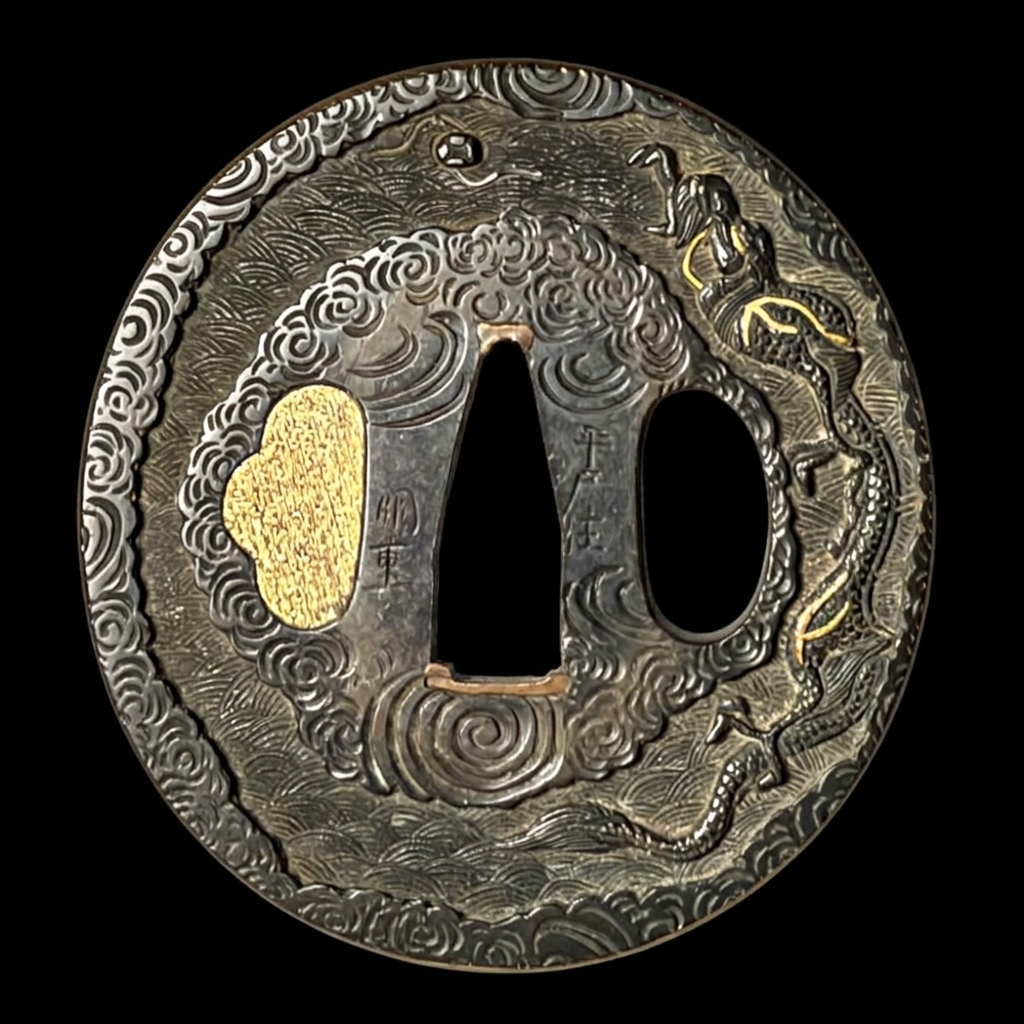
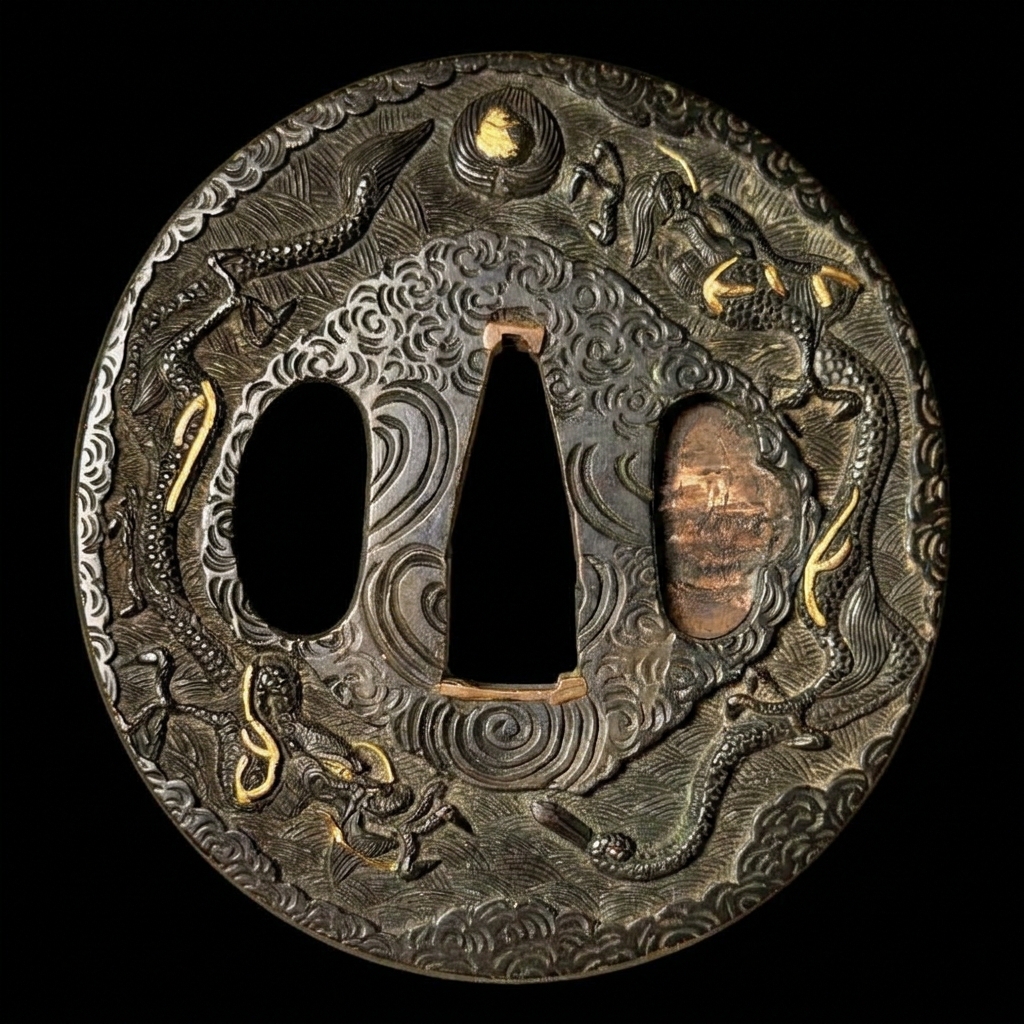
The obverse Omote side, retains the smith’s signature alongside its original, brilliantly textured gold-filled nakago-ana plugging (sekigane), catching the light with centuries-old splendor. The reverse Ura side, tells its own storied history—it once held an exquisite matching gold-filled kogai-hitsuan insert, lost to time, leaving behind a weathered, vacant socket that highlights its long life and practical journey as a samurai’s prized piece of armor.
Step into the dramatic artistry of the Hirado School in Hizen province. Signed by the master himself (平戸住國重), this remarkable iron tsuba captures the turbulent, breathtaking energy of the Unryu (Cloud and Dragon) motif. Masterfully carved in high-relief (takabori), a powerful dragon coils with fierce grace through churning, deeply layered waves, surging forward to chase the sacred, elusive jewel. The obverse Omote side, retains the smith’s signature alongside its original, brilliantly textured gold-filled nakago-ana plugging (sekigane), catching the light with centuries-old splendor. The reverse Ura side, tells its own storied history—it once held an exquisite matching gold-filled kogai-hitsuan insert, lost to time, leaving behind a weathered, vacant socket that highlights its long life and practical journey as a samurai’s prized piece of armor. With lingering traces of delicate gold zogan glinting across the dragon’s scales, claws, and eyes, this tsuba is a gorgeous, battle-worn testament to the multicultural, exotic artistry of Hirado’s metalworking lineage. An artifact that wears its scars and missing gold as a badge of honor, whispering of the warriors who once carried it into the tempest. Dimensions: Width 6.6cm x Height 6.9cm, Thickness 0.5cm, Weight 105g
2 high-resolution detail views — use zoom viewer to inspect hamon, jihada, and metalwork
Hirado Kunishige
平戸市國重Active in Hizen Province during the mid-Edo period, specifically the Kyōho era (1726–1736), Hirado Kunishige was the preeminent master of the Hirado school, though the stylistic diversity of his signatures suggests he may have overseen a highly productive workshop or atelier rather than working solely as an individual artisan [[2]](https://www.mandarinmansion.com/glossary/hirado-kunishige). His work represents the quintessential expression of the *Nanban* (foreign) aesthetic, characterized by a sophisticated synthesis of Chinese-style dragons chasing pearls and the exotic, fashionable inclusion of Western-inspired Roman script [[2]](https://www.mandarinmansion.com/glossary/hirado-kunishige) [[14]](https://www.legacyswords.com/portfolio/kunishige-kozuka/). Utilizing primarily brass and copper alloys, Kunishige employed deep, precise carving often enhanced by green patination in the recesses, gold inlay, and, in rare masterworks, vibrant cloisonné enamel [[2]](https://www.mandarinmansion.com/glossary/hirado-kunishige). Lauded as "first-class" in the 1781 *Sōken Kishō*, his innovative style significantly influenced major Kyoto schools such as Ichinomiya Nagatsune, and his finest extant pieces are highly prized by modern collectors, with select examples achieving *Juyō* status from the NBTHK [[2]](https://www.mandarinmansion.com/glossary/hirado-kunishige).